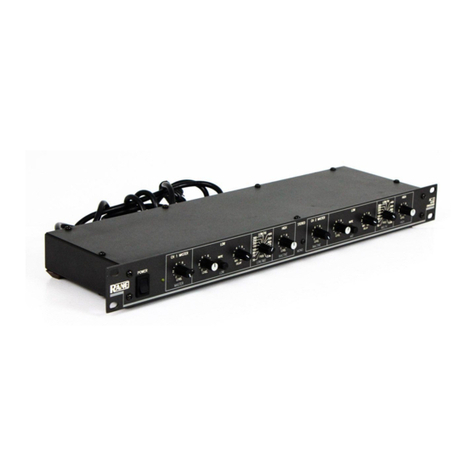
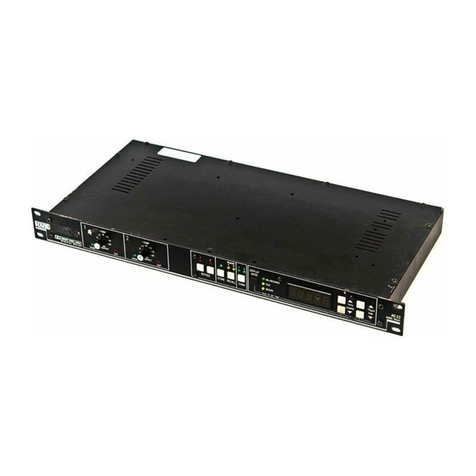
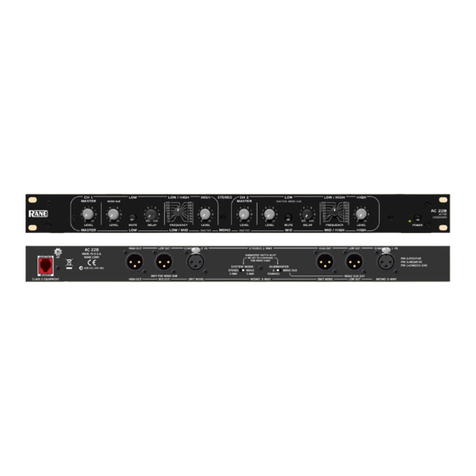
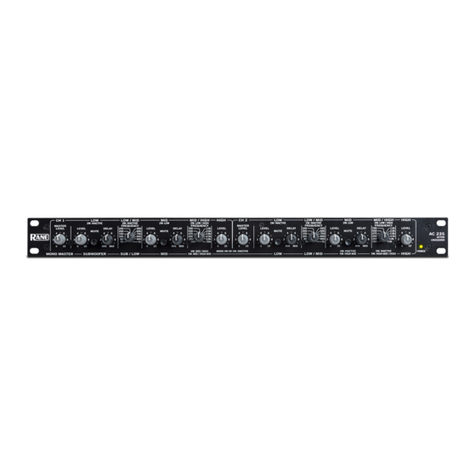
AC 22B
ACTIVE CROSSOVER
Data Sheet-4 All features & specifications subject to change without notice. DOC 106274
Rear Panel
©Rane Corporation 10802 47th Ave. W., Mukilteo WA 98275-5098 TEL 425-355-6000 FAX 425-347-7757 WEB www.rane.com
References
1. S.H. Linkwitz, “Active Crossover Networks for Noncoincident Drivers,” J. Audio Eng. Soc., vol. 24, pp. 2-8 (Jan/Feb 1976).
2. D. Bohn, “A Fourth-Order State-Variable Filter for Linkwitz-Riley Active Crossover Designs,” presented at the 74th Convention of
the Audio Engineering Society, New York, Oct. 9-12, 1983, preprint no. 2011.
3. D. Bohn, “Linkwitz-Riley Crossovers: A Primer,” RaneNote, (1983, 1989, 2005).
4. D. Bohn, “Why Not Wye?” RaneNote, (1984).
Available Accessories
• SC 1.7 Security Cover
Architectural Specifications
e active crossover shall contain 4th-order Linkwitz-Riley
filters. Provisions shall exist to correct for driver misalignment by
means of adding time delay to the low frequency outputs.
e crossover frequency shall be controlled by a continuously
variable control with 41 detents to allow mechanical reference of
crossover setting.
Signal inputs and outputs shall be active balanced terminated
with XLR connectors. RFI filters shall be provided. Infrasonic
filters shall be built-in.
e active crossover shall afford an input level range of off
to +6 dB. e output level controls shall afford a level range of
from off to +12 dB with muting capability on the low frequency
outputs. e crossover shall supply two independent channels.
e unit shall be exempt from agency safety requirements
and powered from a UL listed, CSA certified remote power sup-
ply (120 VAC) or CE approved (230 VAC) via a rear panel input
modular plug. e unit shall be constructed entirely from cold-
rolled steel, and mount into a standard 1U EIA rack.
e unit shall be a Rane Corporation AC 22B Active Crossover.
Choosing the Right Configuration:
Mono, Two-Channel Mono or Stereo?
Very few systems indeed will utilize a two channel crossover
for the purpose of true stereo imaging. Discrete stereo chan-
nels which are run from the mixing board are usually used for
panning effects and/or for separate equalization of left and right
speaker stacks. Different sides of the room often require sig-
nificantly different equalization due to varying room acoustics,
dimensions, positioning of speaker stacks near walls, curtains
and the like.
Even though you may not plan to use stereo equalization
or panning effects, it is recommended that your system utilize
discrete crossover channels for each stack of speakers to ensure
flexibility and control for consistent, optimum sound quality. For
example, if you plan to run a multi-stack system mono 3-way,
use the AC 23B rather than the AC 22B for separate control over
each set of speakers — especially since phase alignment may
differ with each stack requiring separate time delay adjustments.
Even with only a single system equalizer, the AC 23B can deliver
the extra independent control which can make a difference in
sound throughout the listening area. If all drivers are built into a
single cabinet, or you are running bi-amped monitors, then the
AC 22B is the one for you.
When all drivers in stacks are equal and acoustic differences
are not critical, delays are not required, and simplicity of use is
important, we recommend the Rane SAC 22 or SAC 23 Cross-
over.
MADE IN U.S.A.
RANE CORP.
ACN 001 345 482
LOW OUT
CHANNEL 1 IN
MONO 3-WAY
MONO SUB OUT
LOW OUT
CLASS 2 EQUIPMENT
HIGH OUT
STEREO 2-WAY
SUBWOOFER SWITCH MUST
BE SET TO 2-CHANNEL
FOR MONO 3-WAY
CHANNEL 2 IN
LOW OUTHIGH OUT
2-
CHANNEL
SUBWOOFER
MONO SUB
OMIT MONO
MONO 3-WAY
SYSTEM MODE
STEREO
2-WAY
OMIT MONO
MONO
3-WAY
OMIT FOR MONO SUB
MID OUTHIGH OUT
AC 22B
160mA
POWER
PIN 2=POSITIVE
PIN 3=NEGATIVE
PIN 1=CHASSIS GND