3 Assembly
The condensate trap has to be screwed into a pipeline between flanges.
■Remove the flange transport caps from inlet and outlet.
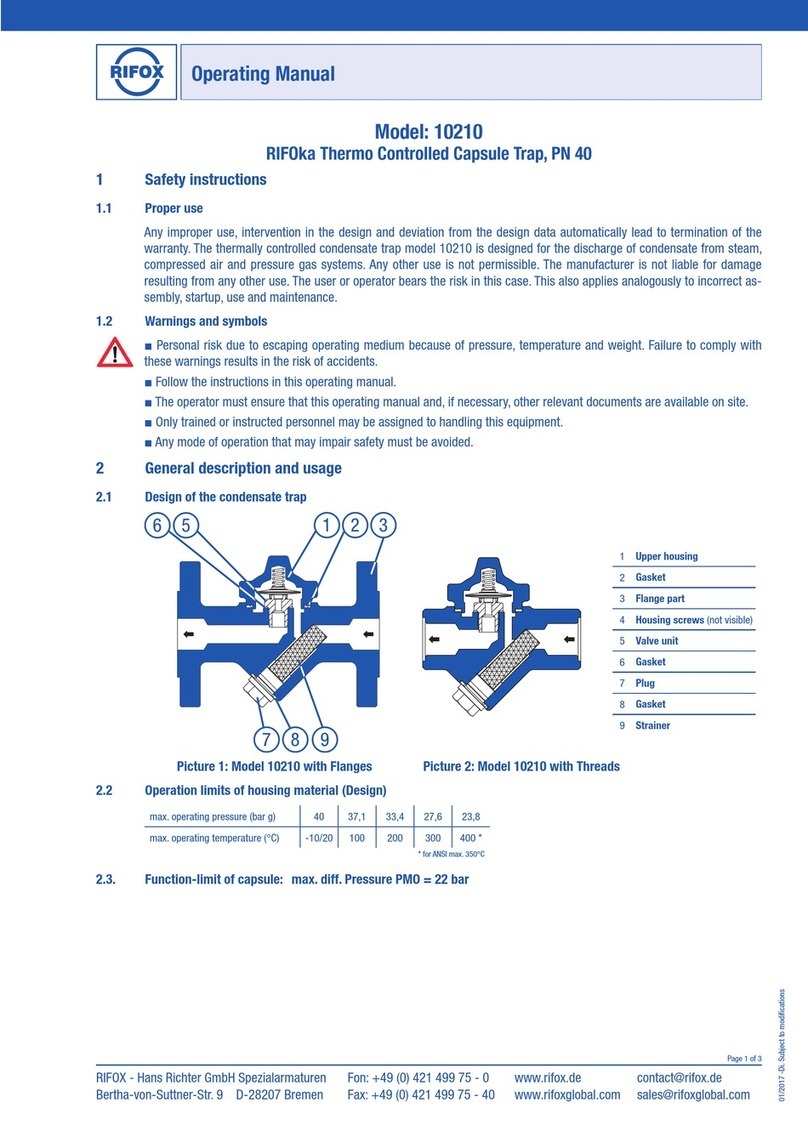
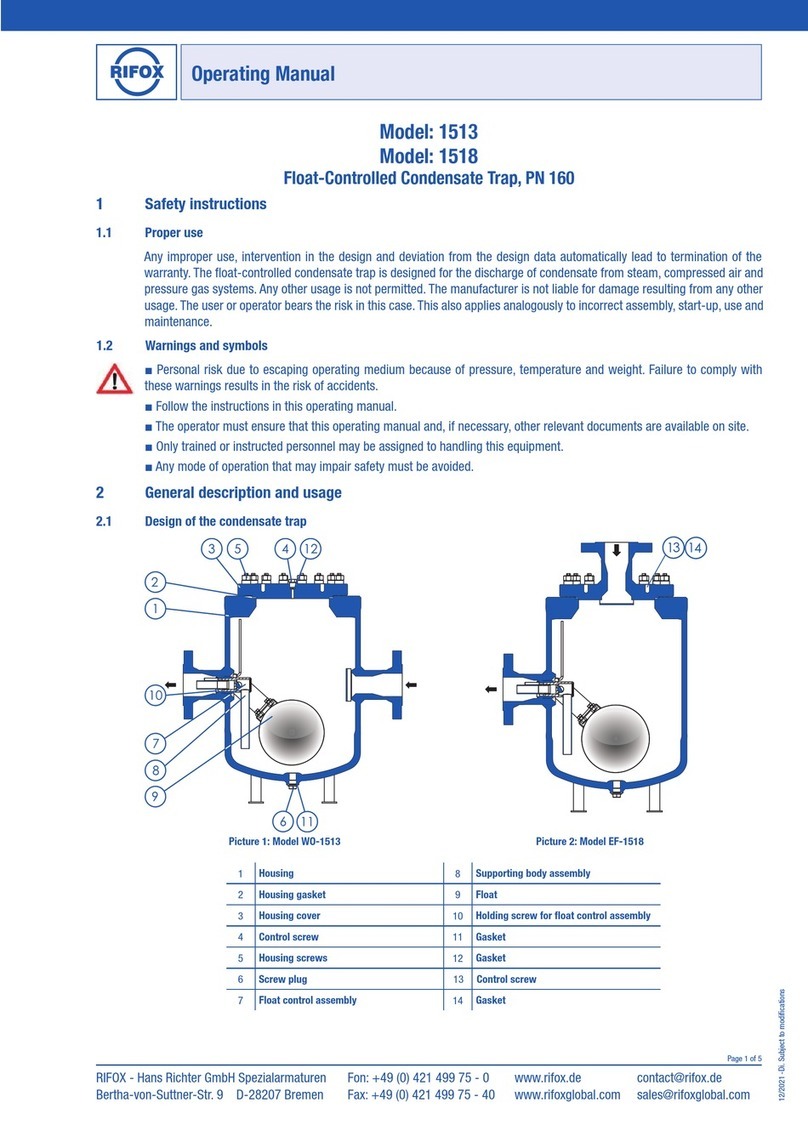
■Fitting direction: according to Picture 1 and 2.
■Supporting brackets: The weight of the condensate trap must be taken up by a holding device and support, e.g. via the
retaining brackets welded onto the housing. The steam trap weight from 68 to 76 kg, depending on the connection sizes.
■To avoid downtimes, it is recommended to install stop valves with bypass to pipeline, both in front of and behind the con-
densate trap.
4 Start-Up
Shut off the float-controlled condensat trap on both sides during the strength tests, because the control unit is not suitable
for the design test pressure according to the nameplate.
The pressure build-up and heating-up of the housing should not take place abruptly. If leakage is detected after the first
inspection, the screws (4 / 5 / 6 / 10) can be fixed under consideration of the given torque moments, as given in Section 6.5.
The screws can only be tightened on when the housing is unpressurized and T<50°C.
5 Monitoring and checking
5.1 Function‘s failures
The function’s failures can be observed either as condensate blockage or as steam / gas leakage.
■Condensate blockage can be determined:
a) with the control screw (4): loosen the control screw (4) by only a quarter turn. If condensate escapes, condensate blockage
exists. Or,
b) only in steam applications: with a surface thermometer to check the housing temperatur before the inlet. If under cooling
is detected, there is condensate blockage. (if necessary, consult with Rifox).
■Gas leakage can be determined with an RIFOX-ultrasonic measuring device.
■Steam leakage (near saturated steam temperatur) can be determined with an surface thermometer on the housing outlet.
■Check the float control assembly according to section 6.2 and replace if required (if necessary, consult Rifox).
5.2 Submerged gastight control unit
■ For submerged gastight control unit: Gas leakage can be visually determined by connecting the trap outlet with a filled
condensate tank.
■ To get the absolute gas tightness, it is required that there must be permanently minimal condensate level in the conden-
sate trap. The condensate trap must be filled with water before start-up.
■ To ensure durable gas tightness, it is required that the condensate is continually gathered into the steam trap. If there is
no condensate be gathered in hours or days, the gas may leak, although the rotary slide ventil is closed.
■ If the condensate level drops under the rotary slide valve, the gas tightness is no longer guaranteed.
6 Maintenance / Inspection
6.1 Opening the steam trap and dismantling the float control assembly
■The condensate trap must be depressurized. Shut off the system securely in front of and behind of the condensate trap.
■Release any remaining pressure in the housing by loosening the control screw (4) by only a quarter turn.
■The condensate trap must not be dismantled from the pipeline system.
■Loosen the housing tension bolts (5) evenly crosswise. Put down the lower housing (3).
■Loosen the protecting cap (14) and put it down.
■Loosen the supporting screw (10) by 1 to 2 turns.
■With a few light strokes using plastic hammer on the front side of the supporting screw (10) to loosen the float control
assembly (7) from its conic housing seat.
■Screw out the supporting screw (10) and take out the float control assembly (7).
Operating Manual
RIFOX - Hans Richter GmbH Spezialarmaturen
Bertha-von-Suttner-Str. 9 D-28207 Bremen
Fon: +49 (0) 421 499 75 - 0
Fax: +49 (0) 421 499 75 - 40
www.rifoxglobal.com
Breite: 170
Höhe:8,15
Oben Links
278,5 20
07/2019 -Di. Subject to modifications
Page 3 of 5