CONSOLE DISPLAY AND MENUS
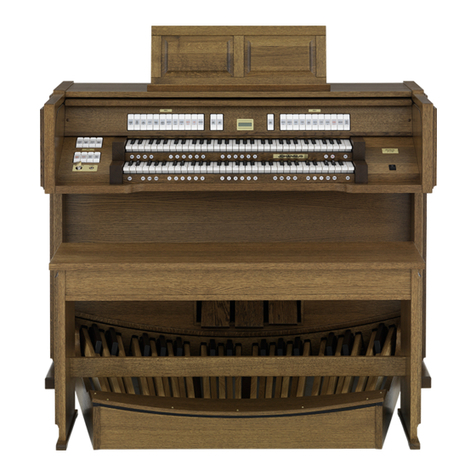
The Rodgers 835 is equipped with a two-line Console Display window located in the
right drawknob panel. This display indicates the Transposer setting, and it can be used to alter
many other settings and organist preferences including MIDI settings, Voice Palette, and
Tremulant rate and depth, among many others.
Two controls are used to select and operate the features of the Console Display. The
smaller knob, located near the Console Display, is called the Select Knob and is used to select
different menu items to be changed. When the Console Display reads “TRANSPOSER 0”,
this knob controls the Transposer function. The larger flush dial, near the Console Display is
called the Alpha Dial and is used to change a menu setting which has been selected.
To move to a new menu or to make a new setting in the same menu in the Console
Display, hold SET and turn the Select Knob. Note: Once any menu other than the Transposer
menu has been selected, it is no longer necessary to hold SET to select further menus.
The blinking square in the Console Display, called the cursor, indicates the setting which
is currently selected. Rotating the Alpha Dial will change the value of any selected setting.
There are three different menus. The User Menu accesses organ and audio settings such
as Voice Palette, Tremulant settings, Master Volume, and Auxiliary Input controls. This
menu is accessed by holding SET and turning the Select Knob counter clockwise (left) from
the Transposer menu.
The second menu controls MIDI settings and is accessed by holding SET and turning the
Select Knob clockwise (right) from the Transposer menu.
The third menu also accesses organ and audio settings, but it is only available when
headphones are used. Note: Please refer to the “Stereo Headphone Jack” section.
To return to the Transposer display, press General Cancel.
COMBINATION ACTION WITH FOUR MEMORY LEVELS
The Rodgers 835 features a combination action easily changed by the organist from the
console. The organist can pre-select registrations and make rapid changes in tone color using
this advanced system.
Rodgers’ microprocessor combination action is a specially refined four-memory system.
This effectively multiplies the number of physical pistons on the console by four.
The 10 General pistons simultaneously affect all stops and controls on the Great, Swell
and Pedal. All manual and pedal registrations may be changed by pressing a General piston.
There are five Divisional pistons for each division. The Great and Swell Divisionals are
operated by pistons located under each respective manual, and the five Pedal Divisionals are