nstalling the RTX6000 Series PC Driver
When using a Windows PC, a driver is needed to support USB Audio Class 2.0. The driver
for the RTX6001 must be installed on a PC for proper operation. The driver supports
Windows 7, 8, 8.1 and 10. Both 32 and 64 bit s stems are supported.
Download the software installation package from the dow
https://www.rtx.dk/en/design
Connecting the Audio Analyzer to a PC USB Port
To operate the Audio Anal zer ou must connect a PC (Windows/MAC/Linux) s stem
controller to the USB port using a standard USB High Speed cable with T pe
(one is supplied with the Audio Anal zer). The PC USB port should not be routed through
neither external nor internal to the PC.
Standard USB cable with Type A
When the RTX6000 series PC driver is installed, the PC should
Anal zer and enumerate the unit.
Switching the Audio Analyzer on for the First Time
Before switching the Audio Anal zer on please ensure that the:
Line voltage selector is set to the voltage of the power suppl
Power suppl voltage is in the specified range
Connect the Main Power Cord to the IEC power connector on the back of the unit.
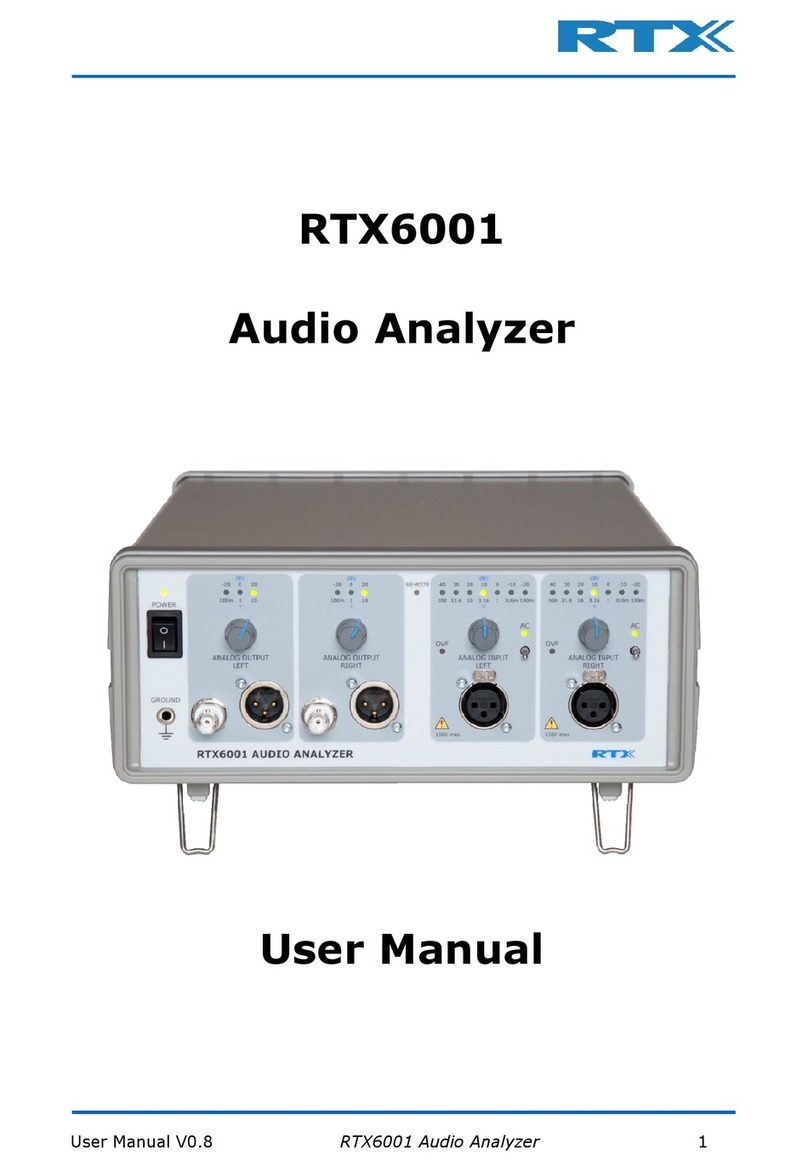
Turn on the Audio Anal zer b toggling the ON/OFF button on the front.
Some of the LED’s on the front should light up.
Depending on the attenuator settings, some clicks from rela s ma be heard at power on
and later during operation. This is normal.
To avoid problems due to DC offsets, it is recommended to use the AC input setting
to 0dBV, -10dBV or -20dBV.
Furthermore, the unit should not be operated with excessive overload for extended
periods of time. Doing so ma compromise its performance.
nstalling the RTX6000 Series PC Driver
When using a Windows PC, a driver is needed to support USB Audio Class 2.0. The driver
for the RTX6001 must be installed on a PC for proper operation. The driver supports
Windows 7, 8, 8.1 and 10. Both 32 and 64 bit s stems are supported.
Download the software installation package from the dow
nload center on the RTX website
https://www.rtx.dk/en/design
-services/contact/download-center/
Connecting the Audio Analyzer to a PC USB Port
To operate the Audio Anal zer ou must connect a PC (Windows/MAC/Linux) s stem
controller to the USB port using a standard USB High Speed cable with T pe
(one is supplied with the Audio Anal zer). The PC USB port should not be routed through
neither external nor internal to the PC.
Standard USB cable with Type A
When the RTX6000 series PC driver is installed, the PC should
Anal zer and enumerate the unit.
Switching the Audio Analyzer on for the First Time
Before switching the Audio Anal zer on please ensure that the:
Line voltage selector is set to the voltage of the power suppl
Power suppl voltage is in the specified range
Connect the Main Power Cord to the IEC power connector on the back of the unit.
Turn on the Audio Anal zer b toggling the ON/OFF button on the front.
Some of the LED’s on the front should light up.
Depending on the attenuator settings, some clicks from rela s ma be heard at power on
and later during operation. This is normal.
To avoid problems due to DC offsets, it is recommended to use the AC input setting
speciall important when operating the unit with inputs set
Furthermore, the unit should not be operated with excessive overload for extended
periods of time. Doing so ma compromise its performance.
When using a Windows PC, a driver is needed to support USB Audio Class 2.0. The driver
for the RTX6001 must be installed on a PC for proper operation. The driver supports
nload center on the RTX website
Connecting the Audio Analyzer to a PC USB Port
To operate the Audio Anal zer ou must connect a PC (Windows/MAC/Linux) s stem
controller to the USB port using a standard USB High Speed cable with T pe
(one is supplied with the Audio Anal zer). The PC USB port should not be routed through
Switching the Audio Analyzer on for the First Time
Connect the Main Power Cord to the IEC power connector on the back of the unit.
Turn on the Audio Anal zer b toggling the ON/OFF button on the front.
Depending on the attenuator settings, some clicks from rela s ma be heard at power on
To avoid problems due to DC offsets, it is recommended to use the AC input setting
speciall important when operating the unit with inputs set
Furthermore, the unit should not be operated with excessive overload for extended