manuals.online logo
Brands
  1. Home
  2. •
  3. Brands
  4. •
  5. Rupes
  6. •
  7. Cutter
  8. •
  9. Rupes RT 15A User manual

Rupes RT 15A User manual

Popular Cutter manuals by other brands

Eraser WC600 operating instructions

Eraser

Eraser WC600 operating instructions

Husqvarna K 760 OilGuard Operator's manual

Husqvarna

Husqvarna K 760 OilGuard Operator's manual

Binding Products GuilloMax user manual

Binding Products

Binding Products GuilloMax user manual

Bms Bulut Makina BULUCUT-6 Operational manual

Bms Bulut Makina

Bms Bulut Makina BULUCUT-6 Operational manual

Westfalia 80 02 22 instruction manual

Westfalia

Westfalia 80 02 22 instruction manual

Perfecta 76 UC Service instructions

Perfecta

Perfecta 76 UC Service instructions

Bosch POF 1400 ACE Original instructions

Bosch

Bosch POF 1400 ACE Original instructions

SignWarehouse.com Bobcat BA-60 user manual

SignWarehouse.com

SignWarehouse.com Bobcat BA-60 user manual

Makita 4112HS instruction manual

Makita

Makita 4112HS instruction manual

GEISMAR STUMEC MTZ 350S manual

GEISMAR STUMEC

GEISMAR STUMEC MTZ 350S manual

Hitachi CM 4SB2 Safety instructions and instruction manual

Hitachi

Hitachi CM 4SB2 Safety instructions and instruction manual

Dexter Laundry 800ETC1-20030.1 instruction manual

Dexter Laundry

Dexter Laundry 800ETC1-20030.1 instruction manual

GCC Technologies AFJ-24S user manual

GCC Technologies

GCC Technologies AFJ-24S user manual

ARCBRO Stinger-PRO 5100 Series Install manual

ARCBRO

ARCBRO Stinger-PRO 5100 Series Install manual

DeWalt XR LI-ION DCS350N manual

DeWalt

DeWalt XR LI-ION DCS350N manual

Baudat ES1 instruction manual

Baudat

Baudat ES1 instruction manual

Makita 4100NH instruction manual

Makita

Makita 4100NH instruction manual

CAB PCU400 instructions

CAB

CAB PCU400 instructions

manuals.online logo
manuals.online logoBrands
  • About & Mission
  • Contact us
  • Privacy Policy
  • Terms and Conditions

Copyright 2025 Manuals.Online. All Rights Reserved.

RT 15A
Fresatrice toupie
Router
Défonceuse
Tischfräsmaschine
Fresadora tupí
Plaina de contornos
Bovenfrees
MANUALE D'ISTRUZIONI
OPERATING INSTRUCTIONS
MODE D' EMPLOI
GEBRAUCHSANWEISUNG
MANUAL DE INSTRUCCIONES
MANUAL DE INSTRUÇÕES
AANWIJZINGEN VOOR HET GEBRUIK EN HET ONDERHOUD
R.U.P.E.S. spa
Realizzazione Utensili
Via Marconi, 3A
20080 Vermezzo (MI) - Italy
tel.: +39.02.946941
fax: +39.02.94941040
e-mail: [email protected]
web: www.rupes.it
headquarter
contacts
FRESATRICE TOUPIE RT 15A
(FIGURE IN PAGINA 28)
IMPORTANTE
ATTENZIONE! Prima di utilizzare la macchina,
leggere attentamente questo MANUALE DI
ISTRUZIONI e il PROSPETTO DELLE NORME
GENERALI DI SICUREZZA allegato. Non comin-
ciate a lavorare con la macchina se non siete
sicuri di avere compreso integralmente il loro
contenuto. Conservare tutti e due i manuali per
eventuali consultazioni successive.
1. DATI TECNICI RT 15A
Motore universale 50/60 Hz
W005.1aznetoP
m/000.52otouvaàticoleV
Livello di pressione acustica continuo
equivalente ponderato A 91 dB (A)
Livello di potenza acustica 104 dB (A)
Livello di vibrazioni abituale
s/m5,2<)oiccarb-onam( 2
Diametro pinza standard 12 mm
Profondità di fresatura 0-60 mm
Calibro di profondità girevole regolazione
della profondità
a 6 posizioni
gK4,5oseP
2. CAMPO DI LAVORO
La fresatrice portatile è un utensile elettrico utiliz-
zato principalmente per fresare legno e plastica.
È particolarmente adatta per profilare bordi,
tagliare nodi, fresare con dima, ribassare,
costruire cornici e incidere.
Insieme alle guide parallele, alle sagome di
copiatura e agli utensili profilati, la fresatrice por-
tatile costituisce un apparecchio elettrico estre-
mamente utile. Il suo design ergonomico permet-
te di lavorare comodamente in qualunque posi-
zione e da diverse angolazioni.
3. ISTRUZIONI DI SICUREZZA PER
L'USO DELLA MACCHINA
ATTENZIONE! Prima di utilizzare la fresatrice,
leggere attentamente il FOGLIETTO DELLE
PRESCRIZIONI DI SICUREZZA allegato alla
documentazione.
- Prima di sostituire gli utensili o di effettuare qua-
lunque altro intervento vicino alla testa di taglio,
allontanare la mano dalla leva dell’interruttore e
staccare la spina dalla presa di corrente.
- Per lavorare con la fresatrice, usare occhiali di
sicurezza.
- Guidare sempre la fresatrice con entrambe le
mani, utilizzando le due impugnature della mac-
china
- Al termine del lavoro, scollegare il motore e
sbloccare la base prima di lasciare la fresatrice.
- Collocare sempre la fresatrice sulla base e su
una superficie piana e pulita.
2
ITALIANO
2A51TReipuotecirtaserF
ENGLISH
5retuoRA51TR
FRANÇAIS
8A51TResuecnoféD
DEUTSCH
11A51TRenihcsamsärfhcsiT
ESPAÑOL
41A51TRíputarodaserF
PORTUGUÉS
81A51TRsonrotnocedanialP
12A51TR
NEDERLANDS
42seerfnevoBA51TR
MANUALE D'ISTRUZIONI
OPERATING INSTRUCTIONS
MODE D'EMPLOI
GEBRAUCHSANWEISUNG
MANUAL DE INSTRUCCIONES
MANUAL DE INSTRUÇÕES
AANWIJZINGEN VOOR HET GEBRUIK EN HET ONDERHOUD
Italiano
31
- Mettere sempre in marcia la fresatrice median-
te la leva dell’interruttore principale.
- Assicurarsi che la fresatrice non possa ribaltar-
si accidentalmente.
Usare solo frese con gambo di diametro adegua-
to alla pinza da utilizzare e adatte alla velocità
della fresatrice.
- Le caratteristiche delle frese della gamma
RUPES sono particolarmente adatte alle presta-
zioni di questa fresatrice; utilizzare preferibilmen-
te frese della vasta gamma RUPES oppure frese
con le stesse caratteristiche.
4. APPARECCHIATURA STANDARD
All’interno della confezione sono presenti i
seguenti componenti:
- Fresatrice toupie RT 15A
- Chiave del 24
- Gruppo squadra laterale
- Connettore aspirazione
- Manuale d’uso e altra documentazione
- 6022387 Riduttore fresa da 12 a 8
- 6022388 Riduttore fresa da 12 a 6
5. MESSA IN FUNZIONE
Questo utensile è dotato di un interruttore di azio-
namento A (Fig. 1), incorporato nell'impugnatura,
che permette di effettuare l'avviamento o l'arresto
della macchina senza lasciarla.
Per impedire la messa in marcia accidentale
della macchina, l'interruttore può essere aziona-
to solo se prima si sblocca la sicura laterale B
(Fig. 3). Una volta che l'interruttore è in posizione
di marcia, non è necessario continuare a preme-
re sulla sicura.
ATTENZIONE! Prima di azionare l'interruttore,
accertarsi sempre che la fresa non sia a contatto
con il pezzo in lavorazione. Quando la macchina
ha raggiunto la velocità massima, portarla a con-
tatto con il pezzo in lavorazione e fermare la
macchina quando la fresa è uscita completamen-
te dal pezzo. In questo modo, la qualità del lavo-
ro realizzato sarà migliore.
6. MONTAGGIO DEGLI UTENSILI DA TAGLIO
ATTENZIONE! Prima di procedere al montaggio
dell'utensile di taglio, accertarsi che la fresatrice
sia scollegata dalla presa di corrente di rete.
Per realizzare il montaggio o l'estrazione del-
l'utensile di taglio, premere il pulsante di blocco
della fresa E (Fig. 2) che impedisce la rotazione
dell'asse e allentare il dado portapinze F(Fig. 2)
con la chiave G in dotazione (Fig. 2). La pinza e
il dado portapinze sono due elementi che si con-
giungono a pressione e quindi bisogna accertar-
si che la pinza resti perfettamente in sede nel
dado.
Inserire l'utensile di taglio H (Fig. 2) e, se neces-
sario, il corrispondente riduttore per fresa I (Fig.
2) all'interno della pinza del portapinze F (Fig. 2).
Stringere saldamente il portapinze F (Fig. 2) con
la chiave in dotazione, mantenendo premuto il
pulsante di blocco E (Fig. 2).
Se si utilizza la fresa con manico da 12 mm o
1/2", non è necessario utilizzare il riduttore.
Utilizzare sempre frese con la più corta lunghez-
za di taglio possibile, per ridurre al minimo il
rischio di scentratura. La fresa, la pinza e il ridut-
tore devono essere puliti da ogni residuo prima di
effettuare il montaggio.
ATTENZIONE! Evitare di lasciare la macchina
senza utensile, dato che la pinza potrebbe rima-
nere troppo stretta e danneggiare la sede dell'as-
se.
Non mettere mai in marcia la macchina con il pul-
sante di blocco della fresa premuto.
7. BLOCCO DELLA BASE
La base può essere bloccata in qualunque posi-
zione ruotando, in senso antiorario, la leva di
blocco J (Fig. 3). Grazie all'azione delle molle
incorporate nelle colonne, allentando questa leva
la base tornerà automaticamente alla posizione
più alta.
ATTENZIONE! Dopo aver realizzato un lavoro,
mettere sempre l'interruttore in posizione OFF e
sbloccare la base mediante la leva di blocco J
(Fig. 3), prima di posare la fresatrice su un super-
ficie piana.
8. REGOLAZIONE DELLA PROFONDITÀ
La profondità può essere regolata con il mecca-
nismo incorporato di regolazione della profondi-
tà, tipo pignone-cremagliera.
Dopo aver allineato la faccia di taglio della fresa
alla superficie del pezzo, la profondità di penetra-
zione può essere regolata fino a 60 mm.
Per sbloccare l'asta di profondità K (Fig. 4) pre-
mere con forza la manopola di regolazione L
(Fig. 4) e ruotarla in modo da alzare o abbassa-
re l'asta di profondità, a seconda che si desideri
ottenere un taglio di maggiore o minore profondi-
tà. L'indicatore graduato di regolazione M (Fig. 4)
può muoversi indipendentemente dalla manopo-
la e ciò permette di posizionare il segno di riferi-
mento sullo zero in qualunque posizione. Dopo
aver regolato l'indicatore, girando nuovamente la
manopola, indicatore e manopola si muoveranno
insieme indicando lo spostamento dell'asta. Un
giro completo della manopola corrisponde a uno
spostamento dell'asta di 34 mm, con una corsa
massima di 55 mm.
3
30
Per fissare l'asta di profondità sulla posizione
desiderata, rilasciare la manopola di regolazione.
Poi, pergarantire il perfetto fissaggio dell'asta,
bloccare con la manopola di fissaggio N (Fig. 4).
REGOLAZIONE DI PRECISIONE. Se si deside-
ra regolare o correggere con precisione la pro-
fondità precedentemente impostata, agire sulla
manopola di regolazione fine O(Fig. 4). Un giro
completo della manopola corrisponde a uno spo-
stamento dell'asta di 1 mm, con una corsa mas-
sima di 5 mm. Ogni segmento dell'indicatore gra-
duato di regolazione fine P (Fig. 4) corrisponde a
un avanzamento di 0,1 mm.
REALIZZAZIONE DI TAGLI PROFONDI. Per
realizzare in sicurezza un taglio molto profondo,
è consigliabile non eseguirlo in una sola passata
ma procedere per tagli successivi, utilizzando i
sei gradini da 3 mm della torretta girevole di pro-
fondità Q (Fig. 4).
Abbassare la macchina fino ad allineare la fresa
alla superficie di appoggio della fresatrice. Con la
manopola di bloccaggio J (Fig. 3), fissare la mac-
china in questa posizione. Allentare la manopola
di fissaggio N (Fig. 4), premere la manopola di
regolazione L (Fig. 4) e girarla fino a far arrivare
l'asta di profondità in fondo al gradino inferiore
della torretta girevole, utilizzando se necessario
la regolazione fine. In questa posizione, girare
l'indicatore di profondità M (Fig. 4) fino a far coin-
cidere il segno di riferimento con la posizione
zero. Questa sarà la posizione di inizio e cioè
quella in cui la fresa entrerà a contatto con il
pezzo da lavorare. Fissare l'asta con la manopo-
la N (Fig. 4), sbloccare la manopola di bloccaggio
e lasciare la macchina in posizione di riposo.
Allentare la manopola di fissaggio N, premere e
girare la manopola di regolazione L spostando
l'asta di regolazione K (Fig. 4) verso l'alto fino a
raggiungere la profondità di taglio desiderata e,
mediante la manopola N, girare di nuovo la tor-
retta Q (Fig. 4) fino a che il gradino più alto si tro-
verà sotto l'asta K (Fig. 4). Realizzare la prima
passata di taglio sul pezzo in lavorazione. Girare
la torretta Q fino al successivo gradino, effettua-
re un'altra passata e così via, fino a raggiungere
la profondità finale desiderata nel momento in cui
si arriva al gradino inferiore.
9. COME BLOCCARE LA
PROFONDITÀ DI FRESATURA
Per l'esecuzione di lavori ripetitivi o per i quali la
profondità di fresatura è sempre la stessa, e nei
casi in cui è meglio evitare che la testa possa
venire sbloccata da una manovra involontaria
della leva di blocco J (Fig. 3), si può fissare la
testa alla profondità desiderata intercalando due
dadi M8 R (Fig. 3) sull'albero filettato, uno sopra
e l'altro sotto il corpo della testa, che permette-
ranno di bloccarla in qualunque punto della
corsa.
ATTENZIONE! Quando si lavora con la profondi-
tà di fresatura bloccata, l'utensile resta per-
manentemente fuori dalla superficie della base e
quindi occorre:
-Aspettare che la macchina si fermi completa-
mente prima di lasciarla, sulla base, su una
superficie piana in modo da liberare l'utensile.
- Togliere i dadi R (Fig. 3), per tornare alle condi-
zioni normali di blocco con la leva J (Fig. 3) al ter-
mine del lavoro.
10. UTILIZZAZIONE DELLE
GUIDE PARALLELE
La guida parallela si usa per la profilatura di bordi
e per il taglio di scanalature di forme diverse, a
seconda delle diverse forme di profili. Per la rifi-
nitura dei bordi e per una maggior vita delle frese
sono particolarmente utili le frese di metallo duro.
La guida parallela S (Fig. 6) va collocata nelle
aperture della base T (Fig. 6) e fissata mediante
i due pomelli U (Fig. 6).
REGOLAZIONE NORMALE DELLA SQUADRA
– Allentare le manopole U (Fig. 6) della base,
spostare la squadra fino alla misura desiderata e
stringere i pomelli in questa posizione.
REGOLAZIONE DI PRECISIONE - Una volta
sistemata e fissata approssimativamente la
squadra, è possibile effettuare una regolazione di
precisione. Per farlo, allentare la manopola di fis-
saggio della squadra V (Fig. 6), ruotare la mano-
pola di regolazione W (Fig. 6) fino alla misura
desiderata e fissare nuovamente in questa posi-
zione la manopola di fissaggio V (Fig. 6) della
squadra. Un giro completo della manopola di
regolazione corrisponde a uno spostamento
della squadra di 1 mm, con una corsa massima
di 10 mm. L'indicatore graduato di regolazione
fine X (Fig. 6) può muoversi indipendentemente
dalla manopola e ciò permette di posizionare il
segno di riferimentosullozero in qualunque posi-
zione. Dopo aver regolato l'indicatore X (Fig. 6),
quando si gira nuovamente la manopola W (Fig.
6), questa girerà con lui e, sapendo che ogni divi-
sione corrisponde a un avanzamento di 0,1 mm,
ciò indicherà lo spostamento della squadra.
11. UTILIZZAZIONE DEL
PALPATORE DI SAGOMA
4

29
28
I guida-dima sono utilizzati per la fresatura di una
gran varietà di forme. Il guida-dima scelto Y (Fig.
7) va fissato alla base T (Fig. 7) con le due viti Z
(Fig. 7). Durante la realizzazione di una copiatu-
ra, c'è una differenza dimensionale tra la dima e
il pezzo fresato. Bisogna calcolare sempre la dif-
ferenza tra il raggio del guida-dima e quello del-
l'utensile, quando si prepara la dima.
12. KIT ASPIRATORE
Per montare il connettore di aspirazione A1 (Fig.
6), sistemarlo nella rientranza centrale della base
T (Fig. 6), orientandolo verso la parte posteriore,
e fissarlo con le viti B1 (Fig. 6).
13. SOSTITUZIONE DELLE SPAZZOLE
ATTENZIONE! Assicurarsi che la macchina sia
scollegata dalla rete elettrica prima di effettuare
qualunque operazione.
Le spazzole devono essere sostituite al raggiun-
gimento della lunghezza minima di 5 mm. Per
farlo, togliere i tappi D1 (Fig. 8) che fissano le
spazzole E1 (Fig. 8) e sostituirle con altre origina-
li RUPES, verificando che entrino senza difficoltà
all'interno delle guide.
È consigliabile lasciar funzionare la macchina a
vuoto perqualche minuto dopo la sostituzione
delle spazzole. Cogliere l'occasione perverificare
anche lo stato del collettore. In presenza di bru-
ciature o deformazioni, è consigliabile portarlo a
riparare presso un centro di assistenza RUPES.
14. LUBRIFICAZIONE E PULIZIA
La macchina viene consegnata completamente
lubrificata in fabbrica e non ha bisogno di cure
particolari durante la sua vita utile. Dopo l'uso, è
importante pulire accuratamente l'apparecchio
con un getto d'aria compressa. Tenere sempre il
cavo di alimentazione in perfette condizioni.
15. LIVELLI DI RUMORE E DI VIBRAZIONI
I livelli di rumore e di vibrazioni di questa macchi-
na sono stati misurati secondo la norma europea
EN50144.
Il livello di rumore raggiunglibile sul luogo di lavo-
ro può superare gli 85 dB(A). In questo caso, è
necessario che l'addetto prenda delle misure di
protezione contro il rumore.
16. GARANZIA
Tutte le macchine elettroportatili RUPES hanno
una garanzia di 12 mesi valida a partire della
data di consegna, con l'esclusione di tutte le
manipolazioni o danni derivanti da un uso inade-
guato o dall'usura normale della macchina.
Per qualunque riparazione rivolgersi al servizio
autorizzato di assistenza tecnica RUPES.
La RUPES si riserva il diritto di modificare i propi
prodotti senza preaviso.
RT 15A ROUTER
(ILUSTRATIONS IN PAGE 28)
IMPORTANT
CAUTION. Read these OPERATING INSTRUC-
TIONS and the attached GENERAL SAFETY
INSTRUCTIONS LEAFLET carefully before
using the machine. Makesureyou have understo-
od them before operating the machine for the first
time.
Keep both sets of instructions for any future que-
ries.
1. TECHNICAL DATA RT 15A
zH06/05rotomlasrevinU
W005,1rewoptupnI
No-load speed 25,000/min
Equivalent measured continuos
acoustic pressue level A 91 dB(A)
Acoustic pressure level 104 dB(A)
Normal level of vibrations (hand-arm) <2,5 m/s2
mm21ØtellockcuhC
mm06-0htpedgnituoR
Revolving depth
gauge 6-position depth adjustment
gK4.5thgieW
2. OPERATION RANGE
The router is an electric appliance used for rou-
ting wood and plastics. It is also very convenient
for trimming edges, cutting out of knots, copy cut-
ting, rebate cutting, making of frames and engra-
ving. Together with parallel guide, template follo-
wers, compasses and profile cutters, it is an
exceedingly useful appliance.
3. SAFETY INSTRUCTIONS FOR
MACHINE OPERATION
WARNING! Before using the router, carefully
read theGENERALSAFETY INSTRUCTIONS
LEAFLET included with the machine documenta-
tion.
- When changing tools or carrying out any other
operation near the cutting head, take your hand
from the on/off lever and unplug the machine
from the mains.
- Use safety goggles when working with the rou-
5
English
ter.
- Always guide the router with both hands, using
the machine's two handles.
- When you have finished working, disconnect
the motor and release the base before leaving
the router.
- Always place the router on its base on a flat,
clean surface.
- Always start the router by using the main on/off
lever.
- Make sure that the router cannot be accidental-
ly knocked over.
- Always use cutter bits with the appropriate shaft
diameter for the chuck collet and the router
speed to be used.
- The specifications of the cutter bits in the
RUPES range are especially suitable for use with
this router; we recommend using cutter bits from
the wide RUPES range or bits with the same spe-
cifications.
4. STANDARD EQUIPMENT
The box contains the following items:
- RT 15A router
- A/f service key: 24
- Lateral fence assembly
- Dust collector connection
- Operating instructions and miscellaneous docu-
mentation.
- 6022387 Cutter bit 12 to 8 adaptor
- 6022388 Cutter bit 12 to 6 adaptor
5. STARTING UP THE MACHINE
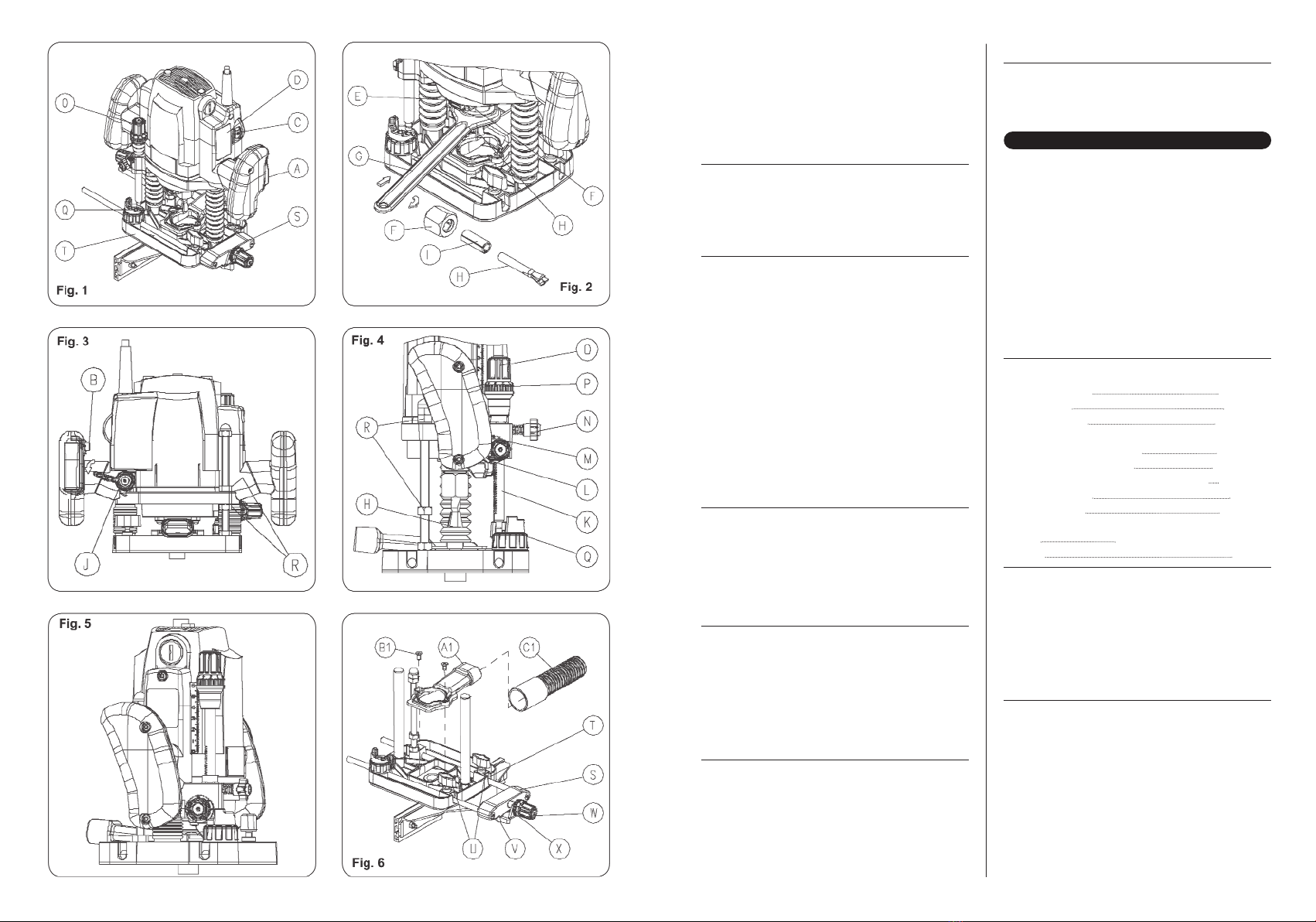
This tool has an operating switch A (Fig. 1) in the
handle, enabling the machine to be turned on
and off without releasing it.
To prevent the machine from starting up acciden-
tally, the switch can only be operated when the
lateral safety catch B (Fig. 3) has been released.
Once the switch is in the on position, pressure
need no longer be applied to the safety catch.
WARNING!
Always make sure that the router is not in contact
with the part being worked before operating the
switch. Once the machine has reached its maxi-
mum speed, bring the machine into contact with
the material, and stop the machine once it is
completely clear of the part. This will improve the
quality of the work.
6. FITTING THE CUTTING TOOLS
WARNING!
Make sure that the router is disconnected from
the mains before attaching the cutting tool.
To attach or remove the cutting tool, press the
router lock button E (Fig. 2) to prevent the shaft
from turning and loosen the chuck-holder nut
F(Fig. 2) with service key G (Fig. 2) The chuck
collet and chuck-holder are attached together by
pressure; you should therefore make sure that
the chuck collet is properly positioned in the nut.
Insert the cutting tool H (Fig. 2) and, if necessa-
ry, the corresponding bit adaptor I (Fig. 2) inside
the chuck-holder collet F (Fig. 2). Tighten the
chuck holder F (Fig. 2) tightly using the service
key, while keeping the lock button E (Fig. 2) pres-
sed.
If you are using the 12 mm or 1/2" shaft bit, the
adaptor is not required. Always use bits with the
shortest possible cutting length in order to redu-
ce the risk of the bit decentring. The bit, chuck
collet and adaptor should be completely clean
before attachment.
WARNING!
Do not leave the machine without a cutting tool,
as this exerts excessive pressure on the chuck
collet and can damage the shaft housing.
Never start the machine while the bit lock button
is pressed.
7. BLOCKING OF THE BASE
The base may be locked in any position by tur-
ning locking lever E(Fig. 3) in the counter-clock-
wise. The action of the springs incorporated in
the columns means that when this lever is loose-
ned the base automatically returns to its highest
position.
WARNING!
After use, always turn the switch to the off posi-
tion and release the base using the locking lever
J (Fig. 3) before placing the router on a flat surfa-
ce.
8. ADJUSTING THE DEPTH
ADJUSTING THE DEPTH. The depth is adjusted
by using the incorporated rack and pinion dep-
thadjustment mechanism.
With the cutter bit face flush against the wood
surface, the penetration depth may be adjusted
up to 60 mm.
To unlock the depth rod K (Fig. 4) press down fir-
mly on adjustment knob L (Fig. 4) and turn it to
raise or lower the depth rod, if a greater or lesser
cutting depth is required. The gauged adjustment
indicator M (Fig. 4) can be moved separately
from the knob, so that it may be set to zero from
any position using the reference mark. When tur-
ning the knob afteradjusting the indicator, both
elements will turn together, there by indicating
the degree to which the rod has been moved. A
full turn of the knob moves the rod by 34 mm,
with a maximum distance of 55 mm.
6
maken van een kopie zal een verschil tussen de
grootte van de mal en het gefreesde deel ver-
schijnen. Het verschil tussen de radius van de
malgeleider en het freesgereedschap moet altijd
in overweging worden genomen bij het maken
van een mal.
12. STOFAFZUIGBEVESTIGING
Om de stofafzuigaansluiting A1 (Fig. 6) te beve-
stigen, plaats deze in de centrale uitsparing in
zool T (Fig. 6), met de aansluiting naar de achter-
kant gericht en houd deze op zijn plaats met
schroeven B1 (Fig. 6).
13. DE BORSTELS VERVANGEN
WAARSCHUWING! Zorg ervoor dat de stekker
uit het stopcontact is verwijderd door u een
bewerking uitvoert.
De borstels moeten worden vervangen als ze
een minimum lengte van 5 mm hebben.
Verwijder hiervoor de afdekkingen D1 (Fig. 8) die
de borstels E1 (Fig. 8) vasthouden en vervang
deze door originele RUPES-borstels. Zorg ervo-
or dat ze vlot glijden in de geleiders.
Het is aan te bevelen de machine gedurende 15
minuten te laten werken, onbelast, na het vervan-
gen van de borstels.
Controleer de toestand van de afzuiger wanneer
u de borstels vervangt. Indien deze verbrand is of
uitsteekt, moet deze worden nagekeken door
een RUPES servicetechnicus.
14. SMEREN EN REINIGEN
De machine wordt volledig gesmeerd geleverd
van de fabriek en vereist tijdens zijn werkin-
gsduur geen speciale zorg. Het is belangrijk om
de machine zorgvuldig te reinigen na elk gebruik
met behulp van een droge luchtstraal.
Onderhoud de voedingskabel in perfecte bedrijf-
stoestand.
15. GELUIDS- EN VIBRATIENIVEAU
De geluids- en vibratieniveaus van dit elektrische
apparaat werden gemeten volgens de Europese
standaard EN50144.
Het geluidsniveau op de werkplek kan 85 dB (A)
overschrijden, in dit geval is het nodig voor de
gebruiker om geluidsbescherming te dragen.
16. GARANTIE
Alle RUPES-gereedschapswerktuigen hebben
een garantie van 12 maanden vanaf de datum
van aankoop, exclusief schade die het resultaat
is van een incorrect gebruik of een natuurlijke slij-
tage op de machine. Alle reparaties moeten wor-
den uitgevoerd door de officiële RUPES techni-
sche hulpdienst.
RUPES behoudt zich het recht voor om zijn pro-
ducten te wijzigen zonder voorafgaande kenni-
sgeving.
27
To hold the depth rod in the required position,
release the pressure from the adjustment knob.
Next, to ensure that the rod is firmly held in place,
it should be locked using fastening knob N (Fig.
4).
PRECISION ADJUSTMENT. If you wish to make
precision adjustments to the previously set
depth, simply turn adjustment knob O (Fig. 4). A
full turn of the knob moves the rod by 1 mm, with
a maximum distance of 5 mm. Each division in
the gauged fine-adjustment indicator P (Fig. 4)
represents an advance of 0.1 mm.
MAKING DEEP CUTS. To safely make cuts that
are too deep to be made with a single pass, we
recommend making several successive cuts
using the six 3-mm steps in the revolving depth
turret Q (Fig. 4).
Lower the machine until the cutting bit is level
with the surface on which the router is resting.
Use locking knob J (Fig. 3) to hold the machine in
this position. Loosen fastening knob N (Fig. 4),
then press down and turn adjustment knob L
(Fig. 4) until the depth rod presses against the
lower step of the revolving depth turret, using fine
adjustment if required. In this position, turn depth
indicator M (Fig. 4) until position zero matches
the reference mark. This will be the starting posi-
tion indicating the point at which the bit comes
into contact with the material. Hold the rod in
place with knob N (Fig. 4), release the locking
knob J (Fig. 3) and leave the machine in the off
position.
Loosen fastening knob N (Fig. 4), then press
down and turn adjustment knob L (Fig. 4),
moving the adjustment rod K (Fig. 4) upwards to
the required cut depth. Then use knob N once
again to turn turret Q (Fig. 4) until the highest
step is below rod K (Fig. 4). Make the first cut on
the material. Turn the turret Q to the next step
and then make another cut, and so on until the
required depth is obtained when the bottom step
is reached.
9. LOCKING THE ROUTING DEPTH
To carry out several repetitive jobs in which the
router depth is always the same, it may be useful
to prevent the head from being released by acci-
dentally moving the locking knob J (Fig. 3). This
may be done by inserting two M8 nuts R (Fig. 3)
in the threaded shaft, one above and one below
the head body. This locks the head at any point
along its depth setting.
WARNING! When working with the router depth
locked, the tool will be permanently outside the
base surface. Therefore the following actions
must be taken:
- Wait until the machine has come to a complete
stop before setting it down on its base, on a flat
surface, with the cutting tool free.
- Remove nuts R (Fig. 3) to return to the normal
lock conditions using lever J (Fig. 3), once the job
is complete.
10. USE OF PARALLEL GUIDE
The parallel guide is used for trimming edges and
cutting slots of different shapes, depending on
the profile shape. Hard metal cutter bits are par-
ticularly useful for smoothing edges and lengthe-
ning the working life of the bits.
The parallel guide S (Fig. 6) is inserted in the
openings on the base T (Fig. 6) and is held in
place using the two knobs U (Fig. 6).
NORMAL SQUARE ADJUSTMENT – Loosen the
base knobs U (Fig. 6), move the square to the
required position and then tighten the knobs in
this position.
PRECISION ADJUSTMENT – Once the square
has been approximately positioned and held in
place, a further fine adjustment may be made. To
do this, loosen square fastening knob V (Fig. 6),
turn the adjustment knob W (Fig. 6) to the requi-
red measurement, then tighten the square faste-
ning knob V (Fig. 6) again in this position.Afull
turn of the knob moves the square by 1 mm, with
a maximum distance of 10 mm. The gauged fine-
adjustment indicator X (Fig. 6) can be moved
separately from the knob, so that it may be set to
zero from any position using the reference mark.
When turning the knob W (Fig. 6) again after
adjusting the indicator
X (Fig. 6), both elements will turn together, there
by indicating the degree to which the square has
been moved, with each division representing an
advance of 0.1 mm.
11. USE OF TEMPLATE GUIDES
The template guides are used for routing with a
wide variety of shapes. The chosen template
guide Y (Fig. 7) is held to the base T (Fig. 7) with
the two screws Z (Fig. 7). On making a copy, a
difference between the size ofthetemplate and
the routed part will appear. The differencebetwe-
en the radius ofthe template guide and the cut-
ting tool must always be taken into account when
making a template.
12. DUST COLLECTOR ATTACHMENT
To attach the dust collector connector A1 (Fig. 6),
7
maximum afstand van 55 mm.
Om de dieptestang in de vereiste positie te hou-
den, laat de druk van de instellingsknop los. Zorg
er daarna voor dat de stang stevig op zijn plaats
wordt gehouden, ze zou vergrendeld moeten
worden via de bevestigingsknop N (Fig. 4).
FIJNINSTELLING Indien u de eerder ingestelde
diepte fijn wilt afstellen, draai de instellingknop O
(Fig. 4). Een volledige draai van de knop verpla-
atst de stang met 1 mm, met een maximum
afstand van 5 mm. Elke verdeling op de geijkte
fijninstelling indicator P (Fig. 4) vertegenwoordigt
een voortgang van 0,1 mm.
DIEPE SNEDES MAKEN Om op veilige wijze
snedes te maken die te diep zijn om met een
enkele freesbeweging te maken, bevelen we aan
om verschillende opeenvolgende snedes te
maken via de zes 3 mm stappen in de draaidiep-
te revolverkop Q (Fig. 4).
Laat de machine zakken tot het freesbit waterpas
is met het oppervlak waarop de bovenfrees rust.
Gebruik de vergrendelknop J (Fig. 3) om de
machine in zijn positie te houden. Draai de beve-
stigingsknop N (Fig. 4) los, druk dan de instel-
knop L (Fig. 4) naar beneden en draai deze tot de
dieptestang drukt tegen de lagere stand van de
draaidiepte revolverkop, gebruik fijnafstelling
indien nodig. Draai de diepte-indicator M (Fig. 4)
tot positie zero overeenkomt met de referentie-
markering. Dit zal de startpositie zijn die 8 aange-
eft
het punt waarop het bit in contact komt met het
materiaal. Houd de stang op zijn plaats met knop
N (Fig. 4), laat de vergrendelknop J (Fig. 3) los
en laat de machine in de uit-positie staan. Draai
de bevestigingsknop N (Fig.) los, druk vervol-
gens instellingsknop L (Fig. 4) naar beneden en
draai deze zodat de instellingstang K (Fig. 4)
naar boven gaat naar de vereiste snijdiepte.
Gebruik dan knop N opnieuw om de revolverkop
Q (Fig. 4) te draaien tot de hoogste stand onder
stang K is (Fig. 4). Maak de eerste snede op het
materiaal. Draai dan revolverkop Q naar de vol-
gende stap en maak nog een snede enzovoort
tot de vereiste diepte bereikt is wanneer de
onderste stap bereikt is.
9. DE FREESDIEPTE VERGRENDELEN
Om verschillende jobs uit te voeren waarbij de
freesdiepte steeds dezelfde is, kan het nuttig zijn
om te verhinderen dat de kop wordt losgelaten
door per ongeluk de vergrendelknop J (Fig. 3) los
te laten. Dit kan worden gedaan door twee M8
moeren R (fig. 3) te plaatsen in de schacht met
schroefdraad, één boven en één onder het kop-
deel. Dit vergrendelt de kop op elk punt langs de
diepte-instelling.
WAARSCHUWING! Wanneer wordt gewerkt met
de freesdiepte vergrendeld, zal het gereedschap
permanent buiten het zooloppervlak zijn. Daarom
moeten de volgende maatregelen worden geno-
men:
- Wacht tot de machine volledig gestopt is voor u
deze op zijn zool neerzet op een vlak oppervlak
en met het freesgereedschap vrij.
- Verwijder de moeren R (Fig. 3) om terug te
keren naar normale vergrendelomstandigheden
met hendel J (Fig. 3), wanneer de job klaar is.
10. GEBRUIK VAN DE PARALLELAANSLAG
De parallelaanslag wordt gebruikt voor het trim-
men van randen en het frezen van sleuven van
verschillende vorm, afhankelijk van de profiel-
vorm. Freesbits in hardmetaal zijn bijzonder nut-
tig voor het afvlakken van randen en het verlen-
gen van de levensduur van de bits.
De parallelaanslag S (Fig. 6) wordt in de openin-
gen op de zool T (Fig. 6) geplaatst en op zijn pla-
ats gehouden middels twee knoppen U (Fig. 6).
NORMALE VIERKANTINSTELLING—Draai de
zoolknoppen U (Fig. 6) los, verplaats het vierkant
naar de vereiste positie en draai de knoppen vast
in deze positie.
FIJNINSTELLING – Wanneer het vierkant onge-
veer juist geplaatst werd en in positie wordt
gehouden, kan een verdere fijnafstelling worden
gemaakt. Draai hiervoor de vierkanten bevesti-
gingsknop V (Fig. 6) los, draai de instellingsknop
W (Fig. 6) naar de vereiste maat en draai dan de
vierkanten bevestigingsknop V (Fig. 6) terug
dicht in deze positie. Een volledige draai aan de
knop verplaatst het vierkant 1 mm, met een maxi-
mum afstand van 10 mm. De geijkte fijnafstelling
indicator X (Fig. 6) kan apart van de knop worden
verplaatst, zodat deze kan worden ingesteld op
zero vanuit elke positie via de referentiemarke-
ring. Wanneer knop W (Fig. 6) opnieuw wordt
gedraaid na het instellen van de indicator X (Fig.
6), zullen beide elementen samen draaien en zo
de mate aangeven waarin het vierkant werd ver-
plaatst, waarbij elke verdeling een voortgang van
0,1 mm vertegenwoordigt.
11. GEBRUIK VAN DE MALGELEIDERS
De malgeleiders worden gebruikt voor het frezen
met een groot gamma vormen. De gekozen mal-
geleider Y (Fig. 7) wordt aan de zool T (Fig. 7)
gehouden met twee schroeven Z (Fig. 7). Bij het
26
place it in the central recess in base T (Fig. 6),
with the connection facing the back, and hold it in
place with screws B1 (Fig. 6).
13. CHANGING THE BRUSHES
WARN ING! Make surethe machine is disconnec-
ted from the mains before performing any opera-
tion. The brushes should be replaced when they
have a minimum length of 5 mm. To do this,
remove the covers D1 (Fig. 8) that hold the bru-
shes E1 (Fig. 8) and replace them with original
RUPES brushes, making sure that they slide
smoothly inside the guides.
It is advisable to allow the machine to run for 15
minutes unloaded after changing the brushes.
When changing the brushes, check the condition
of the collector. If it is burnt or juts out, it should
be serviced by a RUPES service technician.
14. LUBRITATION AND CLEANING
The machine is delivered fully lubricated from the
factoryand does not require any special care
during its working life. It is important to clean the
machine carefully after use, using a dry air jet.
Maintain the supply cable in perfect operating
conditions.
15. NOISE AND VIBRATION LEVEL
The noise and vibration levels of this electrical
device have been measured according to the
European standard EN50144.
The noise level in the workplace can exceed 85
dB(A), in which case it is necessary for the user
to take noise protection measures.
16. WARRANTY
All RUPES power tools are guaranteed for 12
months from the date of purchase, exlcuding any
domage which is a result of incorrect use or of
natural wear and tear on the machine. All repairs
should be carried out by the official RUPES
technical assistance service.
RUPES reserves the right to modify its products
without prior notice.
DÉFONCEUSE RT 15A
(FIGURES EN PAGE 28)
IMPORTANT
ATTENTION! Avant d'utiliser la machine, lisez
attentivement ce MANUEL D'INSTRUCTIONS et
la BROCHURE D'INSTRUCTIONS
GÉNÉRALES DE SÉCURITÉ qui vous sont four-
nis avec cette machine. Assurez-vous de bien
avoir tout compris avant de commencer à travail-
ler sur la machine. Gardez toujours ces deux
manuels d'instructions à portée de la main pour
pouvoir les consulter, en cas de besoin.
1. DONNÉES TECHNIQUES RT 15A
Moteur universel 50/60 Hz
W005.1ecnassiuP
Vitesse à vide 25.000 /min
Niveau de pression acoustique
continu équivalent pondéré A 91 dB (A)
Niveau de puissance acoustique 104 dB (A)
Niveau habituel vibrations (main/bras) <2,5 m/s2
Diamètre pincestandard 12 mm
Profondeurdefraisage 0-60 mm
Calibre de profondeur rotatif ajustage de
profondeur à 6 positions avec échelle
gK4,5sdioP
2. EMPLOI
La défonceuse portable est un outil électrique uti-
lisé principalement pourfraiser le bois et les pla-
stiques. Elle est utilisée pour profiler les bords,
couper les no
Euds, fraiser par reproduction, élé-
gir, construire des cadres et pour la gravure.
Grâce aux guidages parallèles, aux gabarits de
reproduction et aux outils de profilage, la fraiseu-
se portable est un appareil électrique extrême-
ment utile. Sa conception ergonomique permet
de travailler avec aisance, quelle que soit sa
position et sous des angles différents.
3. INSTRUCTIONS DE SÉCURITÉ POUR LE
MANIEMENT DE LA MACHINE
ATTENTION! Avant d'utiliser la fraiseuse, veuil-
lez lire attentivement la BROCHURE D'IN-
STRUCTIONS GÉNÉRALES DE SÉCURITÉ qui
est jointe à la documentation de la machine. - Si
vous changez les outils ou effectuez toute opéra-
tion à proximité de la tête de découpe, retirez la
main du levier de l'interrupteur et déconnectez la
prise du courant du réseau.
Portez des lunettes de sécurité à chaque fois que
vous travaillez avec la fraiseuse.
- Orientez-la en empoignant les deux manettes
de la machine.
- Après avoir effectué un travail, débranchez le
moteur et desserrez la base avant de laisser la
fraiseuse.
- Placez systématiquement la fraiseuse sursa
base et le tout sur une surface plane et propre. -
Veuillez mettre la fraiseuse en marche au moyen
du levier de l'interrupteur principal.
8
Française
- Plaats de bovenfrees altijd op zijn zool op een
vlak, zuiver oppervlak.
- Start de bovenfrees altijd via de aan/uit-hendel.
- Zorg ervoor dat de bovenfrees niet per ongeluk
omgestoten kan worden.
- Gebruik altijd freesbits met de juiste schachtdia-
meter voor de te gebruiken spankop en frees-
snelheid.
- De specificaties van de freesbits in het RUPES-
gamma zijn bijzonder geschikt voor gebruik met
deze bovenfrees; we bevelen aan om freesbits te
gebruiken van het brede gamma bits van RUPES
met dezelfde specificaties.
4. STANDAARD UITRUSTING
De doos bevat de volgende items:
- RT15A- bovenfrees
- A/f servicesleutel: 24
- Montage laterale geleider
- Aansluiting voor stofafzuiger
- Bedieningsinstructies en diverse documentatie
- 6022387 Freesbit 12 tot 8 adaptor
- 6022388 Freesbit 12 tot 6 adaptor
5. DE MACHINE OPSTARTEN
Deze machine heeft een bedieningsschakelaar A
(Fig. 1) in de handgreep waarmee de machine
kan worden in/uitgeschakeld zonder deze los te
laten.
Om te voorkomen dat de machine per ongeluk
opstart, kan de schakelaar enkel bediend worden
als de laterale veiligheidspal B (Fig. 3) ontgren-
deld is. Wanneer de schakelaar in de aan-positie
staat, moet niet langer druk worden uitgeoefend
op de veiligheidspal.
WAARSCHUWING!
Zorg er altijd voor dat de bovenfrees niet in con-
tact is met het te bewerken deel voor u de scha-
kelaar bedient. Wanneer de machine zijn maxi-
mum snelheid bereikt heeft, breng de machine in
contact met het materiaal en stop de machine
wanneer deze volledig voorbij het stuk is. Dit zal
de kwaliteit van het werk verbeteren.
6. DE FREESGEREEDSCHAPPEN
AANBRENGEN
WAARSCHUWING!
Zorg ervoor dat de bovenfrees losgekoppeld is
van het elektriciteitsnetwerk voor u het freesgere-
edschap aanbrengt.
Om het freesgereedschap te plaatsen of te ver-
wijderen, druk op de vergrendelknop E (Fig. 2)
om te verhinderen dat de schacht draait en draai
de moer voor de spankophouder F (Fig. 2) los
met de servicesleutel G (Fig. 2). De spankop en
de spankophouder zijn samen bevestigd door
druk.
U moet er bijgevolg voor zorgen dat de spankop
juist in de moer zit.
Plaats het freesgereedschap H (Fig. 2) en indien
nodig de overeenkomstige bitadaptor I (Fig. 2) in
de spankophouder F (Fig. 2). Draai de spanko-
phouder F (Fig. 2) stevig vast met de servicesleu-
tel, terwijl u de vergrendelknop E (Fig. 2) inge-
drukt houdt.
Indien u de schachtbit van 12 mm of ?" gebruikt
is de adaptor niet vereist. Gebruik altijd bits met
de kortst mogelijk snijlengte ten einde het risico
om het decentreren van het bit te reduceren. Het
bit, de spankop en de adaptor moeten volledig
proper zijn voor de bevestiging.
WAARSCHUWING!
Laat de machine niet staan zonder een freesge-
reedschap gezien dit buitensporige druk uitoe-
fent op de spankop en de schachtbehuizing kan
beschadigen.
Start de machine nooit terwijl de bitvergrendel-
knop ingedrukt is.
7. DE ZOOL BLOKKEREN
De zool kan in elke positie vergrendeld worden
door de vergrendelhendel E (Fig. 3) in tegenwij-
zerzin te draaien. De actie van de veer in de
kolommen betekent dat wanneer deze hendel
gelost wordt de zool automatisch naar zijn hoog-
ste positie terugkeert.
WAARSCHUWING!
Na gebruik, draai de schakelaar altijd in de uit-
positie en laat de zool los via de vergrendelhen-
del J (Fig. 3) voor u de frees op een vlak opper-
vlak plaatst.
8. DE DIEPTE INSTELLEN
De diepte wordt ingesteld via het ingebouwde
heugel en tandwiel diepte-instellingsmechani-
sme.
Met het bitoppervlak vlak tegen het houtopper-
vlak, kan de penetratiediepte worden ingesteld
tot 60 mm.
Om de dieptestang K (Fig. 4) te ontgrendelen,
druk de instelknop L (Fig. 4) stevig naar beneden
en draai deze om de dieptestang te verhogen of
te verlagen, indien een grotere of kleinere snij-
diepte vereist is. De geijkte instelindicator M (Fig.
4) kan afzonderlijk van de knop verplaatst wor-
den zodat deze vanuit elke positie kan worden
ingesteld op zero via de referentiemarkering.
Wanneer de knop wordt gedraaid na het instellen
van de indicator, zullen beide elementen samen
draaien en daardoor de mate aangegeven waa-
rin de stang verplaatst werd. Een volledig draai
van de knop draait de stang met 34 mm, met een
25
- Assurez-vous que la fraiseuse ne tombe pas
par accident.
- Utilisez systématiquement des fraises au dia-
mètre de tige compatible avec la pince à utiliser
et adaptées à la vitesse de la fraiseuse.
- Les spécifications des fraiseuses de la gamme
RUPES sont spécialement adaptées aux presta-
tions de la RT 15A. Utilisez de préférence les frai-
seuses de la gamme RUPES ou uniquement les
fraiseuses dont les caractéristiques correspon-
dent aux dites spécifications.
4. ÉQUIPEMENT STANDARD
La boîte contient les éléments suivants:
- Défonceuse RT 15A
- Clé de service o/c: 24
- Ensemble équerre latérale
- Connecteur d'aspiration
- Mode d'emploi et documentation diverse.
- 6022387 Réducteur fraise de 12 à 8
- 6022388 Réducteur fraise de 12 à 6
5. MISE EN MARCHE
Cet outil est doté d'un interrupteur de commande
A (Fig. 1), incorporé à la manette permettant de
démarrer ou d'arrêter la machine sans la lâcher.
Pour éviter la mise en marche accidentelle de la
machine, l'interrupteur peut uniquement être
actionné après que la sûreté latérale B a été
débloquée (Fig. 3). Une fois que l'interrupteur est
en position de mise en marche, il n'est pas
nécessaire de maintenir la pression sur la sûreté.
ATTENTION!
Assurez-vous en toutes circonstances que la frai-
se n'est pas en contact avec la pièce à usiner
avant d'actionner l'interrupteur. Une fois que la
machine a atteint sa vitesse maximale, rappro-
chez la fraise de la pièce à usiner jusqu'à ce
qu'elle la touche et arrêtez la machine lorsque la
fraise a libéré la pièce. De cette manière, vous
pourrez effectuer un travail de meilleure qualité.
6. MONTAGE DES OUTILS DE COUPE
ATTENTION!
Avant de procéder au montage de l'outil de
découpe, assurez-vous que la fraiseuse est
débranchée de la prise de courant du réseau.
Pour procéder au montage ou au démontage de
l'outil de découpe, appuyez sur le bouton de blo-
cage E de la fraise (Fig. 2) pour empêcher l'axe
de tourner et desserrez le gousset à pinces F
(Fig. 2) à l'aide de la clé de service. La pince et
le gousset à pinces sont deux éléments qui se
fixent l'un à l'autre par exercice d'une pression.
Vous devez donc vous assurer que la pince est
parfaitement bien assise dans le gousset à pin-
ces.
Introduisez l'outil de découpe H (Fig. 2) et si
nécessaire, le réducteur de fraise correspondant
I (Fig. 2) à l'intérieur de la pince du gousset F
(Fig. 2). Ensuite, serrez fermement le gousset à
pinces F (Fig. 2) à l'aide de la clé de service tout
en appuyant sur le bouton de blocage E (Fig. 2).
Si vous utilisez une fraise de 12 mm ou 1/2" de
manche, il est inutile d'utiliser un réducteur.
Utilisez systématiquement des fraises avec une
longueur de découpe la plus courte possible pour
réduire au minimum le risque de désaxement. La
fraise, la pince et le réducteur doivent être pro-
pres et donc exempts de tout résidu avant de
procéder au montage.
ATTENTION!
Evitez de laisser la machine sans outil car la
pince pourrait se serrer plus qu'il ne faudrait et
abîmer le logement de l'axe.
Ne mettez jamais la machine en marche alors
que le bouton de blocage est enfoncé.
7. BLOCAGE DE LA BASE
La base peut être bloquée dans n'importe quelle
position en tournant le levier de blocage J dans
le sens contraire des aiguilles d'une montre (Fig.
3). Par action des ressorts incorporés aux colon-
nes, le desserrage du levierentraîne le retourau-
tomatique du levier à sa position la plus haute.
ATTENTION!
Après avoir réalisé un travail, placez l'interrupteur
en position d'arrêt et retirez la base à l'aide du
levier de blocage J (Fig. 3) avant de placer la frai-
seuse sur une surface plane.
8. RÉGLAGE DE LA PROFONDEUR
REGULATION DE LA PROFONDEUR
La profondeur est ajustée à l'aide d'un mécani-
sme de réglage de la profondeur avec crémaillè-
re et pignon incorporés.
Lorsque la face de découpe est arasée à la sur-
face du bois, la profondeurde pénétration peut
atteindre jusqu'à 60 mm.
Pour débloquer la tige de profondeur K (Fig. 4),
appuyez fermement le bouton de réglage L (Fig.
4) puis tournez-le pour élever ou abaisser la tige
de profondeur pour une découpe plus ou moins
profonde. L'indicateur gradué de réglage M (Fig.
4) peut bouger indépendamment du bouton, ce
qui permet de le placer sur zéro quelle que soit
sa position grâce au marquage de référence.
Une fois ajusté, l'indicateur tournera en même
temps que le bouton, indiquant ainsi le déplace-
ment de la tige. Un tour complet du bouton corre-
spond à un déplacement de la tige de 34 mm
avec un parcours maximum de 55 mm.
9
ремонтно-профилактических мероприятий
отключите аппарат от сети.
снимите заглушки гнезда щеткодержателя D1
(рис. 8), которые удерживают щетки E1 (рис. 8), и
замените щетки новыми (используйте
оригинальные запчасти RUPES). Убедитесь, что
рекомендуем после этого запустить фрезер на 15
минут в холостом режиме, чтобы придать щеткам
замене щеток вы обнаружите повреждения или
сбои на коллекторе, мы рекомендуем вам
обратиться для ремонта на уполномоченные
станции техобслуживания RUPES.
смазанным и в дальнейшем не требует никакого
специального технического обслуживания.
работы очищайте его потоком сухого сжатого
силового кабеля.
Уровень шума и вибраций, создаваемых данным
аппаратом, измерялся согласно европейскому
стандарту EN 50144. Уровень шума на рабочем
оператор должен принять меры по защите от
шума.
распространяется на ущерб или повреждения,
возникшие в результате некорректного
использования или естественного износа изделия.
уполномоченных станциях техобслуживания
RUPES.
внесение изменений в свои изделия без
предварительного уведомления.
RT15A BOVENFREES
(ILLUSTRATIES OP PAGINA 28)
BELANGRIJK
OPGEPAST Lees zorgvuldig deze BEDIENIN-
GSINSTRUCTIES en de bijgeleverde brochure
met VEILIGHEIDSVOORSCHRIFTEN voor u de
machine gebruikt. Zorg ervoor dat u deze begrijpt
voor u de machine de eerste keer bedient.
Bewaar de beide sets voorschriften voor toekom-
stige vragen.
1. TECHNISCHE GEGEVENS RT15A
zH06/05rotomelesrevinU
Opgenomen vermogen 1.500 W
Onbelast toerental 25.000/min
Equivalent gemeten continu
akoestisch drukniveau A 91 dB (A)
Akoestisch drukniveau 104 dB (A)
Normaal vibratieniveau (hand-arm) <2,5 m/s2
mm21ØpoknapS
mm06-0etpeidseerF
Draaidiepte instelling 6-positie diepte-afstelling
gK4,5thciweG
2. BEDIENINGSBEREIK
De bovenfrees is een elektrisch apparaat
gebruikt voor het frezen van hout en plastic. Het
is ook zeer handig voor het trimmen van randen,
het uitsnijden van knopen, kopieerfrezen, het fre-
zen van sponningen, het maken van kaders en
graveren.
Samen met de parallelaanslag, malgeleiders,
passer en vormfrees, is het een buitengewoon
nuttig apparaat.
3. VEILIGHEIDSVOORSCHRIFTEN
VOOR DE MACHINEBEDIENING
WAARSCHUWING! Voor u de bovenfrees
gebruikt, lees zorgvuldig de brochure met VEILI-
GHEIDSVOORSCHRIFTEN die bij de machine-
documentatie wordt geleverd.
- Wanneer u gereedschappen verwisselt of een
andere bewerking in de buurt van de snijkop uit-
voert, neem uw hand van de aan/uit-hendel en
verwijder de stekker uit het stopcontact.
- Gebruik een beschermbril tijdens het werken
met de bovenfrees.
- Geleid de bovenfrees altijd met beide handen,
via de twee handgrepen van de machine.
- Wanneer u klaar bent met het werk, schakel de
motor uit en laat de zool los voor u de bovenfre-
es neerzet.
24
Nederlands
Pour placer la tige de profondeur dans la position
souhaitée, cessez d'appuyer sur le bouton de
réglage. Ensuite, pour garantir une bonne fixa-
tion de la tige, bloquez-la avec le bouton de fixa-
tion N (Fig. 4).
REGLAGE DE PRECISION. Si vous souhaitez
ajuster ou modifier avec précision la profondeur
que vous avez définie, il suffit de tourner le bou-
ton de réglage O (Fig. 4). Un tour complet du
bouton correspond à un déplacement de la tige
de 1 mm avec un parcours maximum de 5 mm.
Chaque division de l'indicateur gradué de l'aju-
stage de précision P (Fig. 4) correspond à une
avancée de 0,1 mm.
REALISATION DE DECOUPES PROFONDES.
Pour effectuer en une seule passe et en toute
sécurité une découpe très profonde, il est con-
seillé d'effectuer plusieurs découpes successives
en utilisant les six échelons de 3 mm de la tourel-
le tournante de profondeur Q (Fig. 4).
Abaissez la machine jusqu'à ce que la fraise soit
au même niveau que la surface sur laquelle
lafraiseuse est appuyée.Al'aide du bouton de
blocage J(Fig. 3) placez la machine dans cette
position. Desserrez le bouton defixation N(Fig.4)
et appuyez puis tournez le bouton de réglage L
(Fig. 4) jusqu'à ce que la tige de profondeur tam-
ponne l'échelon inférieur de la tourelle tournante
de profondeur en recourant au réglage de préci-
sion si nécessaire. Dans cette position, tournez
l'indicateur de profondeur M (Fig. 4) jusqu'à ce
que la position zéro coïncide avec le marquage
de référence. Ce sera la position de départ qui
indiquera le point auquel la fraise entre en con-
tact avec la pièce à usiner. Stabilisez la tige à l'ai-
de du bouton N (Fig. 4), désactionnez le bouton
de blocage J (Fig. 3) et placez la machine en
position de repos.
Desserrez le bouton de fixation N (Fig. 4),
appuyez et tournez le bouton de réglage L (Fig.
4) en déplaçant la tige de réglage K (Fig. 4) vers
le haut jusqu'à obtenir la profondeurde découpe
souhaitée puis encore une fois à l'aide du bouton
N, tournez la tourelle Q (Fig. 4) jusqu'à ce que
l'échelon le plus élevé soit en dessous de la tige
K (Fig. 4). Effectuez la première passe de décou-
pe de la pièce à usiner. Tournez la tourelle Q
jusqu'à l'échelon suivant puis effectuez une autre
passe. Répétez successivement cette opération
jusqu'à atteindre la profondeur souhaitée.
9. BLOCAGE DE LA PROFONDEUR
DE DÉFONÇAGE
Pour la réalisation de tâches répétitives pour
lesquelles la profondeur de fraisage est toujours
la même et pour lesquelles il conviendrait d'éviter
de lâcher la tête par actionnement involontaire du
levier de blocage J (Fig. 3), il est possible de blo-
quer la tête à la profondeur souhaitée en interca-
lant deux écrous M8 R (Fig. 3) dans l'axe fileté,
l'un au-dessus et l'autre en dessous de la tête, ce
qui permettra de le bloquer à n'importe quel point
du parcours.
ATTENTION! Lorsque vous travaillez avec la
profondeur de fraisage bloquée, l'outil reste con-
tinuellement en dehors de la surface de la base,
c'est pourquoi vous devrez:
- attendre que la machine s'arrête totalement
avant de la placer, alors qu'elle est reliée à la
base, sur une surface plane qui dégage l'outil.
- retirer les écrous R (Fig. 3) pour revenir aux
conditions normales de blocage par le levier J
(Fig. 3) dès que vous terminez le travail.
10. EMPLOI DU GUIDE PARALLÈLE
Le guide parallèle s'utilise pour le profilage des
bords et la découpe des rainures de différentes
formes conformément aux formes variées de
profils. Pour l'ébarbage des bords et pour une
durée d'utilisation plus longue des fraises, il con-
vient d'utiliser des fraises en métal dur.
Le guide parallèle S (Fig. 6) se place dans les
ouvertures de la base T (Fig. 6) et se fixe au
moyen des boutons U (Fig. 6).
REGLAGE NORMALDE L'EQUERRE –
Desserrez les boutons U(Fig. 6) de la base,
déplacez l'équerre vers la mesure souhaitée et
replacez les boutons dans cette position.
REGLAGE DE PRECISION – Unefois que
l'équerre est placée dans la position souhaitée,
vous pouvez procéder à un réglage de précision.
Pour ce faire, desserrez le bouton de fixation de
l'équerre V (Fig. 6), tournez le bouton de réglage
W (Fig. 6) jusqu'à la mesure souhaitée puis
replacez le bouton de fixation V (Fig. 6) de
l'équerre dans cette position. Un tour complet du
bouton de réglage correspond à un déplacement
de l'équerre de 1 mm avec un parcours maxi-
mum de 10 mm. L'indicateur gradué de réglage
de précision X (Fig. 6) peut bouger indépendam-
ment du bouton, ce qui permet de le placer sur
zéro quelle que soit sa position grâce au marqua-
ge de référence. Après ajustage de l'indicateur X
(Fig. 6), lorsque le bouton W (Fig. 6) tourne à
nouveau, il le fera en indiquant le déplacement
de l'équerre, en sachant que chaque division cor-
respond à une avancée de 0,1 mm.
10
необходимости выполнения пазов слишком
глубоких для фрезерования за один проход
рекомендуется фрезерование в несколько
проходов, используя шестипозиционный
револьверный упор Q (рис. 4) с шагом 3 мм.
Опустите машину до касания фрезой
машину в данной позиции при помощи рукоятки J
(рис. 3). Отверните винт N (рис. 4), нажмите и
поверните регулятор L (рис. 4) до касания
револьверного упора, при необходимости
используйте регулятор точной настройки O (рис.
таким образом, чтобы совместить отметку «О»
(ноль) с контрольной отметкой. Это и будет
начальная позиция, в которой фреза коснется
освободите фиксирующую рукоятку J (рис. 3) и
верните фрезер в исходное состояние.
Отверните винт N (рис. 4), нажмите и поверните
регулятор L (рис. 4) до достижения регулятором
таким образом, чтобы верхняя ступень
револьверного упора была под стержнем
следующий уровень и выполните следующий
требуемая глубина не будет достигнута.
которых глубина фрезерования играет большую
роль и существует риск деблокирования головки
случайным нажатием рукоятки J (рис. 3), можно
зафиксировать головку на желаемой глубине с
помощью двух гаек R (рис. 4).
глубиной режущий инструмент всегда выступает
из поверхности основания, поэтому:
• дождитесь полной остановки аппарата, перед
тем как поставить его;
• ставьте аппарат так, чтобы режущий инструмент
оставался свободным;
• расфиксируйте глубину и вернитесь к
нормальному состоянию, как только вы закончите
текущее задание.
для прорезания пазов различного профиля.
подрезке кромок являются фрезы из
углеродистой стали.
отверстия основания T (рис. 6) и крепится с
помощью двух фиксирующих винтов U (рис.
6).
этого, сдвигая параллельный упор, установите его
в требуемое положение и закрепите с помощью
двух фиксирующих винтов U (рис. 6).
упора в приблизительное положение и
блокировании его в этом положении ослабьте
фиксатор V (рис. 6) и отрегулируйте положение
параллельного упора, используйте регулятор
регулятора точной настройки перемещает
параллельный упор на 1 мм, а максимальный ход
регулировочный индикатор X (рис. 6) может
вращаться независимо от регулятора и может
быть установлен в нулевое положение из любого
положения, используя контрольную отметку.
при повороте регулятора, оба элемента
повернутся вместе, таким образом, указывая
размер, на который был перемещен
составляет 0,1 мм.
копировальное кольцо Y (рис. 7) крепится к
фрезеровании по шаблону размер шаблона
отличается от размеров получаемой детали.
иметь в виду, что радиус шаблона отличается от
радиуса режущего инструмента.
его в центральное отверстие в основании T (рис.
части аппарата и зафиксировать винтами B1
23