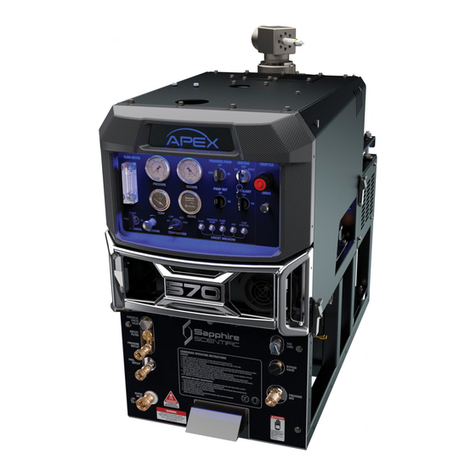
PART# 49-100 REV B SAPPHIRE SCIENTIFIC MODEL 460SS® 3
1. Read the operator’s manual before
starting this unit.
Failure to adhere to instructions could result in
severe personal injury or could be fatal.
2. Operate this unit and equipment only
in a well-ventilated area.
Exhaust fumes contain carbon monoxide, which
is an odorless and deadly poison that can cause
severe injury or death. DO NOT run this unit in
an enclosed area. DO NOT operate this unit
where the exhaust may enter a building
doorway, window, vent or other opening.
3. Gasoline is extremely flammable and
its vapors can explode if ignited.
Store gasoline only in approved containers, in
well-ventilated, unoccupied buildings and away
from sparks or flames. Never carry gasoline or
any flammable materials in the vehicle. Fumes
could accumulate inside of the vehicle and
ignite, causing an explosion.
4. This unit must be operated with the vehicle
doors and windows open in order to ensure
adequate ventilation to the engine.
5. DO NOT operate unit if gasoline is spilled.
Do not turn ignition switch until the gasoline
has been cleaned up. Never use gasoline for
cleaning purposes.
6. DO NOT place hands, feet, hair, clothing or
any body parts near rotating or moving parts.
Rotating machinery can cause severe injury or
death.
7. NEVER operate this unit without belt and
safety guards. High speed moving parts, such as
belts and pulleys, should be avoided while the
unit is running. Severe injury, fatality or damage
may result.
8. NEVER service this unit while it is running.
High speed mechanical parts as well as high
temperature components may result in injury or
severed limbs.
9. Engine components will be extremely hot
from operation. To prevent severe burns, DO
NOT touch these areas while the unit is running
or shortly after the unit is shut off.
10. DO NOT touch any part of the exhaust
system while the system is running or for 20
minutes after the unit is shut off. Severe burns
could result.
11. Water under high pressure at high
temperature can cause burns, severe personal
injury, or fatality. Shut down unit, allow to
cool down, and relieve system of all pressure
before removing caps, valves, plugs, fittings,
filters or hardware.
12. NEVER leave the vehicle engine running
while the unit is in operation.
13. Battery acid contains sulfuric acid. To
prevent acid burns, avoid contact with skin, eyes
and clothing. Batteries also produce explosive
hydrogen gases while charging. To prevent fire
or explosion, charge batteries only in a well-
ventilated area. Keep sparks, open flames, as
well as other sources of ignition away from
battery at all times. Remove all jewelry prior to
servicing batteries. Keep batteries out of the
reach of children.
Before disconnecting the negative (−) ground
cable, ensure that all switches are in the off
position. If on, a spark could occur at the ground
connection terminal which could cause an
explosion if hydrogen gas or gasoline vapors are
present. ALWAYS disconnect the negative (−)
terminal first.
14. DO NOT smoke around the machine. Gas
fumes could accumulate and ignite. Battery
gases are extremely flammable. This will
prevent possible explosions.
15. DO NOT damage the vehicle in any way
during the installation. When routing fuel lines
DO NOT configure the hose in any locations