INSTALLATION
MANUAL
©Scania CV AB 2016, Sweden
Radiators and radiator fans
01:05 Issue 8.0 en-GB 8
Radiator fans
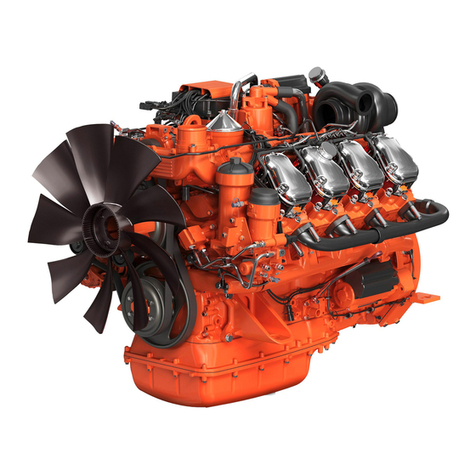
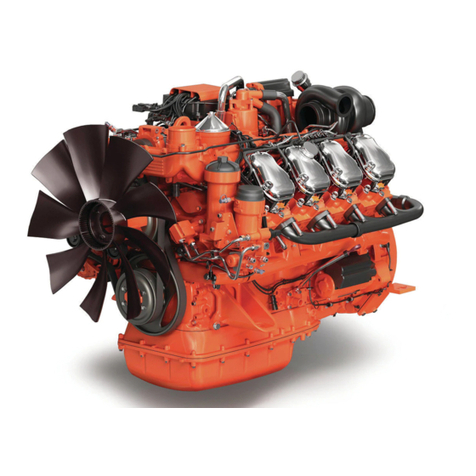
The engines are available with 2 types of radiator fan – a pusher fan or puller fan.
The significant difference between the two systems is that a puller fan provides a
more even distribution of the air flow through the radiator. See the illustrations.
With a pusher fan, the cooling capacity is also reduced as the cooling air is warmed
when it passes the engine, exhaust pipe and driven unit. A pusher fan also results in
a greater pressure drop across the radiator since the distribution over the surface of
the radiator is not so good.
This means that a particular size of radiator requires a larger volume of air with a
pusher fan to achieve the same cooling capacity.
The fan ring must be correctly located and designed for the fan to achieve maximum
air flow and to ensure that distribution across the radiator is as efficient as possible.
See Installation of radiator and radiator fan.
In order to optimise the cooling capacity, first check that heated air is not being re-
circulated. If it is, a suitable shield must be fitted. The second measure is to increase
the size of the radiator.
It is possible to optimise the fan speed or fan diameter to increase capacity. If the size
of the fan or the fan speed is changed the power requirement and noise level of the
fan increase. Information about permissible combinations can be found in the Data
Handbook.
A pusher fan can help to combat heating of the engine compartment by dissipating
heat radiated by the engine, exhaust pipe and driven unit.