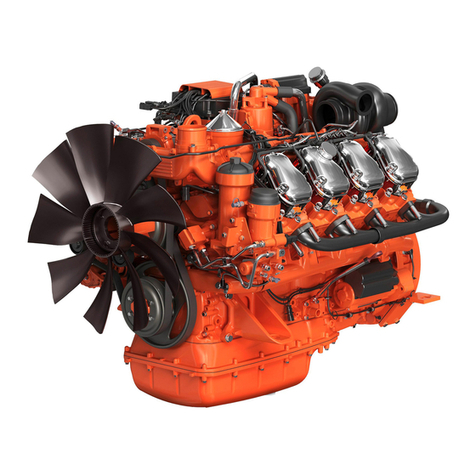
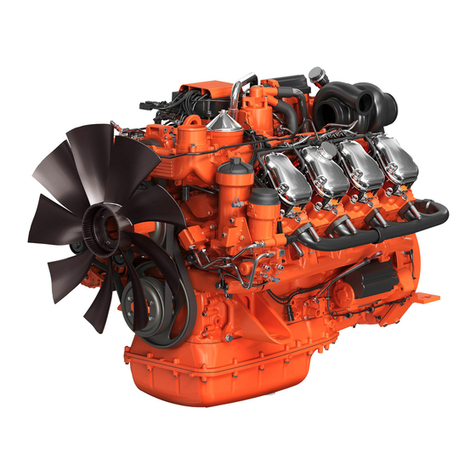
Scania DI09 User manual

INSTALLATION
MANUAL
©Scania CV AB 2016, Sweden
02:04 Issue 7.0 en-GB 1
Exhaust system
Marine engines
DI09, DI13, DI16
333 380

INSTALLATION
MANUAL
©Scania CV AB 2016, Sweden
02:04 Issue 7.0 en-GB 2
Sound reduction.......................................................................................................3
Exhaust noise....................................................................................................... 3
Exhaust system design ........................................................................................ 4
Connection of exhaust system to engine ................................................................7
V-clamp............................................................................................................... 7
Exhaust pipe bends.............................................................................................. 8
Weld flanges for connection to turbocharger.................................................... 11
Exhaust bellows................................................................................................. 12
Exhaust back pressure ..........................................................................................13
Measuring exhaust back pressure...................................................................... 13
Type of exhaust system .........................................................................................14
Wet exhaust system........................................................................................... 15
Insulating the exhaust system...............................................................................17
Protection against water ingress ..........................................................................19
Multi-engine installation.......................................................................................20
Dimensioning the exhaust system ........................................................................22
Calculation example.......................................................................................... 23
Important data.......................................................................................................25

INSTALLATION
MANUAL
©Scania CV AB 2016, Sweden
Sound reduction
02:04 Issue 7.0 en-GB 3
Sound reduction
Assess the need for sound reduction in new installations from case to case, based on
the applicable conditions in relation to noise requirements, length and type of exhaust
system, location of the exhaust system outlet etc.
Some form of sound reduction is required in most installations.
The thermal insulation of the exhaust system affects the sound level. A thermally in-
sulated system can result in a higher noise level than an uninsulated system.
Exhaust noise
Undamped exhaust noise, measured 1 metre downstream of the turbocharger at full
power output:
The most important frequency range for exhaust noise is between 50 and 500 Hz. Ex-
haust flow in the system can generate hissing sounds, e.g. at sharp pipe bends and
edges. This is known as self-generated sound. This phenomenon occurs higher up in
the frequency range and is effectively dampened with an absorption silencer (e.g.
glass fibre). Vibrations in the silencer casing can also generate noise. For this reason,
avoid silencers with flat surfaces.
Engine Sound level (dBA) Most important one-third octave
band (Hz)
DI09 115-117 40-160
DI13 115-118 50-200
DI16 116-118 63-250

INSTALLATION
MANUAL
©Scania CV AB 2016, Sweden
Sound reduction
02:04 Issue 7.0 en-GB 4
Exhaust system design
Position the silencer as close to the end of the exhaust system as possible. In order to
obtain the best noise reduction, there should only be a short tailpipe after the silencer
as shown in the graph.
• For all-speed engines, read the specified maximum speed for the engine.
• For single-speed engines, read the operating speed of the engine.
If the silencer cannot be positioned close to the exhaust system outlet because of a
lack of space, it should be placed as close to the engine as possible. This location is,
however, unfavourable in silencing terms if the pipes beyond it are long. It may then
be a good idea to install another silencer close to the outlet or to end the exhaust sys-
tem with two 90° pipe bends with a suitable length between them.
Note:
Sharp exhaust pipe bends close to the outlet increase the risk of hissing sounds.
1
2
3
1200
2.0
L(m)
rpm
1.8
1.6
1.4
1.2
1.0
0.8
1500 1800 2100 2400
337 694
Graph for determining the longest length of tailpipe.
1. DI09.
2. DI13.
3. DI16.

INSTALLATION
MANUAL
©Scania CV AB 2016, Sweden
Sound reduction
02:04 Issue 7.0 en-GB 5
Exhaust outlet
Design the exhaust system so that the exhaust gases are not reflected against vertical
walls, since this results in increased noise level.
Position the exhaust outlet so that no exhaust gases can be drawn into the engine in-
take. If exhaust gases are drawn into the intake, intake air temperature increases rap-
idly. The exhaust gases contain soot particles so there is also a risk of the air filter
becoming blocked.
WARNING!
Position the exhaust outlet so that exhaust gases cannot enter areas occupied by peo-
ple.
Example
If 2 silencers are used in the system, they should be positioned in series at a distance
of 2/3 of the length of the tailpipe and with the silencer used to dampen high-frequen-
cy noise furthest away from the engine.
Since the pipes which form part of an exhaust system also operate as silencers, it is
important that they are dimensioned correctly.
Note:
The exhaust back pressure increases with the number of pipe bends and with in-
creased pipe length. This leads to higher fuel consumption and loss of power.
IMPORTANT!
The installer is responsible for ensuring that the exhaust system is well sealed during
installation. He is also responsible for ensuring that the pipe and silencer suspension
is designed in such a way that system leaks cannot arise during operation.

INSTALLATION
MANUAL
©Scania CV AB 2016, Sweden
Sound reduction
02:04 Issue 7.0 en-GB 6
Examples of long exhaust systems (i.e. longer than 5 metres) with designs which aid
sound reduction.
Examples of short exhaust systems with designs which aid sound reduction.
L = Length of tailpipe, determined from graph
a = 2/3 of L. Length a is less significant in exhaust systems with only one silencer
338 555
338 554
aL
338 556
L
a
338 557
L
a
a
L
338 558

INSTALLATION
MANUAL
©Scania CV AB 2016, Sweden
Connection of exhaust system to engine
02:04 Issue 7.0 en-GB 7
Connection of exhaust system to engine
There should always be a flexible connection between the exhaust system and the en-
gine which absorbs the movement of the engine and changes in length in the exhaust
system due to temperature changes. A flexible connection can consist of the Scania
exhaust bellows. Position the flexible connection as close to the turbocharger con-
nection as possible.
IMPORTANT!
The weight of the exhaust system must not load the exhaust bellows or turbocharger.
Therefore, place a suspension point immediately after the flexible connection.
The illustration to the right shows the recommended installation of the exhaust sys-
tem.
If the exhaust pipes are very long or if the exhaust system has a relatively long hori-
zontal part between 2 vertical parts, several flexible connections may be required in
the system. There must then be a fixed anchorage point on one side of the vertical
exhaust bellows and a suspension which allows axial movement on the other side.
V-clamp
Scania pipe sections have flanges secured with V-clamps.
Note:
Do not use the V-clamp to force together joints, but only to fix the flanges.
1
2345
369 312
Recommended installation of exhaust system.
1. Turbocharger.
2. Exhaust pipe bend.
3. Exhaust bellows.
4. Exhaust pipe.
5. Bracket.
338 567

INSTALLATION
MANUAL
©Scania CV AB 2016, Sweden
Connection of exhaust system to engine
02:04 Issue 7.0 en-GB 8
Exhaust pipe bends
Dry exhaust pipe bends
The engines can be equipped with a 90° exhaust pipe bend on the turbocharger ex-
haust outlet. The exhaust pipe bend can be fitted at different angles and rotated 360°
around the connection with the turbocharger.
The exhaust pipe bend is connected to the turbocharger with a V-clamp.
The exhaust pipe bend outlet has a flange that is connected with a V-clamp. It is usu-
ally connected directly to the Scania exhaust bellows.
On DI16 XPI a flange is connected between the turbocharger and exhaust pipe bend.
The flange, which is marked in grey in the illustration, is connected with 4 Ø 11 mm
screws.
12
Ø
185,3
Ø
185,3
56
148
128
129
195
357 881
1. Exhaust pipe bend for the DI13 072/077.
2. Exhaust pipe bend for the DI09, DI13 except for 072/077 and the DI16 The flange
marked in grey is only used on DI16 XPI.

INSTALLATION
MANUAL
©Scania CV AB 2016, Sweden
Connection of exhaust system to engine
02:04 Issue 7.0 en-GB 9
Water-cooled exhaust pipe bends
DI09, DI13
For engines with heat exchangers, there are also water-cooled exhaust pipe bends.
They have outlets to fit an exhaust gas temperature sensor (1), thread 1/8-27 NPTF.
The upper illustration shows an example of a water-cooled exhaust pipe bend for
DI09 and DI13. The table gives the measurements for all water-cooled exhaust pipe
bends for DI09 and DI13.
IMPORTANT!
The exhaust pipe bend and hose or pipe downstream of it must not be angled higher
than the bottom edge of the turbocharger, i.e. 15° (see illustration). Otherwise, water
can penetrate into the back of the engine and cause liquid slugging. This may lead to
bent connecting rods and the total destruction of the engine.
This applies to the entire exhaust installation downstream of the turbocharger.
Engine type Dimensions (mm)
ABC
DI09 246 437 423
DI13 072 200 437 434
DI13 077 199 495 433
Other DI13 146 454 400
1
338 206
AB
C
Ø150
Example of a water-cooled exhaust pipe bend for DI09 and DI13.
M
in15
367 912
Minimum installation angle for DI09 and DI13.

INSTALLATION
MANUAL
©Scania CV AB 2016, Sweden
Connection of exhaust system to engine
02:04 Issue 7.0 en-GB 10
DI16
The illustrations below show the dimensions of the water-cooled exhaust pipe bends
for DI16.
1 = Outlet to fit an exhaust gas temperature sensor, thread 1/8-27 NPTF.
DI16 PDE.DI16 XPI.
1
338 207
291
478 477
Ø150
515
1
357 879
369
458 458
Ø
150
484,5
410
Other manuals for DI09
6
This manual suits for next models
2
Table of contents
Other Scania Engine manuals
Scania
Scania DC09 User manual
Scania
Scania DI16 User manual

Scania
Scania DI09 PDE User manual

Scania
Scania DC13 070A User manual
Scania
Scania DC16 User manual
Scania
Scania OC16 User manual
Scania
Scania DC11 User manual

Scania
Scania DI9 55 User manual
Scania
Scania DI09 User manual
Scania
Scania DI13 XPI User manual
Scania
Scania DI09 User manual

Scania
Scania DI13 series User manual

Scania
Scania DI16 PDE User manual

Scania
Scania DI14 82 User manual

Scania
Scania DI09 User manual
Scania
Scania DI16 XPI series User manual

Scania
Scania DC12 User manual

Scania
Scania 9-Series User manual
Scania
Scania DI09 User manual
Scania
Scania DI09 User manual