CAUTION
•Never leave a module unsupported or unsecured. If a module should fall, the
glass could break. A module with broken glass cannot be repaired and must not
be used.
Clearance between Modules
A clearance of 6 mm (1/4”) between modules is sufficient in most installations to accommodate thermal
expansion. However, the appropriate clearance is dependent upon many installation specific factors
including the support structure, temperature at the site, and the maximum operating temperature of the
module.
Orientation, Tilt Angle, and Shading
Photovoltaic modules generate maximum power when facing directly towards the sun. Since applications
and needs are different it is recommended that you consult a PV system integrator or use a commercially
available software program to determine the expected energy output. The following paragraphs list some
general rules of thumb.
To maximize annual energy output, point the array south in the northern hemisphere and north in the
southern hemisphere. Tilt the array from horizontal equal to site latitude. Your direction and tilt can vary
depending on when you wish to maximize power output. Note that these orientations are true, not
magnetic North and South.
Dirt tends to accumulate on modules installed at flatter angles and does not wash off as readily during
rainfall. Dirt accumulation on the module will reduce its energy output.
Modules should be located in an unshadowed location where they will receive maximum exposure to the
sunlight for the longest possible time during the day. Shadowing caused by buildings, trees, utility poles,
and other obstructions, may significantly reduce the module energy output.
If it is not possible to place the array in a shadow-free location, a location should be selected where there
is no shading between the hours of 9 AM and 3 PM. This is the most energy-productive part of the day.
Keep in mind that the worst case shading will occur on December 21 in the northern hemisphere and
June 21 in the southern hemisphere.
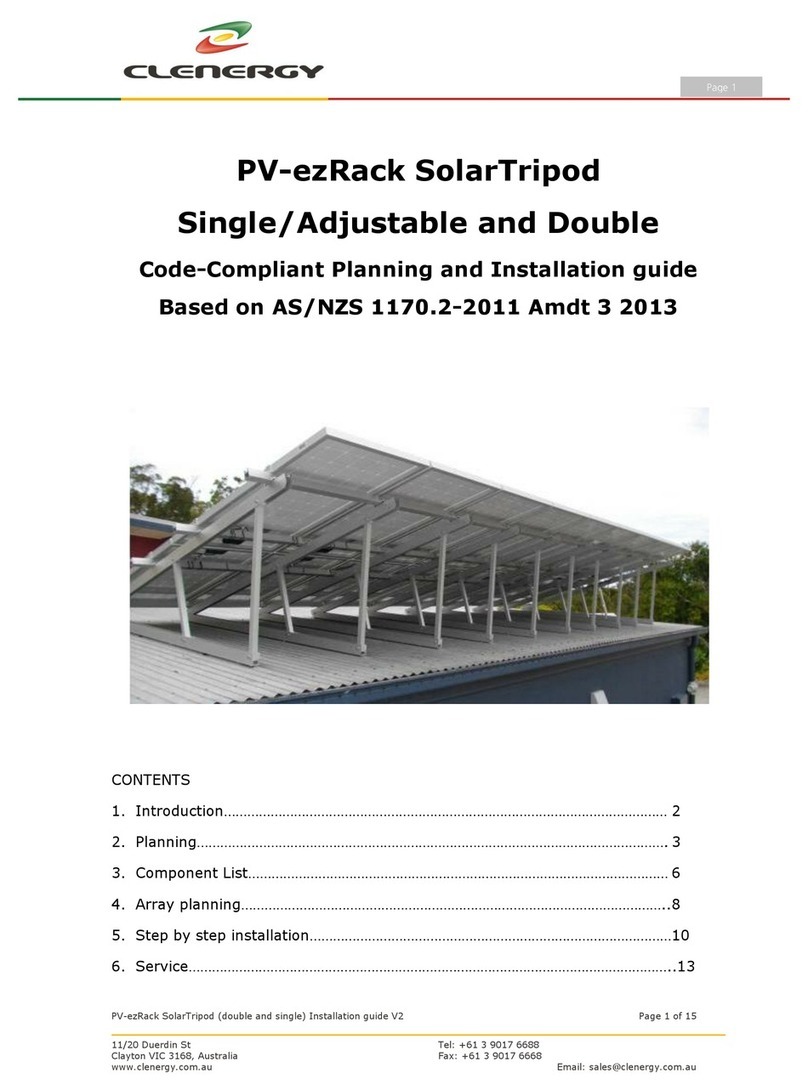
In systems that are configured with multiple rows of modules, the rows should be spaced far enough
apart to minimize the impact of rows shading other rows. This distance is very dependent on the latitude
at which the system is installed. The closer to the equator, the smaller this distance. The further from the
equator, the greater is this distance.
If there are questions regarding the optimum configuration in which to arrange and wire the modules, it is
recommended that you obtain assistance from your SCHOTT Solar dealer or distributor or retain an
engineer familiar with the design of PV systems.
PM-00-003 F ASE-300 Manual
6