manuals.online logo
Brands
  1. Home
  2. •
  3. Brands
  4. •
  5. Seagate
  6. •
  7. Storage
  8. •
  9. Seagate Barracuda 180 Family User manual

Seagate Barracuda 180 Family User manual

Other manuals for Barracuda 180 Family

1

This manual suits for next models

4

Other Seagate Storage manuals

Seagate 15K.5 - Cheetah - Hard Drive Operating and safety instructions

Seagate

Seagate 15K.5 - Cheetah - Hard Drive Operating and safety instructions

Seagate ST11200N User manual

Seagate

Seagate ST11200N User manual

Seagate EXOS ST16000NM004J User manual

Seagate

Seagate EXOS ST16000NM004J User manual

Seagate Barracuda ES ST3500630NS User manual

Seagate

Seagate Barracuda ES ST3500630NS User manual

Seagate ST34502LW/LC User manual

Seagate

Seagate ST34502LW/LC User manual

Seagate Constellation CS User manual

Seagate

Seagate Constellation CS User manual

Seagate Backup Plus Desktop User manual

Seagate

Seagate Backup Plus Desktop User manual

Seagate PULSAR ST100FX0002 User manual

Seagate

Seagate PULSAR ST100FX0002 User manual

Seagate IRONWOLF ST16000VN001 User manual

Seagate

Seagate IRONWOLF ST16000VN001 User manual

Seagate ST2400MM0129 User manual

Seagate

Seagate ST2400MM0129 User manual

Seagate Momentus 5400 User manual

Seagate

Seagate Momentus 5400 User manual

Seagate HAWK 4 ST15230N User manual

Seagate

Seagate HAWK 4 ST15230N User manual

Seagate IRONWOLF ST8000VN0004 User manual

Seagate

Seagate IRONWOLF ST8000VN0004 User manual

Seagate MARATHON 1680 User manual

Seagate

Seagate MARATHON 1680 User manual

Seagate Lyve Drive Shuttle User manual

Seagate

Seagate Lyve Drive Shuttle User manual

Seagate ST34323A User manual

Seagate

Seagate ST34323A User manual

Seagate ST32000641AS - Barracuda XT 2 TB Hard Drive User manual

Seagate

Seagate ST32000641AS - Barracuda XT 2 TB Hard Drive User manual

Seagate ST136403LW/LC User manual

Seagate

Seagate ST136403LW/LC User manual

Seagate 7200.9 - Barracuda 7200.9 Hard Drive User manual

Seagate

Seagate 7200.9 - Barracuda 7200.9 Hard Drive User manual

Seagate Savvio 15K User manual

Seagate

Seagate Savvio 15K User manual

Seagate ST1000LX000 User manual

Seagate

Seagate ST1000LX000 User manual

Seagate ST303204N1A1A-RK - Hard Drive Retail User manual

Seagate

Seagate ST303204N1A1A-RK - Hard Drive Retail User manual

Seagate Medalist 6540 User manual

Seagate

Seagate Medalist 6540 User manual

Seagate ST8000DM002 User manual

Seagate

Seagate ST8000DM002 User manual

Popular Storage manuals by other brands

IBM 40/80 GB HH DLTVS user guide

IBM

IBM 40/80 GB HH DLTVS user guide

Synology DiskStation DS716+II Quick installation guide

Synology

Synology DiskStation DS716+II Quick installation guide

Vantec NexStar-HX4 user manual

Vantec

Vantec NexStar-HX4 user manual

LaCie Christofle Galet datasheet

LaCie

LaCie Christofle Galet datasheet

LaCie Rugged Thunderbolt user manual

LaCie

LaCie Rugged Thunderbolt user manual

OCZ IBIS datasheet

OCZ

OCZ IBIS datasheet

Transcend JetFlash 110 Brochure & specs

Transcend

Transcend JetFlash 110 Brochure & specs

QNAP TS 32PXU Series user guide

QNAP

QNAP TS 32PXU Series user guide

LaCie RUGGED RAID user manual

LaCie

LaCie RUGGED RAID user manual

Freecom CLS DOCK Quick install guide

Freecom

Freecom CLS DOCK Quick install guide

PNY Attache P-FD64MBATT3 install guide

PNY

PNY Attache P-FD64MBATT3 install guide

OWC Mercury Elite Pro Dual mini Assembly manual

OWC

OWC Mercury Elite Pro Dual mini Assembly manual

OLT 6x6 Maximizer Assembly manual

OLT

OLT 6x6 Maximizer Assembly manual

Transcend JetFlash 160 Specifications

Transcend

Transcend JetFlash 160 Specifications

Thunderbolt 600 user manual

Thunderbolt

Thunderbolt 600 user manual

Intel RAID High Availability user guide

Intel

Intel RAID High Availability user guide

LaCie 12big Thunderbolt 3 Quick install guide

LaCie

LaCie 12big Thunderbolt 3 Quick install guide

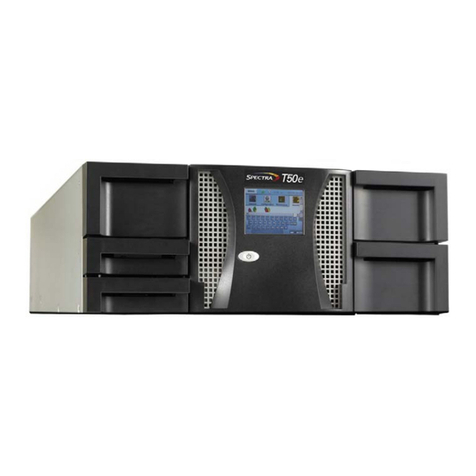
Spectra Logic T-Series Spectra T50e quick start guide

Spectra Logic

Spectra Logic T-Series Spectra T50e quick start guide

manuals.online logo
manuals.online logoBrands
  • About & Mission
  • Contact us
  • Privacy Policy
  • Terms and Conditions

Copyright 2025 Manuals.Online. All Rights Reserved.

Barracuda 180 Installation Guide
Model ST1181677LW/LC/LWV/LCV, SCSI interface disc drive
Publication Number: 100109942, Rev. A, December 2000
Handling precautions/electrostatic discharge protection
• Disc drives are fragile. Do not drop or jar the drive and handle the drive
only by the edges or frame.
• Drive electronics are extremely sensitive to static electricity. Keep the
drive in its antistatic container until you are ready to install it. Wear a wrist
strap and cable connected to ground. Discharge static from all items near
or that will contact the drive. Never use an ohmmeter on any circuit
boards.
• Turn off the power to the host system during installation.
• Always use forced-air ventilation when operating the drive.
• Use caution when troubleshooting a unit that has voltages present.
• Do not disassemble the drive; doing so voids the warranty.
• Return the entire drive for depot service if any part is defective.
• Do not apply pressure or attach labels to circuit board or drive top.
Electromagnetic compliance
See Safety and Regulatory Agency Specifications, p/n 75789512.
Drive characteristics
Formatted capacity ....................................181.6 Gbytes
Max. data blocks .......................................354,600,001 (1522C441h)
Cylinders and heads (user accessible) ......24,247 / 24 heads
Disc rotation ...............................................7,200 rpm
Operating voltages .....................................+5V +12V
Typical operating current .........................0.81A 0.81A
What you need
• Phillips screwdriver and four 6-32 UNC drive mounting screws
• Forced-air ventilation to provide adequate drive cooling
• An unused drive power connector (not applicable to LC/LCV models)
To operate at LVD transfer rates, you must use an LVD-capable SCSI host
adapter, LVD I/O cable and active negation external terminator
Multimode interface
This drive can operate in single-ended (SE) or low voltage differential (LVD)
mode. This multimode capability provides backwards compatibility so you
can use it with or without an LVD-capable host adapter. The primary bene-
fits of LVD technology include faster transfer rates, reduced power con-
sumption, increased allowable cable lengths, and improved device
connectivity.
You can configure the drive to switch between SE and LVD modes auto-
matically or force it to operate in SE mode only. To configure this option,
see Figure 2.
Note. To operate at the Ultra2 rates in LVD mode, all devices on the same
bus (cable) must be running in LVD mode. If you add any SE device
to the bus, all devices on that bus operate in SE mode.
Note. Some LVD host adapters provide an LVD connector and an SE con-
nector on the same host adapter to allow you to run SE and LVD
drives concurrently at their maximum capabilities. Check your SCSI
host adapter documentation. See Figure 3.
Caution. Do not mix LVD drives on the same bus with high voltage differ-
ential (HVD) devices–drive damage may occur.
Installation instructions
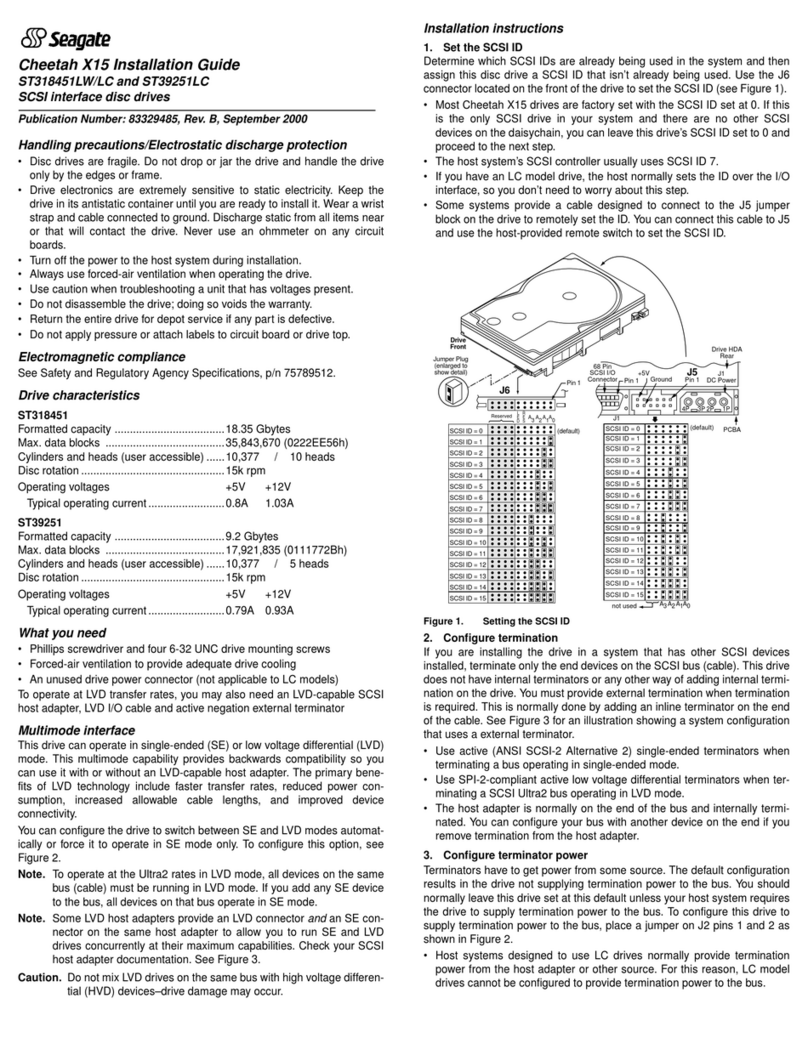
1. Set the SCSI ID
Determine which SCSI IDs are already being used in the system and then
assign this disc drive a SCSI ID that isn’t already being used. Use the J6
connector located on the front of the drive to set the SCSI ID (see Figure 1).
• Most ST1181677 drives are factory set with the SCSI ID set at 0. If this is
the only SCSI drive in your system and there are no other SCSI devices
on the daisychain, you can leave this drive’s SCSI ID set to 0 and pro-
ceed to the next step.
• The host system’s SCSI controller usually uses SCSI ID 7.
• If you have an LC or LCV model drive, the host normally sets the ID over
the I/O interface, so you don’t need to worry about this step.
• Some systems provide a cable designed to connect to the J5 jumper
block on the drive to remotely set the ID. You can connect this cable to J5
and use the host-provided remote switch to set the SCSI ID.
Figure 1. Setting the SCSI ID
2. Configure termination
If you are installing the drive in a system that has other SCSI devices
installed, terminate only the end devices on the SCSI bus (cable). This drive
does not have internal terminators or any other way of adding internal termi-
nation on the drive. You must provide external termination when termination
is required. This is normally done by adding an inline terminator on the end
of the cable. See Figure 3 for an illustration showing a system configuration
that uses an external terminator.
• Use active (ANSI SCSI-2 Alternative 2) single-ended terminators when
terminating a bus operating in single-ended mode.
• Use SPI-2-compliant active low voltage differential terminators when ter-
minating a SCSI Ultra2 bus operating in LVD mode.
• The host adapter is normally on the end of the bus and internally termi-
nated. You can configure your bus with another device on the end if you
remove termination from the host adapter.
3. Configure terminator power
Terminators have to get power from some source. The default configuration
results in the drive not supplying termination power to the bus. You should
normally leave this drive set at this default unless your host system requires
the drive to supply termination power to the bus. To configure this drive to
supply termination power to the bus, place a jumper on J2 pins 1 and 2 as
shown in Figure 2.
• Host systems designed to use LC and LCV drives normally provide termi-
nation power from the host adapter or other source. For this reason, LC
and LCV model drives cannot be configured to provide termination power
to the bus.
SCSI ID = 0 (default)
Jumper Plug
(enlarged to
show detail)
J6
Drive
Front
Pin 1
Reserved
A2A1A0
A
L
E
D
R
E
S3
SCSI ID = 1
SCSI ID = 2
SCSI ID = 3
SCSI ID = 4
SCSI ID = 5
SCSI ID = 6
SCSI ID = 7
SCSI ID = 8
SCSI ID = 9
SCSI ID = 10
SCSI ID = 11
SCSI ID = 12
SCSI ID = 13
SCSI ID = 14
SCSI ID = 15
J1
DC Power
J1
68 Pin
SCSI I/O
Connector
Drive HDA
Rear
SCSI ID = 8
SCSI ID = 9
SCSI ID = 10
SCSI ID = 11
SCSI ID = 12
SCSI ID = 13
SCSI ID = 14
SCSI ID = 15
A
not used
3A2A1
SCSI ID = 0
SCSI ID = 1
SCSI ID = 2
SCSI ID = 3
SCSI ID = 4
SCSI ID = 5
SCSI ID = 6
SCSI ID = 7
A0
J5
Pin 1
4P 3P 2P 1P
PCBA
Pin 1
+5VGround
(default)
Figure 2. Option select jumpers
4. Connect the drive activity LED (optional)
Connect the Drive Activity LED cable to J6 pins 11 and 12 (see Figure 2), or
connect a drive ID and Drive Activity LED cable to J5, depending on host
system requirements.
5. Check the other available jumper settings
Select other options on J2 as illustrated in Figure 2. Do not change these
unless instructed to do so by the host system documentation.
6. Mount the drive in the host system and connect cables
Note. LC and LCV drives are designed to be attached to a carrier or
tray and inserted into the host system without I/O or power
cables.
a. Mount LW and LWV model drives to the host system’s chassis
using four 6-32 UNC screws. Two mounting holes are in each side
of the drive and there are four mounting holes in the bottom of the
drive. Do not over-tighten or force the screws. You can mount the
drive in any orientation.
b. Connect the SCSI I/O cable into the drive’s SCSI connector. Take
care not to stretch or crimp this cable, and do not block the sys-
tem’s cooling air flow with the cable.
Note. For Ultra2 and faster operation, special twisted pair LVD
cables are required.
c. Connect the DC power cable to the drive. See Figure 3.
Figure 3. Cable connections and external termination
7. Format the drive
The drive has been low level formatted at the factory. You do not need to
perform another low level format on this drive unless you decide to perform
certain diagnostics through the host adapter. If you do decide to perform a
low level format, do not abort the format as this is likely to make the drive
inoperable. A low level format, with verify turned on, will typically take four
hours.
Protect against power failure or other power interruptions during the format.
a. Turn on DC power to the host system.
b. Boot the system from a system floppy, CD, or from a previously
installed hard disc drive if there is one.
c. Format the drive.
Caution. Formatting a drive erases all user data. Be sure that you under-
stand this principle before formatting any hard disc drive. It is not
necessary to format a drive that previously has been used to
store data, unless your intention is to erase all user data. Seagate
is not responsible for lost user data.
Barracuda disc drives are designed to operate with a variety of operating
systems. Please refer to your system or SCSI controller manual for informa-
tion about formatting and setting up the drive. Some quick desktop system
notes are provided below.
•MicrosoftTM.Set the drive type in CMOS to “Zero,” “None,” or “No hard
drive installed.”Use FDISK.EXE and FORMAT.EXE. Systems using Win-
dows 98 or later can create one single partition (drive letter) on the drive.
•MacintoshTM.Use a third-party drive utility (most revisions of Apple’s HD
Setup utility only work with drives having special Apple firmware).
Troubleshooting
•Drive does not spin up. Check cables and all jumper settings. Make
sure cable pin 1 (edge stripe) matches PCB pin 1.
•Drive spins, but no LED on/off activity. Check SCSI ID setting. Set the
ID so that each device on the SCSI chain has its own unique ID. See also
the next item below. Host I/O controller is usually ID7.
•Computer does not seem to recognize the drive. Verify that the drive
is enabled by the SCSI host adapter setup utility.
•FDISK does not detect the drive. Run the FDISK program located on
your Windows startup diskette. Type fdisk/status to verify that your hard
drive is present.
Seagate support services
For online information about Seagate products, visit www.seagate.com or
e-mail your disc questions to DiscSupport@Seagate.com.
If you need help installing your drive, consult your dealer first. If you need
additional help, call a Seagate technical support specialist. Before calling,
note your system configuration and drive model number.
Africa +31-20-316-7222 Norway 800-113 91
Australia 1800-14-7201 Poland 00 800-311 12 38
Austria 0 800-20 12 90 Spain 900-98 31 24
Belgium 0 800-74 876 Sweden 0 207 90 073
Denmark 80 88 12 66 Switzerland 0 800-83 84 11
France 0 800-90 90 52 Singapore 800-1101-150
Germany 0 800-182 6831 Taiwan +886-2-2514-2237
Hong Kong 800-90-0474 Thailand 001-800-11-0032165
Indonesia 001-803-1-003-2165 Turkey 00 800-31 92 91 40
Ireland 1 800-55 21 22 United Kingdom 0 800-783 5177
Italy 800-790695 USA/Canada/ 1-800 SEAGATE or
Malaysia 1-800-80-2335 Latin America +1-405-936-1234
Middle East +31-20-316-7222 Other European
Netherlands 0 800-732-4283 countries +31-20-316-7222
New Zealand 0800-443988
Warranty. Contact your place of purchase or our web site (www.seagate.com).
Return Merchandise Authorization (RMA). Before returning the drive, verify that it
is defective. Seagate Worldwide customer service centers are the only facilities autho-
rized to service Seagate drives. Contact nearest center for return procedures and
trade regulations.
Shipping the drive
Caution. Back up the data before shipping. Seagate assumes no responsibility for
data lost during shipping or service. Shipping drive in an unapproved container voids
the warranty. Pack the drive with original box and packing materials. Use no other
materials. This prevents electrical and physical damage in transit.
© 2000 Seagate Technology LLC. All rights reserved
Publication number: 100109942, Rev. A, December 2000, Printed in U.S.A.
Seagate, Seagate Technology, the Seagate Logo, and Barracuda are either registered
trademarks or trademarks of Seagate Technology LLC. All other trademarks are the
property of their respective owners.
Enable parity check of SCSI bus.
Disable parity check.
J2 Pin 1
Reserved Positions
Parity Check option
Single-ended I/O
Terminator Power
Write protect = Off (enables writing).
Write protect = On (disables writing).
Write Protect option
Disable the Delay Motor Start option.
Motor start delay equal to the
SCSI ID multiplied by 12 seconds.
Delay Motor Start option (valid
only if the Enable Motor Start
jumper is not connected)
Enable motor start. The drive waits for
the Start Unit command from the host
before starting the spindle motor.
Disable motor start (default). The
drive starts according to the Delay
Motor Start option.
Motor Start option
Pin 1
End
SCSI I/O
Connector
Drive with
HDA up, PCB
down, viewed
from front
Pin 1
DC Power
Connector
J2
Drive Front J6
J1
Pin 1
HDA
J6
A2
A3A1A0
Reserved
Remote
LED
L
E
D
R
E
S
Reserved
Shipped with cover installed.
Do not remove.
Do not install jumpers
on these four positions.
J6 Jumper
CATH
11
12
J2 Jumper
(default)
(default)
(default)
(default)
A jumper here forces single-ended
I/O operation.
No jumper allows host to select either
single-ended or LVD operation.
Host adapter or other device provides
term. power to external terminator.
Term. Power to SCSI Bus
(default)
(default)
Pin 1
(check your
adapter for
Pin 1 location)
Host
Adapter
PCB
Twisted Pair
LVD Cable
Ultra160 or Ultra2 LVD bus segment
SPI-2 compliant
active LVD
external terminator
on the end of
the cable
SCSI LVD/SE
SCSI SE
Ultra SCSI SE bus segment