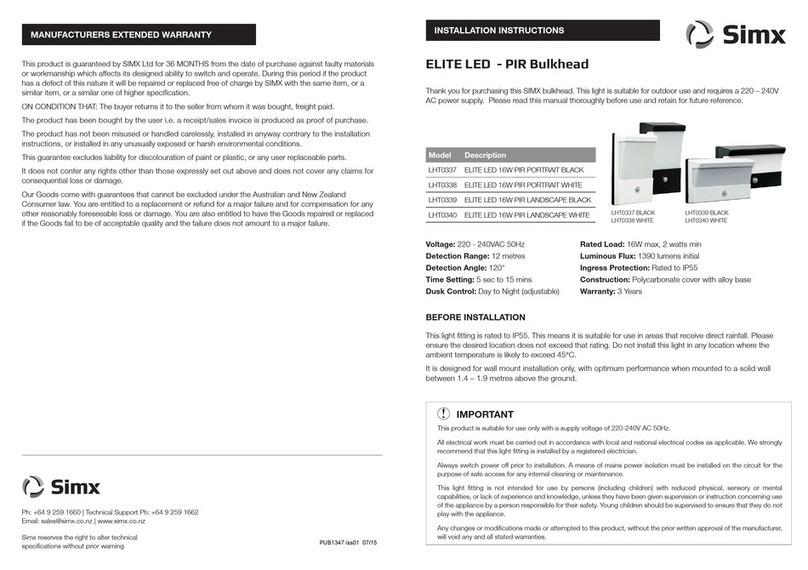
We strongly recommend a registered electrician installs this light tting.
Warning: Isolate the power supply before installation.
• Release the front fascia of the light, by inserting a at head screwdriver into the two tabs at the base of the
tting and gently turn these. Remove the front facia.
• Unscrew and remove the small connection cover on the front of the tting.
• Position the unit against wall in the desired location, ensuring the power supply cable can easily enter the
tting through the rubber grommet at the rear of the tting.
• Use the holes in each corner of the tting to mark the 4 drill holes required to secure the base to the wall
(and mark the cable inlet location if required).
• Drill the wall and t the wall plugs supplied.
• Use a sharp knife to cut a small ‘X’ in the rubber grommet and feed the power supply cable through into
the light tting. Note: Please ensure the cable enters the grommet from beneath to avoid moisture migration.
• The light tting can now be xed to the wall using the mounting screws provided.
• Strip cable insulation 6mm and attach to the terminal block following the label denotations.
• After the wiring is secured, the PIR controls should be set and tested, as described in ‘DAYTIME Walk
Test’ on the following page.
• Once this is done, and changes are no longer required, replace the small connection cover securely, and
ret the front fascia, using the double-sided tape (supplied) between the fascia and the opal lens for more
permanent xing.
ELITE LED PIR Bulkhead is a Class 1 tting and therefore needs to be Earthed for electrical safety.
Waterproof cable should be used for outdoor installations. Using Twin and Earth 3 core round exible cable
at least 1mm² gauge is preferred.
Avoid directing the PIR sensor towards objects that may move in the wind, such as shrubs or trees, or at
highly reective surfaces. Avoid positioning the light tting near heat sources, such as hot ventilator ducts,
air conditioning units, exhaust outlets, street lighting or trafc, all of which may interfere with PIR operation.
Note that a PIR sensor is more sensitive to a heat source moving across its coverage area, and less sensitive
to a heat source that moves directly towards the PIR.
ELECTRICAL INSTALLATION
INSTALLING YOUR ELITE PIR BULKHEAD
PIR Setting Controls