BMD-5DIN
DC brush motor controller
User manual
Tallinn Science Park Tehnopol, Akadeemia tee 21/6,
Tallinn 12618, Estonia Phone: + 372 6559914,
e-mail: sale@smd.ee
url: http://smd.ee
1) Make sure the power supply is turned off. Please, wire just when power is off.
2) Select input signals logic and voltage range for the analog speed regulation signal (refer to the
section 7).
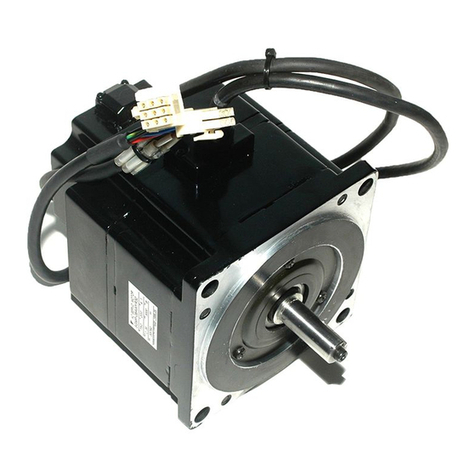
3) Connect the motor to the controller terminals A and B.
4) Connect the control elements to the controller according to chosen speed adjusting method:
- Internal potentiometer - additional connection doesn’t required
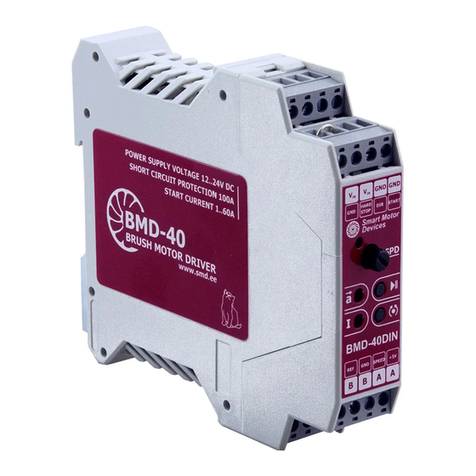
- External potentiometer – connect potentiometer to the contacts “SPEED”, GND and “+5V”. The
internal potentiometer “SPEED” should be turned to the end left position.
- Analog signal 0…5 V or 0…10 V – connect the source of analog signal to the “SPEED” contacts: “-“ to
the “GND” contact and “+” to the “SPEED” contact. The motor speed is proportional to the signal
voltage. The jumper “10V | 5V” determines the voltage range for the analog speed regulation signal
(refer to the section 7).
5) If needed, connect control elements to the “START/STOP” and “DIR” contacts. These inputs are
clean contact.
6) Connect power supply to the controller contacts: “+”of the power supply to the terminal “VIN”, “-“ of the
power supply to the terminal “GND“. Wire cross-section should be suitable to the motor current
consumption. We recommend using wire cross-section 1 mm2. Ground the power supply unit.
7) Set speed and acceleration regulators to the end CCW position, which correspond to their minimum
values.
8) Using the potentiometer «CURRENT ADJUST», set the maximum motor current. Adjust the
«CURRENT ADJUST» potentiometer and control the set current limit by a voltmeter, connected to
«GND» and «Vref » terminals (fig.3). The motor current limitation can be calculated as:
Ilim = 0.1 + 4.9 x (VREF / 3.3)
Fig. 3. Connection of a voltmeter for setting of a motor maximum current limit.
6. Motor Control
1. Choose the method of speed regulation: internal or external potentiometer or analog voltage signal.
2. Connect the motor, power supply and control elements to the controller according to the section 5.
3. Turn on the power supply. The controller is ready for operation. LED at the front panel of the
controller should solid light. Adjust the motor current limit (see the section 5).
4. Start the motor by button or input signal «START/STOP». The LED should start blinking (period 1
sec). 5. Adjust the motion parameters by using of a speed regulator, acceleration potentiometer and
direction input or button.
In case of short-circuit of motor phases or overcurrent 10A for 15 µs, the controller turns to an
emergency mode, deenergizes the motor and indicates the alarm by LED blinking.