4
Application
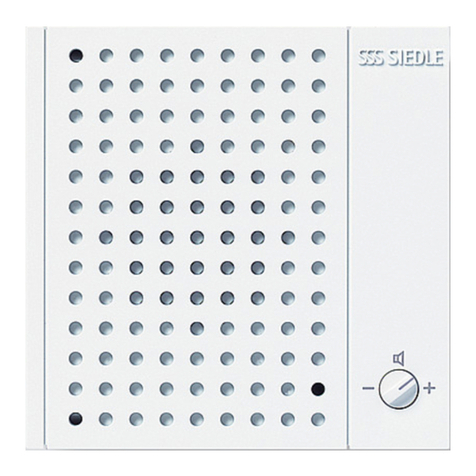
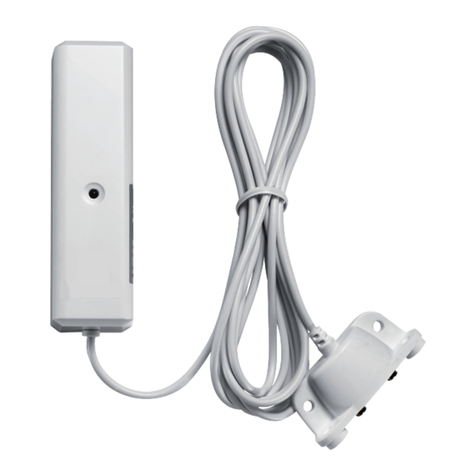
Secondary signal unit with 3-tone
call signal, chime and 2-tone call
signal.
Subtle low-prole design for surface-
mounting. Volume adjustable from
the outside, approx.86dB(A).
Operation in the Siedle door and
in-house telephony systems
(1+ntechnology).
Can be connected to HTS/
HTC811-…
Electrical voltage
Mounting, installation and servicing
work on electrical devices may only
be performed by a suitably qualied
electrician.
Electrostatic charging
As a result of electrostatic charging,
direct contact with the circuit board
can result in destruction of the
device. Direct contact with the circuit
board must therefore be avoided.
Mounting and installation
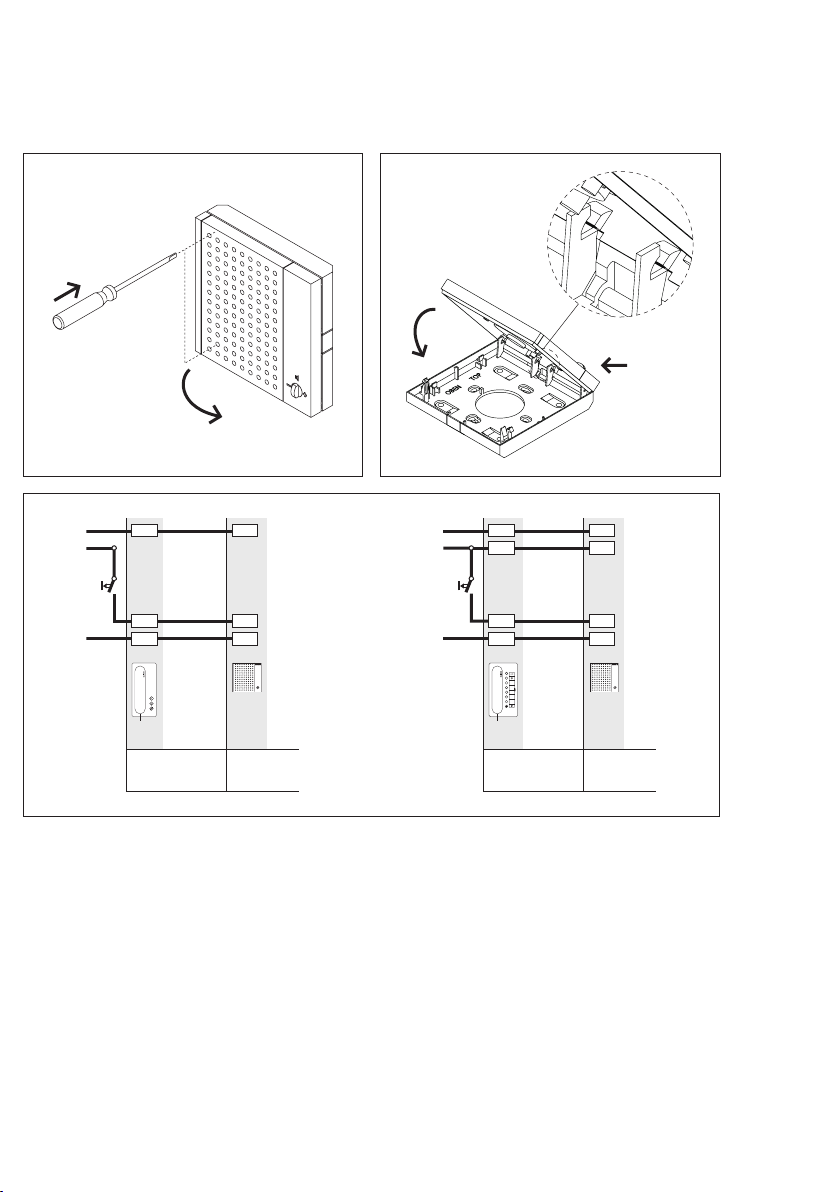
1 Open the auxiliary signalling unit
by light pressure with a small screw-
driver on the concealed spring tabs.
Hinge open the cover panel to the
right and remove.
2 Connection parallel to the
HTS811-…/HTC811-…
3 Attach the cover panel on the
right hand side, hinge on the left
and clip into place.
The rotary controller can be used to
adjust the ring tone volume from
very low to the maximum volume.
English
Terminal assignment
1
7
Connection to the 1+n
system (Door call)
ERT Story call
G Gong signal
Call tones when connecting:
to side circuit installation
door call: 3-tone call signal
(without Gconnection)
or 3-tone chime
(with Gconnection)
storey call: 2-tone call signal
to ETC602-…
main/side circuit door loudspeaker:
3-tone call signal
storey door loudspeaker: 3-tone
chime
storey call: 2-tone call signal
If terminalG(+) is not connected,
the door call can only be used as
a 3-tone call.
Specications
Ringing volume: approx. 86dB(A)
Operating voltage: 12VAC,
16–20VDC
Operating current: max.190mA
Protection system: IP20
Ambient temperature:
0°Cto+40°C
Dimensions (mm) WxHxD:
107x107x25
Application
Appareil de signalisation auxiliaire
avec appel 3 tonalités, carillon et
appel 2 tonalités.
Construction plate discrète pour
montage en saillie. Volume réglable
de l’extérieur, env.86dB(A).
Fonctionnement dans la communica-
tion de porte et intérieure de Siedle
(technique1+n).
Peut être branché sur HTS/
HTC811-…
Tension électrique
L’installation, le montage et
l’entretien d’appareils électriques
ne doivent être réalisés que par un
spécialiste en électricité.
Charge électrostatique
La charge électrostatique peut
détruire l’appareil en cas de contact
direct avec la carte de circuits
imprimés. Evitez par conséquent
tout contact direct avec la carte de
circuits imprimés.
Montage et installation
1 Ouvrir l’appareil de signalisation
auxiliaire en exerçant une légère
pression à l’aide d’un petit tournevis
sur les languettes à ressorts mas-
quées. Rabattre la partie supérieure
du boîtier sur la vers la droite et
déposer-le.
2 Raccordement parallèlement au
HTS811-…/HTC811-…
3 Accrocher la partie supérieure
à droite, la rabattre sur la gauche
et l’encliqueter.
Le régulateur rotatif permet de
régler le volume de la sonnerie pro-
gressivement, du volume très faible
au volume maximum.
Français