the “COM” jack.
(2) Connect test leads across the source or loading
being measured and read voltage value on the LCD
display.
4.3 DC Voltage Measurement
WARNING! Maximum Input Voltage is 600V AC/DC.
Do not attempt to take any voltage measurement that
may exceed to avoid electrical shock hazard or damage
to this meter.
(1) Set the rotary switch at DC600V position. Connect
the red test lead to “V/” jack and the black test to
the “COM” jack.
(2) Connect test leads across the source or loading
being measured and read voltage value on the LCD
display.
4.4 AC Current Measurement
WARNING! The input current should not exceed
indicated values, it is to avoid electrical shock hazard or
damage to this meter.
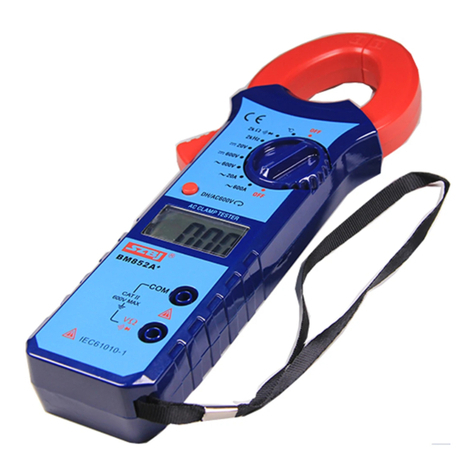
(1) Set the rotary switch at AC600A position.
(2) Press the trigger to open transformer jaw and clamp
one conductor only, making sure that the jaw is
firmly closed around the conductor. Read current
value on LCD display.
(3) If current under test is smaller, the lower range has to
be selected.
Note: a) Disconnect the test lead with the meter for
safety before this measurement.
b) If two or more conductors are clamped, the
meter will stop operating.
c) The accurate reading will be obtained by the
conductor across center of the transformer jaws.
4.5 Resistance Measurement
WARNING! When checking in-circuit resistance, be
sure the circuit under test has all power removed and all
capacitors have been discharged fully.
(1) Set the rotary switch at 2000 position.
(2) Connect the red test lead to “V/” jack and the black
test to the “COM” jack.
(3) Connect test leads across the resistor to be
measured and read LCD display.
(4) When at open circuit or over-range condition, “1” will
be displayed.
4.6 Diode Measurement
(1) Set the rotary switch at position. When the
input is not connected, i.e. at open circuit, the figure
“1” will be displayed.
(2) Connect the red test lead to “V/” jack and the black
test to the “COM” jack.(The polarity of red lead is
positive “+”)
(3) If diode test mode is selected, connect the red and
black leads to the anode and cathode of the diode,
the forward voltage drop of this diode will be
displayed in mV.
(4) The figure “1” will be displayed when the diode is
reversed under test.
4.7 Continuity Test
(1) Set the rotary switch at position. When the
input is not connected, i.e. at open circuit, the figure
“1” will be displayed.
(2) Connect the red test lead to “V/” jack and the black
test to the “COM” jack.
(3) Connect tip of the test leads to the points where the
conduction needed. If the resistance is under 50,
the buzzer will sound continuously.
Note: The circuit to be tested must in power off status
during the continuity check, because any load signals
may sound the buzzer and mislead the result.
Ⅴ. Maintenance of meter
Warning! Switch off the power, the meter
pens and any of input signals to prevent
electric shock before opening the cover of
meter or the cover of battery.
5.1 When the meter displays the symbol of “
”,
the battery should be changed. Open the battery cover,
and then change the used battery with two new 1.5V
batteries size 7(AAA) to ensure the normal operation of
the meter.
5.2 Keep the meter and the pens clean, dry and
non-destructive. Clean cloth or detergent may be used
for cleaning the cover of the meter. No grinding agent or
organic solvent can be used for the same cleaning
purpose.
5.3 The meter should be protected against damage,
vibration and impact. It shouldn’t be placed where high
temperature or intense magnetic field exists.
5.4 Calibrating of the meter is done on a yearly basis.
Ⅵ. Accessories
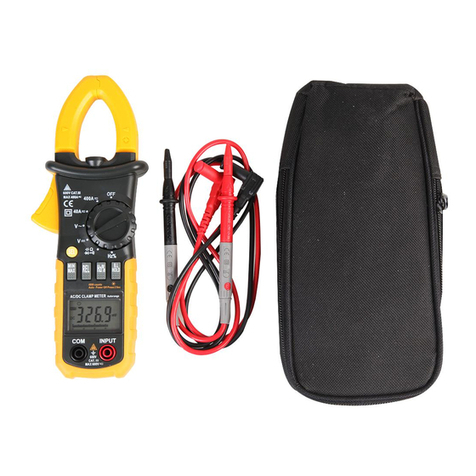
6.1 A pair of test leads
6.2 One instruction manual