2 3
www.tecnetusa.com
Government law restricts the operation of unlicensed radio transmitters within government
controlled territories.
Illegal operation is punishable by fine or imprisonment or both.
Refer service to qualified technicians only.
EXPLOSIVE ATMOSPHERES (GASES, DUST, FUMES, etc.)
Shut OFF the transceiver while refueling or while parked in gasoline service stations.
Do not carry spare fuel containers in the trunk of your vehicle if your transceiver is mounted in the
trunk area
INJURY FROM RADIO FREQUENCY TRANSMISSIONS
Do not operate your transceiver when somebody is either touching the antenna or standing within
two to three feet of it to avoid the possibility of radio frequency burns or related physical injury.
1. Safety / Warnings
Notices
The transceiver operates on 12V negative ground systems only! Check the battery polarity and
voltage of vehicle before installing the transceiver.
Power Cable Connection
Do not attempt to configure your transceiver while driving, it is dangerous.
This transceiver is designed for a 13.8V DC power supply. Don’t use a 24V battery including
over DC 16V supply to power on the transceiver.
Do not put the transceiver in excessively dusty, humid or wet areas, nor unstable surfaces.
Do not modify the transceiver for any reason.
Please keep it away from interferential devices (such as TV, generator, Medical devices etc.)
Do not expose the transceiver to long periods of direct sunlight nor place it close to heating
appliances.
If an abnormal odor or smoke is detected coming from the transceiver, turn OFF the power
immediately. Contact an Authorized Dealer.
Do not transmit with high output power for extended periods; the transceiver may overheat.
Do not operate the transceiver when vehicle engine is stopped for extended periods. The
vehicle engine may not be started due to low battery.
Do not use incompatible accessories from other manufactures. It could result in damage and or
malfunction to the accessory and or to the radio.
Precautions
Please read carefully the following precautions to prevent fire, personal injury, or transceiver
damage:
1. Check for an existing hole, conveniently located in the firewall, where the power cable can be passed through.
If no hole exists, use a circle cutter to drill a hole, then install a rubber grommet
2. Run the power cable though the firewall and into the engine compartment.
3. Connect the red lead to the (+) battery terminal and the black lead to the negative (-) battery terminal.
Place the fuse as close to the battery as possible.
4. Coil the surplus cable and secure it with a retaining band.
Be sure to leave enough slack in the cables so the transceiver can be removed for servicing while keeping
the power applied.
For passenger safety, install the transceiver securely using the supplied mounting bracket and
screw set so the transceiver will not break loose in the event of a collision.
When replacing the fuse in the DC power cable, be sure to replace it with a fuse of the same value.
Never replace a fuse with one that is rated with a higher value.
Installing the Transceiver
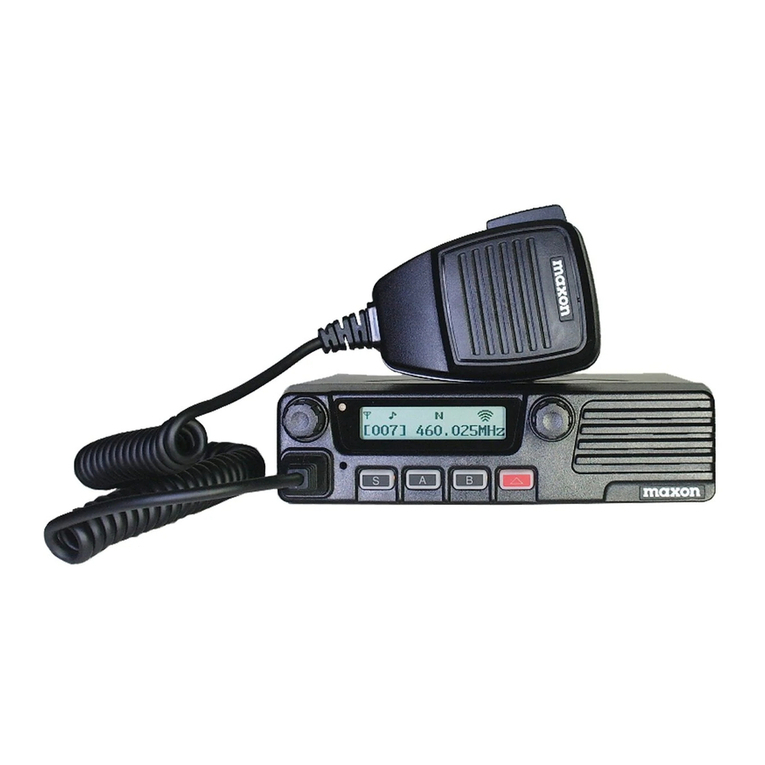
1. Mark the position of the hole in the dash, using the mounting bracket as a template. Using a 4.2mm (5/32 inch)
drill bit, drill the holes, then attach the mounting bracket using the supplied screws.
Mount the transceiver within easy reach of the user and where there is sufficient space at the rear of the
transceiver for cable connections.
2. Connect the antenna and the supplied power cable to the transceiver.
3. Slide the transceiver into the mounting bracket and secure it using the supplied hex-headed screws.
4. Mount the microphone hanger in a location where it will be within easy reach of the user.
The microphone and microphone cable should be mounted in a place where they will not interfere with the
safe operation of the vehicle.
Electronic equipment in your vehicle may malfunction if they are not properly protected from the
radio frequency energy which is present while transmitting.
Typical examples include electronic fuel injection, anti-skid braking, and cruise control. If your
vehicle contains such equipment, consult the dealer for the make of vehicle and enlist his/her aid
in determining if they will perform normally while transmitting
Preparation