
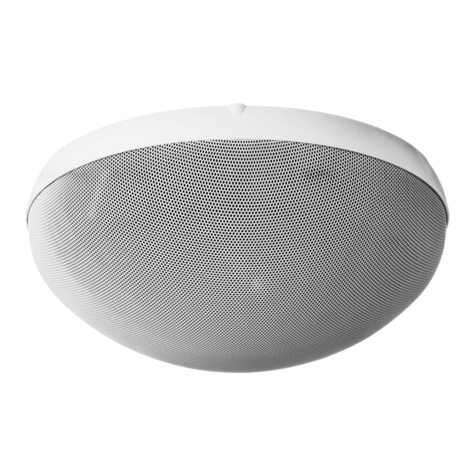
Toa H-2/WP User manual

OPERATING INSTRUCTIONS
H-2
H-2WP
SPEAKER SYSTEM
Please follow the instructions in this manual to obtain the optimum results from this unit.
We also recommend that you keep this manual handy for future reference.
TOA Corporation
2
3
3
3
4
8
9
9
10
10
11
11
11
12
12
TABLE OF CONTENTS
1. SAFETY PRECAUTIONS
2. GENERAL DESCRIPTION
3. FEATURES
4. HANDLING PRECAUTIONS
. NOMENCLATURE
6. INSTALLATION
6.1. Direct Wall/Ceiling Mounting
6.2. Mounting the Speaker using an Electrical Box
6.3. Mounting the Speaker using Supporting Rails
6.4. Removing the Front Grille
7. OUTDOOR USE (H-2WP ONLY)
7.1. Waterproofing
7.2. Speaker Mounting Angle
8. REPAINTING THE GRILLE AND TRIM PIECE
9. PROTECTION CIRCUITRY INFORMATION
10. EQUALIZATION
11. SPECIFICATIONS
Accessories

1. SAFETY PRECAUTIONS
• Be sure to read the instructions in this section carefully before use.
• Make sure to observe the instructions in this manual as the conventions of safety symbols and messages
regarded as very important precautions are included.
• We also recommend you keep this instruction manual handy for future reference.
Safety Sym ol and Message Conventions
Safety symbols and messages described below are used in this manual to prevent bodily injury and property
damage which could result from mishandling. Before operating your product, read this manual first so you are
thoroughly aware of the potential safety hazards as well as understand the safety symbols and messages.
Indicates a potentially hazardous situation which, if mishandled,
could result in death or serious personal injury.
Indicates a potentially hazardous situation which, if mishandled,
could result in moderate or minor personal injury, and/or property
damage.
WARNING
CAUTION
WARNING
CAUTION
When Installing the Unit
• Install the unit only in a location that can
structurally support the weight of the unit and the
mounting bracket. Doing otherwise may result in
the speaker falling down and causing personal
injury and/or property damage.
When the Unit is in Use
• Do not operate the speaker for an extended period
of time with the sound distorting. This is an
indication of a malfunction, which in turn can cause
heat to generate and result in a fire.
When the Unit is in Use
• Should the following irregularity be found during
use, immediately stop operating the unit and
contact your nearest TOA dealer. Make no further
attempt to operate the unit in this condition as this
may cause fire or electric shock.
• If you detect smoke or a strange smell coming
from the unit.
• If water or any metallic object gets into the unit
• If it is malfunctioning (no tone sounds.)
2

2. GENERAL DESCRIPTION
TOA's H-2 and H-2WP are small, dome-shaped 2-way speakers featuring high sound quality. The H-2 is
designed for indoor use, and the H-2WP is designed for outdoor use.
Note: Protect the H-2WP from rain when installing. (Refer to P. 10 "7.1. Waterproofing".)
3. FEATURES
• The speaker's smooth curved surface allows it to blend in with the interiors of most modern buildings.
• The speaker's small (10 cm) woofer features a magnetic circuit (employing a neodymium magnet) that
ensures powerful low-frequency sound reproduction.
• The one-inch balanced dome tweeter features ferro-fluid to ensure superb transient response characteristics
for clear, high frequency sound output and high power-handling capabilities.
• The speaker's built-in, crossover network circuitry features sharp cut-off characteristics that realize uniform
energy radiation while suppressing unwanted input signals to the woofer or tweeter.
• The speaker is designed with an emphasis on installation ease and safety, as well as easier conduit wiring
when an electrical box is installed.
• The speaker's round mounting base frame allows the speaker to be installed at any mounting angle.
Note: When mounting the H-2WP speaker to a wall, to ensure its watertightness it must not be tilted any
more than 4 degrees up from its downward-facing position.
• A built-in matching transformer permits the speaker to be used for both high- and low-impedance
applications. For low-impedance applications, either the 4 or 16 terminal can be selected. Impedance
can be easily changed from outside the unit.
• Detachable screw terminals facilitate connection. Dual positive and negative terminals also facilitate bridge
connections.
• The H-2's enclosure and front grille are made of fire-resistant ABS (UL Standard 94: V-0 Grade).
• The structure of the speaker's front grille is specially designed for ease of refinishing and repainting.
4. HANDLING PRECAUTIONS
• Avoid using the speaker on the beach because the speaker's life can be greatly shortened by sea breezes.
• The speakers are not magnetically shielded. Install them as far away as possible from television sets or
computer's CRTs to avoid degradation in picture quality.
3

5. NOMENCLATURE
[Front Panel]
[Side Panel]
Unit: mm
Front grille (grille frame)
Front grille (Grille)
[Side Panel]
Anti-slip piece
Accessory (Base frame)
[Rear Panel]
Aiming marker
Lock tab
[Installation Example]
4
Detachable input connector
Connector for impedance selection
(For mounting to
an electrical box)

6. INSTALLATION
6.1. Direct Wall/Ceiling Mounting
Step 1. Base frame mounting
1-1. Pull the cables out of the wall or ceiling through the
hole in the center of the base frame, then strip the
insulation back about mm from the cable ends.
Tip
• Usable cable: Solid cable or stranded cable (0.2
mm
2
- 2. mm
2
) (Corresponding to
AWG No. 24-14)
• The base frame hole can also be used for 1/2
EMT conduit fitting.
1-2. Secure the base frame to the wall or ceiling panel
with screws at four places shown on the right.
Notes
• Use nuts and bolts (not supplied with the unit) that
are appropriate for the structure and composition of
the wall or ceiling.
• Protect the H-2WP from rain when installing. (Refer
to P. 10 "7.1. Waterproofing".)
Step 2. Wiring and impedance changes
2-1. Unplug the detachable input connector from the
speaker socket, and with a small slot screwdriver,
loosen the screws of the terminals to use.
1/2" EMT conduit fitting
Base frame
About mm

2-2. Insert the stripped cable ends into the input
connector, and tighten the connector screws.
Note
When not bridging connections, be sure to also
tighten the screws of the terminals not in use to avoid
vibration or rattle noises.
• When not bridging
connections
• When bridging
connections
To next
speaker
From amplifier
2-3. Attach two impedance selector sockets to the 16-pin
connector to select the desired impedance. (Preset to
12 W for 100 V line and 6 W for 70 V line.)
Note
The speakers are designed to be used for both 70 V
and 100 V line applications. When using the 100 V
line, do not select the "420 " impedance, since the
speaker itself or power amplifier may be damaged.
• When selecting 830
(preset by the factory)
• When selecting 4
• When selecting 16
Impedance selector socket
2-4. Insert the detachable input connector into the
speaker socket.
6

Step 3. Speaker and grille mounting
3-1. Rotate the three speaker lock tabs away from their
locking position on the edge of speaker.
3-2. After aligning the speaker with the base frame, rotate
the three lock tabs back into position to clamp the
speaker to the base frame. (Temporary fixing state.)
Note
When mounting the speaker, do not touch its paper
cone, as permanent damage to the speaker may
result.
3-3. Position the speaker and tighten the three locking
screws.
Lock tab
Base frame
Base frame
Speaker system
Locking screw
Stud screw
7

3-4. Set the front grille's aiming marker to the speaker
front (i.e. speaker orientation) so that the three stud
screws align with the corresponding stud receptacles,
then push the grille onto the speaker.
Speaker front
Stud screw
Aiming marker
Stud receptacle
6.2. Mounting the Speaker using a Electrical Box
The speaker system can be mounted to walls or ceilings using a electrical box*. Mount the base frame to the
electrical box using two holes shown in the figure below. Further mounting procedures are the same as
detailed in Steps 2 and 3.
* Distance between mounting holes: 69.9 mm (2 ¾), 83.3 mm (3 9/32) or 88.9 mm (3 ½ )
• Mounting example 1
Base frame
• Mounting example 2
Memo
Electrical box mounting screws are attached to the speaker.
8

6.3. Mounting the Speaker using Supporting Rails
The speaker system can also be mounted to walls or ceilings using supporting rails. Mount the base frame to
the rails using four holes shown in the figure below. Follow Steps 2 and 3.
6.4. Removing the Front Grille
Be sure to use the front grille's three anti-slip pieces when
detaching the grille from the speaker. First carefully pull
the grille by hand from two positions, and then detach from
the one remaining position.
Caution
If you raise only one or two of the three anti-slip pieces,
the front grille may be broken. Be sure to pull its three
pieces out evenly and gradually.
Anti-slip piece
9

7. OUTDOOR USE (H-2WP ONLY)
7.1. Waterproofing
The H-2WP's base frame has a gasket for watertightness.
To completely prevent water from getting into a gap
between the base frame and wall or ceiling panel, apply
caulking agent over the inside of the gasket before
mounting the base frame.
7.2. Speaker Mounting Angle
When mounting the H-2WP speaker on a wall, to ensure
its watertightness it must not be tilted any more than 4
degrees up from its downward-facing position.
Notes
• The H-2WP features drip-proof construction. However,
do not dash water over it when cleaning as this may
cause damage to the speaker components.
• When installing the H-2WP outdoors in a snowy area,
protect the speaker so that it is not covered with snow.
Gasket
Caulking agent
10
Other manuals for H-2/WP
1
This manual suits for next models
1
Other Toa Speakers System manuals







Popular Speakers System manuals by other brands





Sondpex
Sondpex Active Speaker System and Digital Music... User manual and installation instructions

JVC
JVC NX-PN7 instructions

Marshall Amplification
Marshall Amplification AR-DM61-BT user manual

Yamaha
Yamaha NX-A01 - Speaker Sys Product bulletin
SE Audiotechnik
SE Audiotechnik I-LINE manual
Gemini
Gemini WRX-843 Series user manual