manuals.online logo
Brands
  1. Home
  2. •
  3. Brands
  4. •
  5. TriangleTube
  6. •
  7. Industrial Equipment
  8. •
  9. TriangleTube PSRKIT25 User manual

TriangleTube PSRKIT25 User manual

This manual suits for next models

9

Other TriangleTube Industrial Equipment manuals

TriangleTube Instinct 110 User manual

TriangleTube

TriangleTube Instinct 110 User manual

TriangleTube TTP Series User manual

TriangleTube

TriangleTube TTP Series User manual

TriangleTube MAXI-FLO MF 350 PT Series Manual

TriangleTube

TriangleTube MAXI-FLO MF 350 PT Series Manual

TriangleTube PRESTIGE Excellence Series User manual

TriangleTube

TriangleTube PRESTIGE Excellence Series User manual

TriangleTube INSRKIT124 User manual

TriangleTube

TriangleTube INSRKIT124 User manual

TriangleTube MAXI-FLO MF-135 Manual

TriangleTube

TriangleTube MAXI-FLO MF-135 Manual

Popular Industrial Equipment manuals by other brands

ABB Unifix AD Instruction handbook

ABB

ABB Unifix AD Instruction handbook

Mark 7 Evolution user manual

Mark 7

Mark 7 Evolution user manual

Husky HyPET Original instructions

Husky

Husky HyPET Original instructions

bora PM-1800 user manual

bora

bora PM-1800 user manual

Grizzly T32428 owner's manual

Grizzly

Grizzly T32428 owner's manual

Siemens 8MF1 Series operating instructions

Siemens

Siemens 8MF1 Series operating instructions

ABB HT610965 Operation manual

ABB

ABB HT610965 Operation manual

ABB SafeLink Installation and operating instructions

ABB

ABB SafeLink Installation and operating instructions

Phoenix PHX-150 user guide

Phoenix

Phoenix PHX-150 user guide

ABB A165-L32 Operation manual

ABB

ABB A165-L32 Operation manual

ABB HT842936 Operation manual

ABB

ABB HT842936 Operation manual

Hermetica 10 Series user manual

Hermetica

Hermetica 10 Series user manual

HORNER OEE Solution manual

HORNER

HORNER OEE Solution manual

Hammerhead HG375 parts manual

Hammerhead

Hammerhead HG375 parts manual

SCHUNK VERO-S NSE-A3 138 Assembly and operating manual

SCHUNK

SCHUNK VERO-S NSE-A3 138 Assembly and operating manual

ABB HT566657 Operation manual

ABB

ABB HT566657 Operation manual

Webasto GSE CAN installation guide

Webasto

Webasto GSE CAN installation guide

ABB HT614003 Operation manual

ABB

ABB HT614003 Operation manual

manuals.online logo
manuals.online logoBrands
  • About & Mission
  • Contact us
  • Privacy Policy
  • Terms and Conditions

Copyright 2025 Manuals.Online. All Rights Reserved.

PRESTIGE Solo 60, 110, 175 and 250
HX Field Replacement Kit
1
Each Heat Exchanger (HX) Replacement Kit includes
the following items already installed on the heat
exchanger:
- Combustion chamber insulation
- Burner head and gasket
- Sight glass assembly
- Burner mounting plate gasket
The following items are shipped in a PARTS BOX and
must be installed as part of the HX replacement:
- Vent outlet gasket
- Blower gasket
- Boiler piping gaskets
- Long handle phillips head screwdriver
- Long handle T-20 Torx screwdriver
- Igniter, igniter gasket, screws
- Temperature sensors and harness adapters
Recommended tools:
A. Pipe wrenches
B. Phillips and flat head screw drivers
C. 10 mm socket and/or 10 mm wrench
D. Adjustable wrench
E. Needle nose pliers
F. Diagonal cutting pliers
G. Calibrated combustion analyzer
Quantity Kit Part
Number
Description Model
P 110 Natural Gas
tainless teel
Condensate Pan
PT 110 Natural Gas
Polypropylene
Condensate Pan
P 60 (Nat. & LP)
/ P 110 LP
tainless teel
Condensate Pan
PT 60 (Nat. & LP)
/ PT 110 LP
Polypropylene
Condensate Pan
P 175 & PT 175
(Nat. & LP)
Both Condensate Pans
P 250 & PT 250
(Nat. & LP)
Both Condensate Pans
1 P RKIT01 Heat Exchanger Assembly X
1 PTRKIT124 Heat Exchanger Assembly X
1 P RKIT76 Heat Exchanger Assembly X
1 PTRKIT125 Heat Exchanger Assembly X
1 P RKIT25 Heat Exchanger Assembly X
1 P RKIT26 Heat Exchanger Assembly X
Indicates a potentially hazardous situation
which, if ignored, can result in serious injury
or substantial property damage.
Indicates special instructions on installation,
operation or maintenance, which are impor-
tant to equipment but not related to personal
injury hazards.
NOTICE
WARNING
For your safety, turn off electrical power sup-
ply at service panel and allow unit to cool
before proceeding to avoid possible electrical
shock and scald hazard. Failure to do so can
cause severe personal injury or death.
Use a two wrench method when tightening piping
onto the boiler piping connections. Use one
wrench to prevent the boiler piping from turning /
twisting. Failure to support the boiler piping and
connections in this manner could cause damage to
the boiler and its components.
Failure to follow instructions below can result
in severe personal injury or damage if ignored.
• Instructions are for a qualified installer/
service technician only.
• Read all instructions before proceeding.
• Follow instructions in proper order.
WARNING
WARNING
WARNING
Preliminary Instructions
1. Verify that the heat exchanger kit is correct for
the model of boiler. See table on page 1.
2. Turn off power to the unit at the main service
panel and allow the unit to cool.
ELECTRICAL SHOCK HAZARD!
Ensure power to the boiler has been switched off
prior to servicing the unit.
3. Remove the front jacket panel of the boiler by
removing the thumbscrew located on the upper
edge of the unit. Lift the panel up and pull for-
ward to remove the front panel from the unit.
4. Using a voltmeter verify there is no electrical
power to the boiler by checking for power on
the boiler’s power supply terminals L and N
5. Shut off gas supply to the inlet of the unit at the
external main manual shutoff valve.
6. Close external system isolation valves to the
boiler supply and return piping and on the sys-
tem make up / fill piping.
7. Attach a hose to external boiler drain. Place
other end of this hose to a suitable drain.
8. Open external boiler drain valve and begin
draining the boiler.
To assist in the draining of the boiler, remove the
air vent at the top of the unit or manually lift
open the pressure relief valve.
NOTICE
WARNING
PRESTIGE Solo 60, 110, 175 and 250
HX Field Replacement Kit
2
4
5
3
2
1
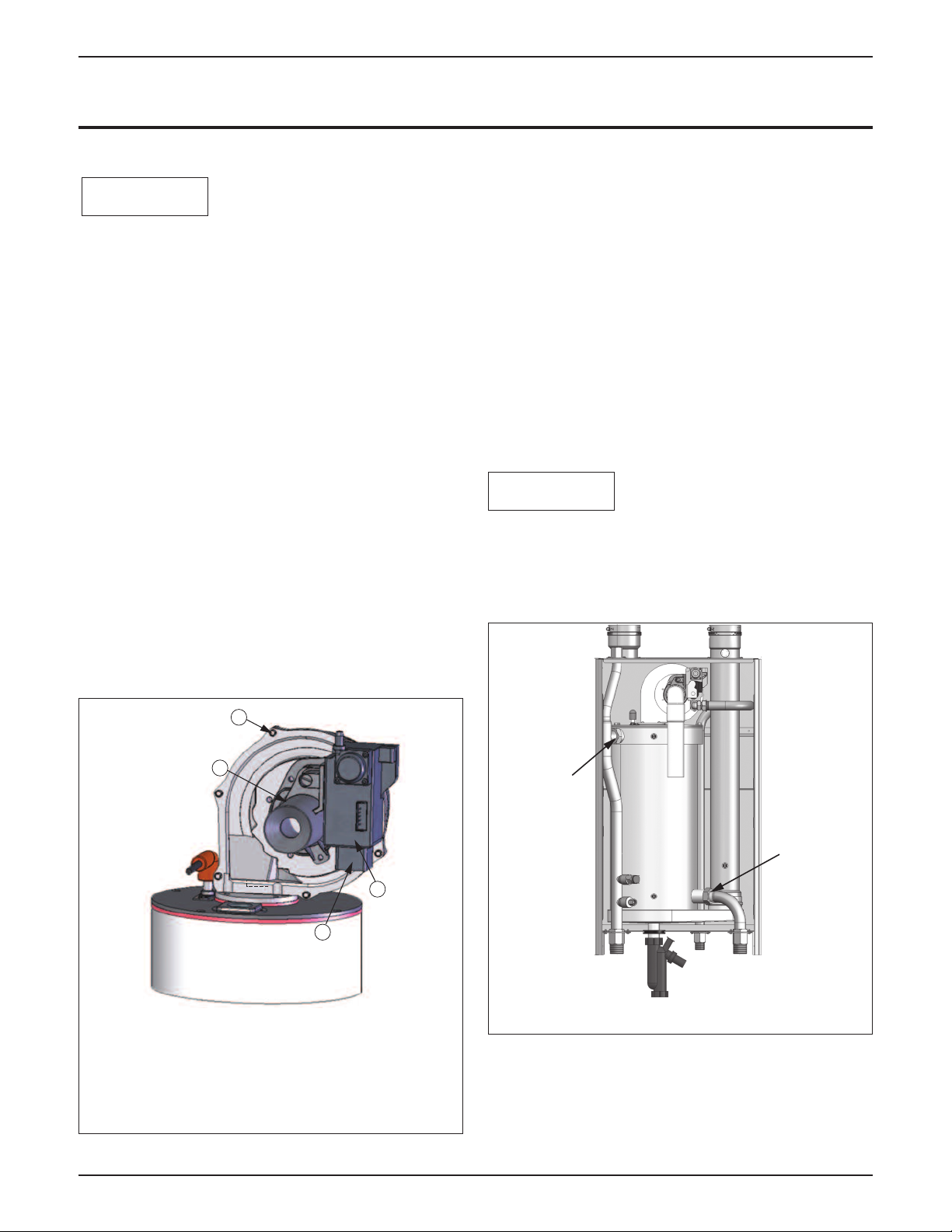
Fig. 1: Prestige Solo 60
4
5
3
1
Fig. 2: Prestige Solo 110
Removal of Venting Connection
1. Use a flat head screw driver to loosen the banding
clamp located on the vent outlet adapter. (Fig. 4).
2. Remove vent piping from vent outlet adapter as
the internal flue tube / vent outlet adapter must be
removed.
3. Disconnect the yellow wire leads/ olex plug
from the flue temperature sensor (shown as
Item 1 in Figs. 1-3). The flue temperature sen-
sor may be located in the vent pipe or the con-
densate pan depending on the model. Use care
when disconnecting the wire leads as not to
damage the sensor terminals or the wire leads.
Before disconnecting any wire connections mark
and label all connections and location of the con-
nections.
Stainless Steel Vent Outlet Adapter Removal
1. Dismount the vent outlet adapter from top of boil-
er cabinet by removing the 4 mounting screws.
Do not discard the mounting screws and vent out-
let adapter as they will be reused. (Fig. 4)
2. Remove entire vent outlet adapter by lifting ver-
tically upward and out of the boiler cabinet
using a twisting / rocking motion (Fig. 5).
NOTICE
PRESTIGE Solo 60, 110, 175 and 250
HX Field Replacement Kit
3
3
5
4
2
1
Fig. 3: Prestige Solo 175/250
Vent Outlet
Adapter
Test
Port
Banding
Clamp
Mounting
Screws
(4) Each
Vent Outlet
Adapter Gasket
Fig. 4: Vent Outlet Adapter Mounting
Vent/Heat
Exchanger
Gasket
Heat Exchanger
Adapter
Vent Outlet
Adapter
Fig. 5: Removal of Vent Outlet Adapter
PRESTIGE Solo 60, 110, 175 and 250
HX Field Replacement Kit
4
3. In case of insufficient space above the boiler,
remove combustion air inlet piping and boiler
relief valve / air vent assembly from the top of
the boiler. Remove all screws securing the top
jacket panel from the side panels and remove
vent outlet adapter and top jacket panel togeth-
er from the boiler cabinet. Put all items in a safe
place as they will all be reused.
4. Once the vent outlet adapter is removed from the
boiler, it should be inspected for deformation
damage or corrosion.
If there are any signs of deformation, damage or
corrosion on the vent outlet adapter, replace it
immediately. Check condition of flue sensor
mounting, replace vent outlet adapter if necessary.
Failure to comply could result in flue gas leakage
resulting in severe personal injury or death.
Polypropylene Vent Outlet Adapter Removal
1. Dismount the vent outlet adapter from top of boil-
er cabinet by twisting the vent outlet adapter
counter clockwise to disengage the retaining tabs.
Remove the vent outlet adapter by lifting verti-
cally to disengage it from the internal vent pipe.
2. Remove the internal vent pipe from the unit by
lifting vertically upward and out of the boiler
cabinet using a twisting / rocking motion.
Removal of Electrical Connections (MCBA)
Before disconnecting any wire connections mark and
label all connections and location of the connections.
1. Remove top access panel located above the heat
exchanger on the top jacket panel.
2. Remove ignition cable and green ground wire
from the igniter. (Fig. 6).
3. Disconnect the ignition cable from the CBA
control module and remove air intake pipe from
venturi. (Shown as item 2 in Figs 1-3). Place
the intake pipe and ignition cable aside, DO
NOT discard as they will be re-used.
4. Disconnect the electrical connection(s) for the
blower at the blower housing.
5. Remove the mounting screw and disconnect the
black rectifier plug from the gas valve.
6. Disconnect the grey flat ribbon cable from the
display board at the CBA control module.
7. Disconnect the orange low voltage and high volt-
age wiring terminal strips by unplugging the bot-
tom strips from the upper portion.
8. Remove the retaining screw for control mount-
ing panel and swing open the control mounting
panel. The high voltage and low voltage termi-
nals should pass through the lower cutouts of
the panel to allow movement of the panel.
9. Disconnect the red wire leads from supply tem-
perature sensor (Shown as item 3 in Figs 1-3)
located at the top of the heat exchanger.
10. Disconnect the blue wire leads from return tem-
perature sensor (Shown as item 4 in Figs 1-3)
located at the bottom of the heat exchanger.
NOTICE
WARNING
Ignition
Cable
Igniter
Venturi
Fig. 6: Top of Heat Exchanger

PRESTIGE Solo 60, 110, 175 and 250
HX Field Replacement Kit
5
11. Disconnect the orange wire leads from the Low
Water Cut-Off (LWCO) pressure switch
(Shown as item 5 in Figs 1-3). Use care when
disconnecting the wire leads as not to damage
the LWCO terminals or the wire leads.
Removal of Electrical Connections (TriMax)
Before disconnecting any wire connections mark and
label all connections and locations of the connections.
1. Remove top access panel located above the heat
exchanger on the top jacket panel.
2. Slide left and right tabs of control panel inward
and lower control panel.
3. Pull the retaining tabs on top of the rear cover to
remove the rear control box cover.
4. Remove green ground wire from the igniter and the
ignition cable from the Tri ax control module.
5. Remove air intake pipe (Shown as item 2 in
Figs. 1-3) from venturi. Place the intake pipe
aside, DO NOT discard as it will be re-used.
6. Disconnect the electrical connection(s) for the
blower at the blower housing.
7. Disconnect the olex plug from the gas valve.
8. Disconnect the olex plug from supply tem-
perature sensor (Shown as item 3 in Figs. 1-3)
located at the top of the heat exchanger.
9. Disconnect the olex plug from return temper-
ature sensor (Shown as item 4 in Figs. 1-3)
located at the bottom of the heat exchanger.
10. Disconnect the orange wire leads from the Low
Water Cut-Off (LWCO) pressure switch
(Shown as item 5 in Figs. 1-3). Use care when
disconnecting the wire leads as not to damage
the LWCO terminals or the wire leads.
Removal of Gas Connection
1. Disconnect the gas supply piping inside the
boiler at the brass union located just below the
gas valve using two wrenches.
2. The gas piping can remain inside the boiler or
be removed for additional clearance / access.
Removal of Blower/Gas Valve/Venturi Assembly
1. Remove 4 blower mounting screws from the
burner plate using the extended Phillips/Torx
head screw driver provided in the kit and
remove the blower/gas valve/venturi. Gas
valve and venturi assembly can remain connect-
ed to the blower housing. Discard old blower
gasket. (Fig. 7).
NOTICE
Venturi/Gas Valve
Assembly
Blower
Blower
Gasket
Burner
Plate
Fig.7 Blower/Gas Valve and Venturi Assembly
PRESTIGE Solo 60, 110, 175 and 250
HX Field Replacement Kit
6
Removal of Water Connections
1. Remove condensate trap and cabinet gasket
from the boiler. Do not discard, as they will be
reused. Cut serrated washer on polypropylene
condensate pan to remove retaining nut.
2. Using a pipe or adjustable wrench, loosen the
brass union nuts located on the internal return
and supply connections of the heat exchanger.
3. Removal of the supply pipe requires the removal
of the piping support flange and the 2 mounting
screws (if present) along with the relief valve /
air vent piping. Do not discard the piping sup-
port flange and mounting screws. Once the
boiler supply and return piping are disconnect-
ed, discard the existing boiler piping gaskets.
4. Cut tie strap holding the heat exchanger in place
at the bottom of the unit (if present).
Removal of Heat Exchanger
Obtain assistance in lifting the heat exchanger
from the cabinet as 2 people will be required.
1. Remove the sheet metal “anti-bounce” bracket
insert (if present) from the upper mounting
brackets located behind the heat exchanger
(Fig. 8). This clip is used to avoid vertical
motion of the heat exchanger during transport
and is not required to be installed with the
replacement heat exchanger.
2. Lift the heat exchanger about 4” to 6” to disen-
gage from the rear jacket panel and clear the
condensate tube from the bottom panel. Tilt
heat exchanger forward from the top and care-
fully rotate it forward in order to remove from
the boiler cabinet.
Preparation of ew Heat Exchanger
Do not damage or throw away shipping box,
foam packs, and HX Tracking Form as all these
items are used to return the old heat exchanger,
if required for warranty evaluation.
1. Carefully open and unpack the PARTS BOX
from its shipping carton.
2 . Carefully remove heat exchanger from shipping
box. Do not discard packing materials, as the
shipping box should be reused to return the old
heat exchanger back to Triangle Tube if
required for warranty consideration.
3. Check new heat exchanger for any damage.
Check position of the flue gasket in the new heat
exchanger.
4. Install new temperature sensors with O-ring gas-
kets in return and supply sensing locations.
5. Install new temperature sensor with O-ring gas-
ket in flue sensing location (PSRKIT01 &
PSRKIT76 only)
6. Install the new igniter gasket and igniter in the
burner plate using 2 screws provided. Some heat
exchanger kits include two different style ignit-
ers. Install the same style igniter as originally
installed in the boiler. Tighten screws evenly.
See Table 2, page 14 for torque specifications.
NOTICE
NOTICE
Fig. 8: Heat Exchanger “Anti-bounce”
Bracket
PRESTIGE Solo 60, 110, 175 and 250
HX Field Replacement Kit
7
Installation of ew Heat Exchanger
Prior to installation of the new heat exchanger,
carefully check the interior of the boiler cabinet.
Dry the cabinet / insulation when signs of mois-
ture are present. Check integrity of all wiring.
Repair / replace when necessary.
1. Lift new heat exchanger into place by engaging
the rear HX brackets (top and bottom) into the
rear boiler jacket panel provisions.
Installation of Blower/Gas Valve/Venturi Assembly
1. ount the blower/gas valve/venturi assembly
on top of the heat exchanger. Use the new
blower gasket provided in the kit. Install 4 new
blower mounting screws ( 4 x 12) ensuring
they are properly tightened and the blower is
mounted securely to the burner plate (Fig. 9).
See Table 2, page 14 for torque specifications.
Installation of Water Connection
1. Connect boiler supply piping back to supply con-
nection of new heat exchanger. Use a new boiler
piping gasket provided in the kit between heat
exchanger and supply pipe. Tighten the brass
union nut ensuring a leak tight seal. (Fig. 10).
Reinstall piping support flange (if present).
2. Connect boiler return piping back to return con-
nection of new heat exchanger. Use a new boil-
er piping gasket provided in the kit between heat
exchanger and return pipe. Tighten the brass
union nut ensuring a leak tight seal. (Fig. 10).
Use care when tightening the heat exchanger
union nuts. If excessive torque is applied to the
union nut, damage can occur to the boiler piping
or the gasket seal resulting in leakage.
3. Install cabinet gasket where heat exchanger
condensate drain nipple penetrates the cabinet.
4. Install the condensate drain assembly as shown
in Fig. 11.
NOTICE
NOTICE
2
4
3
1
1. Gas Valve
2. Venturi
3. “Straight” Gas Valve Fitting
4. Blower
Fig. 9: Prestige Burner Assembly
Boiler
Supply
Piping
Union
Nut
Boiler
Return
Piping
Union
Nut
Fig. 10: Heat Exchanger Piping Union uts
PRESTIGE Solo 60, 110, 175 and 250
HX Field Replacement Kit
8
5. A new metal washer must be installed when
installing the condensate drain assembly onto a
polypropylene condensate pan. The new metal
washer must first be cut using a pair of diagonal
cutting pliers to make it into a split washer.
Insert the split metal washer into the retaining
nut and screw onto the condensate drain assem-
bly without rubber gaskets. Use the condensate
drain assembly as a tool to press the retaining
nut with split metal washer onto the polypropy-
lene condensate pan. Unscrew the condensate
drain assembly and proceed to the next step.
Ensure the installation of the condensate drain
assembly included the metal washer when
attaching to a polypropylene condensate pan.
Failure to comply could result in the trap assem-
bly dislocating from the boiler.
6. Slide the retaining nut, and rubber seals from the
condensate drain assembly over the heat exchang-
er condensate drain nipple. Connect the condensate
drain assembly to the retaining nut and tighten.
Ensure the condensate drain assembly contains
the plastic seated ball. Do not install the conden-
sate drain assembly if the ball is lost or missing,
replace the entire assembly.
Installation of Gas Connection
1. Install the gas piping inside the unit if it was
removed for additional clearance/access.
2. Connect gas piping to the gas valve at the brass
union located just below the gas valve. Tighten
the union using two wrenches. See Table 2, page
14 for torque specifications.
Installation of Stainless Steel Vent Outlet
Adapter
1. Ensure flue gasket is seated properly in the heat
exchanger adapter. Apply clean water to the bot-
tom of the vent outlet adapter and flue gasket.
(Fig. 12).
2. Insert vent outlet adapter through the top jacket
panel into the heat exchanger adapter. (Fig. 12).
Use a slight twist motion with a downward
force as it is inserted into the adapter. Ensure
the gasket remains seated in the heat exchanger
adapter.
WARNING
WARNING
Moisten
Gasket Prior
to Insertion of
Flue Tube
Vent
Outlet
Adapter
Ensure
Adapter is
Clean of All
Debris
Heat Exchanger
Adapter
Fig. 12: Heat Exchanger/Flue Tube Gasket
Flexible Tubing
(or 3/4 PVC/
CPVC Piping
to Drain)
Compression
Nut with
Rubber Seal
Fill Plug
with Vaccum
Break Port
Condensate
Drain Assembly
Plastic Ball
(Not shown)
Retaining Nut
Place the Metal
Washer and (2)
Rubber Gaskets
in this Order for
Proper Seal.
Fig.11: Condensate Drain Assembly
PRESTIGE Solo 60, 110, 175 and 250
HX Field Replacement Kit
9
3. In case of limited top boiler clearance, insert vent
outlet adapter through the removed top jacket
panel. Bring this entire assembly in place togeth-
er on top of the boiler side panels. Use a slight
twist motion with a downward force as the vent
outlet adapter is inserted into the heat exchanger
adapter. Ensure the gasket remains seated in the
heat exchanger adapter. Secure the entire top jack-
et panel to the side panels with the original screws.
4. Install new vent outlet gasket provided in the kit
in vent outlet adapter. Ensure the combustion test
port of the vent outlet adapter is facing toward the
front of the boiler. Re-use the existing 4 mount-
ing screws and secure vent outlet adapter to top of
boiler jacket panel. (Fig. 13).
If during the install of the flue tube into the heat
exchanger the flue gasket becomes dislodged, it
is extremely important that the install is halted
and the gasket is reseated in the adapter. Failure
to comply could result in leakage of flue prod-
ucts into the surrounding area resulting in death
or personal injury.
Installation of Polypropylene Vent Outlet
Adapter
1. Ensure flue gasket is seated properly in the heat
exchanger adapter. Apply clean water to the bot-
tom of the internal vent pipe. (Fig. 12)
2. Insert the internal vent pipe into the heat
exchanger adapter. Use a slight twist motion
with a downward force as it is inserted into the
adapter. Ensure the gasket remains seated in the
heat exchanger adapter.
3. Ensure flue gasket is seated properly in the top of
the internal vent pipe. Apply clean water to the
bottom of the vent outlet adapter.
4. Install the vent outlet adapter on top of boiler
cabinet by twisting the vent outlet adapter clock-
wise to engage the retaining tabs. Ensure the flue
gasket remains seated in the internal vent pipe.
5. Install new vent outlet gasket provided in the kit
in vent outlet adapter. Ensure the combustion
test port of the vent outlet adapter is facing
toward the front of the boiler. (Fig. 13)
If during the install of the internal vent pipe or
vent outlet adapter the flue gasket becomes dis-
lodged, it is extremely important that the install
is halted and the gasket is reseated. Failure to
comply could result in leakage of flue products
into the surrounding area resulting in death or
personal injury.
WARNING
WARNING
Ensure Adapter
is Clean of All
Debris
Gasket
Fig. 13: Vent Outlet Adapter Gasket
PRESTIGE Solo 60, 110, 175 and 250
HX Field Replacement Kit
10
Installation of Electrical Connections (MCBA)
1. Connect the orange wire leads to the Low Water
Cut-Off (LWCO) pressure switch.
2. Connect the Harness Adapter to the blue return
temperature sensor wires of the boiler wiring
harness using the included Wire Taps.
- Place the unstripped wire harness wire into
the run channel of the Wire Tap and close
the side cover (Fig. 14).
- Insert the Harness Adapter unstripped wire
into the Wire Tap and use pliers to squeeze
the U-Connection into the Wire Tap.
- Close the hinged cover and make sure it
latches.
- Plug the Harness Adapter into the return
temperature sensor
3. Connect the Harness Adapter to the red supply
temperature sensor wires of the boiler wiring
harness using the included Wire Taps. Follow
the Harness Adapter instructions above then
plug the Harness Adapter into the supply tem-
perature sensor.
4. Reconnect the yellow flue temperature wires to
the flue temperature sensor if the sensor was not
replaced. If the flue temperature sensor was
replaced, connect the Harness Adapter to the
yellow flue temperature sensor wires of the
boiler wiring harness using the included Wire
Taps. Follow the Harness Adapter instructions
above then plug the Harness Adapter into the
flue temperature sensor.
5. Connect the black rectifier plug to the gas valve
and secure with provided screw.
6. Connect the electrical connection(s) for the
blower to the blower housing.
7. Connect the green ground wire to the igniter
ground terminal.
8. Pass the orange low voltage and high voltage
wiring terminal strips through the lower cutouts
of the control mounting panel. Close the control
mounting panel and secure with the retaining
screw. Connect the orange low and high voltage
wiring terminal strips to the upper portion.
9. Connect the gray ribbon cable from the display
board to the CBA control module.
10. Connect the ignition cable to the igniter and the
CBA control module.
11. Install the air intake pipe back on the venturi air
inlet connection. ake sure the ignition cable is
secured with a cable tie to the air intake pipe. Also
make sure the ignition cable is not in contact with
any metal surfaces or routed over the sight glass.
12. Install top access panel located above the heat
exchanger on the top jacket panel.
Run Channel
Wire Harness
Adapter Wire
Wire Harness
Sensor Wire
U-Connection
Fig. 14: Harness Adapter Installation