Truma ZUC User manual

Zeitschaltuhr ZUC
+1h Day h+ m+
CH1 CH2 Reset 1 2
AUTO
CH2ON OFFCH1
AUTO
O
F
F
O
N
O
N
O
F
F
AM
PM
FIX
FIX
FIX
FIX
+1h MO TU WE TH FR SA SU
Seite 1
Page 7
Page 12
Pagina 17
Pagina 22
Side 27
Strana 32
34000-30900 · 11/99 · 2’B W · ©
Truma Gerätetechnik GmbH & Co
Postfach 1252
D-85637 Putzbrunn
Service
Telefon 49 (0) 89 46 17-142
Telefax 49 (0) 89 46 17-159
e-mail: [email protected]
http://www.truma.com

2
Gebrauchsanweisung
Kurzbeschreibung
Die Zeitschaltuhr ZUC für die
Heizungen Trumatic C 3400,
C 3402, C 6000 und C 6002 er-
möglicht auf Kanal CH1 jeweils
8 voneinander unabhängige Ein-
und Ausschaltzeiten für den
Heizbetrieb.
Auf Kanal CH2 können für eine
Nachtabsenkung der Raumtem-
peratur während des Heizbetrie-
bes ebenfalls 8 Ein- und Aus-
schaltzeiten eingegeben werden.
Wichtige Hinweise
1. Während der auf CH2 pro-
grammierten Zeiten wird die
Raumtemperatur um ca. 8°C
gegenüber dem am Raumther-
mostat eingestellten Wert abge-
senkt (dieser Wert ist werkseitig
eingestellt und läßt sich bei Be-
darf ändern). Das Ein- oder Aus-
schalten der Heizung ist über
CH2 nicht möglich.
2. Das Zusammenlegen von Ein-
und Ausschaltzeiten durch Block-
bildung spart Speicherplatz.
3. Die Schaltuhr ZUC wird von
der Heizungselektronik mit 12 V
versorgt. Nach einer Unterbre-
chung der Stromversorgung (z.B.
Hauptschalter, Ausbau oder
Nachladen von Batterien) er-
scheinen im Display verschiede-
ne Symbole. Mit einem Bleistift
o.ä. die „Reset“ Taste einmal
kurz drücken, im Display er-
scheint OFF 00.00 und die
Schaltuhr ist wieder betriebsbe-
reit.
4. Erfolgt während des Betriebes
der Heizung über die Zeitschalt-
uhr eine Störabschaltung (rote
LED leuchtet), muß zum Zurück-
setzen der Störung die Taste 1
4 x gedrückt werden. Hierdurch
wird die Heizung aus- und wie-
der eingeschaltet.

3
Inbetriebnahme
Die Heizung Trumatic C kann am
Bedienteil oder an der Zeit-
schaltuhr (Taste 1) ein- und
ausgeschaltet werden. Wird die
Heizung über die Zeitschaltuhr
bedient, so muß der Schalter am
Bedienteil auf „AUS“ stehen.
Aktuellen Tag und Uhr-
zeit einstellen
Wird die aktuelle Zeit während
den Sommermonaten program-
miert muß zusätzlich die „±1h“
Taste gedrückt werden. Die Uhr-
zeit wird um 1 Stunde vorgestellt
und im Display erscheint eben-
falls „ 1h“.
Taste über die gesamte
Dauer dieses Einstellvorgangs
gedrückt halten.
Mit der Taste „DAY“ den aktuel-
len Wochentag und mit den Ta-
sten „h+“ und „m+“ die aktuelle
Uhrzeit einstellen.
Hinweis: Werden die Tasten
„h+“ oder „m+“ länger als
2 Sekunden gedrückt, so erfolgt
ein Schnellvorlauf der Ziffern.
Schaltzeiten
programmieren
Auf CH1 und CH2 stehen je 8
Ein- und Ausschaltzeiten zur Ver-
fügung (2 x 16 = 32 Speicher-
plätze).
Zur Eingabe der Ein- und Aus-
schaltbefehle für die Heizung, die
Taste „CH1“ drücken. Für eine
Temperaturabsenkung (während
des Heizbetriebes) die Taste
„CH2“ drücken.
Im Display erscheint:
CH1 ON --:-- bzw. CH2 ON --:--.
Jetzt mit den Tasten „h+“ und
„m+“ den Einschaltzeitpunkt
eingeben und mit der Taste
„Day“ den Tag aufrufen, an dem
der Befehl ausgeführt werden
soll. Nach dieser Eingabe die
Taste „CH1“ bzw. „CH2“ (wie
ursprünglich gewählt) erneut kurz
betätigen, damit der Einschalt-
bzw. Absenkbefehl in den Spei-
cher übernommen wird.
Im Display erscheint:
CH1 OFF --:-- bzw.
CH2 OFF --:--.
Wie bei der Einschaltzeit, jetzt
mit den Tasten „h+“, „m+“ und
„Day“ die entsprechende Aus-
schaltzeit eingeben.
Nach dieser Eingabe die Taste
„CH1“ bzw. „CH2“ erneut kurz
betätigen, Ausschaltzeit ist ge-
speichert.

4
Im Display erscheint jetzt
CH1 ON --:-- bzw. CH2 ON --:--.
Dieser freie Speicherplatz kann
für weitere Einschaltzeiten belegt
werden. Durch mehrmaliges
Drücken wird jeweils der nächste
freie Speicherplatz für einen
Schaltbefehl ON oder OFF aufge-
rufen. Freie Speicherplätze haben
auf die Funktion der program-
mierten Schaltzeiten keinen Ein-
fluß. Nach ca. 90 sek. schaltet
die Uhr automatisch oder durch
Drücken der Taste sofort auf
Normalanzeige um.
Blockbildung
Im Rahmen der Schaltzeitpro-
grammierung lassen sich Schalt-
befehle auch zusammenfassen.
Soll zur gleichen Zeit geschaltet
werden, läßt sich dies mit folgen-
den Wochentagsblöcken realisie-
ren:
tägliche Wiederholungen:
Montag bis Sonntag (Mo....Su)
nur an Werktagen:
Montag bis Freitag (Mo-Fr)
nur am Wochenende:
Samstag und Sonntag (Sa-Su)
Diese Kombinationen können
während der Programmierung
der Schaltzeiten mit der Taste
„Day“ aufgerufen werden (z.B.
Mo, Tu, We, Th, Fr). Die Schalt-
zeit, die auf diese Weise z.B.
Montag-Freitag, jeweils 13.00
Uhr ausgeführt wird belegt nur
einen Speicherplatz.
Schaltzustandsanzeige
Der aktuelle Schaltzustand
„ON“ = Ein oder „OFF“ = Aus
wird in Verbindung mit folgen-
den Symbolen:
Auto, , Fix,
CH1 (links), CH2 (rechts)
neben der Uhrzeitangabe im Dis-
play angezeigt.
Kontrolle und/oder
Änderung der eingege-
benen Schaltzeiten
Mit den Tasten „CH1“ bzw.
„CH2“ werden die eingegeben
Schaltzeiten nacheinander ange-
zeigt (Speicherkontrolle).
Die Änderung erfolgt durch
„Überschreiben“ der jeweiligen
Schaltzeit mit den „neuen“
Daten. Siehe: Schaltzeiten pro-
grammieren.

5
Handschalter/
Vorwahlschalter
Die Eingabetasten 1 und 2
haben jeweils 4 Funktionsstufen.
1x drücken:
Vorwegnahme des nächsten
Schaltbefehls ON bzw. OFF.
nochmaliges Drücken:
Konstantes Einschalten
-Schließer Ein-
Anzeige im Display: FIX ON
nochmaliges Drücken:
Konstantes Ausschalten
-Schließer Aus-
Anzeige im Display: FIX OFF
nochmaliges Drücken:
Rückkehr zum Automatikbetrieb.
Sommerzeit-Winterzeit
Umstellung
Von Winterzeit auf Sommerzeit:
Taste „±1h“ einmal kurz
drücken, im Display erscheint
das Symbol 1h.
Von Sommerzeit auf Winterzeit:
Taste „±1h“ einmal kurz
drücken, im Display erlischt das
Symbol 1h.
Einstellen der Absen-
kungstemperatur
Auf der Rückseite der Zeitschalt-
uhr ist ein Einstellregler. Werksei-
tig ist die Zeitschaltuhr auf die
maximale Temperaturdifferenz
von 8°C eingestellt. Durch Dre-
hen im Uhrzeigersinn bis An-
schlag kann die Temperaturdiffe-
renz auf ein Minimum von 2°C
eingestellt werden.
Löschen einer Schaltzeit
Ist ein Schaltvorgang zu löschen,
so ist im Minuten- und/oder
Stundenbereich das Symbol --
im Display aufzurufen.
z.B.: Schaltzeit 22.15 soll
gelöscht werden. mit Taste „h+“
solange drücken bis --:15 im Dis-
play angezeigt wird. (kann auch
im Minutenbereich vollzogen
werden: nach 22:59 erscheint im
Display 22:--). Die Teilangabe
bleibt im Speicher erhalten, ist
aber als Schaltzeit unwirksam
(Schaltvorgang wird nicht ausge-
führt).

6
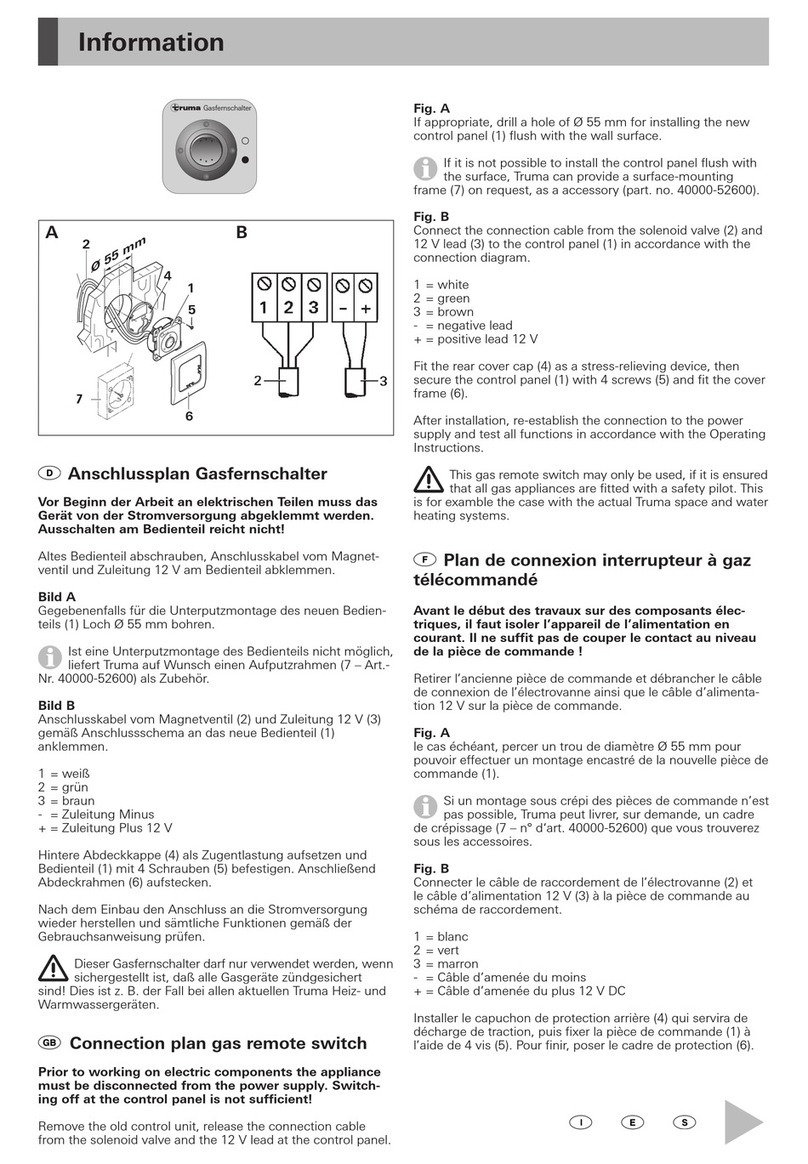
Ach ung: Vor Beginn der Monta-
ge muß die Versorgungsspan-
nung der elektronischen Steuer-
einheit abgeklemmt werden!
Ausschalten am Bedienteil reicht
nicht! Der Einbau unter Span-
nung kann die Zerstörung der
Zeitschaltuhr und der Heizungs-
elektronik zur Folge haben!
1. Einbauort festlegen, Loch
Ø 15 mm für die Kabeldurch-
führung bohren und Kabel durch-
stecken.
2. Zeitschaltuhr mit den 2 beilie-
genden Schrauben befestigen
und Anschlußkabel zur elektroni-
schen Steuereinheit der Heizung
führen.
3. Deckel der elektronischen
Steuereinheit abschrauben und
die Kabeldurchführung freilegen.
Stecker auf Zubehörstiftleiste
(15-polig) anstecken und Deckel
wieder aufschrauben.
Hinweis: Wird die Kabelverlän-
gerung 5 m (Sonderzubehör Art.-
Nr. 34000-38400) verwendet, so
muß die Verlängerung an der
Zeitschaltuhr aufgesteckt wer-
den. Das serienmäßige An-
schlußkabel 3 m dient dann als
Verlängerung zur Steuerelektro-
nik.
Abmessungen (H x B x T):
75 x 75 x 21 mm
S romverbrauch bei 12 V:
0,001 A
Anschluß-Kabellänge: 3 m
Kabelverlängerung: 5 m
Tempera urabsenkung:
max. 8°C
Umgebungs empera ur:
-20°C bis 55°C
Ganggenauigkei :
Typ. 2,5 Sek./Tag bei 20°C
Speicherplä ze je Kanal:
8 x Ein - 8 x Aus
Kürzes e Schal zei : 1 Min.
Programmierbar: jede Minute
Schal ungsvorwahl: ja
Handschal er: ja
Schal zus andsanzeige: ja
Spezialfunk ionen:
Wochentags-Blockbildung,
Tages- und Wochenprogramm,
Sommer-/ Winterzeit-Umschal-
tung
Einbauanweisung Technische Da en

7
Opera ing ins ruc ions
Brief Description
The ZUC timer switch for the
Trumatic C 3400, C 3402,
C 6000, and C 6002 heating
systems allows, on Channel
CH1, eight independent times
for switching heating operation
on and off.
On Channel CH2 inputs can be
made for a night-time reduction
in the room temperature during
heating operation, likewise with 8
on-and-off switching times.
Important Notes
1. During the periods program-
med under CH2, the room tem-
perature will be reduced by
about 8°C in relation to the value
set on the room thermostat (this
value is preset at the works, and
can be changed if required). It is
not possible to switch the hea-
ting on and off on Channel CH2.
2. Memory space can be saved
by compiling on-and-off swit-
ching times into block forma-
tions.
3. The ZUC timer switch is sup-
plied with 12 V by the heating
system electronics. After an in-
terruption to the power supply
(e.g. main switch, removal or
recharging of batteries), a variety
of symbols will appear in the dis-
play. Using a pencil or similar im-
plement, press the „Reset" but-
ton once briefly, and the display
will show OFF 00.00; the timer
switch is ready for operation
once again.
4. In the event of a fault dis-
connection (red LED lights up)
while the heating system is in
operation by means of the timer
switch, the button 1 must be
pressed four times to reset after
the fault. This will cause the hea-
ting system to be switched off
and then switched on again.

8
Taking into operation
The Trumatic C heating system
can be switched on and off at
the control panel or at the timer
switch (button 1). If the sy-
stem is operated via the timer
switch, the switch on the control
panel must be at „OFF“.
Setting current date
and time
If the current time needs to be
programmed during the summer
months, the „±1h“ button also
needs to be pressed. The time
will be advanced by one hour
and the symbol „ 1h“ will like-
wise be shown in the display.
Keep the button pressed
down throughout this adjustment
process.
Use the „DAY“ button to set the
current day of the week, and the
buttons „h+“ and „m+“ to set
the current time.
No e: If the buttons „h+“ or
„m+“ are pressed down for lon-
ger than 2 seconds, the figures
will advance rapidly.
Programming switching
times
There are eight on-and-off swit-
ching times available on CH1
and CH2 (2 x 16 = 32 memory
places).
To input commands for switching
the heating on and off, press the
button „CH1“. To reduce the
temperature (during heating ope-
ration), press „CH2“.
The display will show:
CH1 ON -:- or CH2 ON -:-
respectively.
Now enter the switch-on mo-
ment with the buttons „h+“ and
„m+“, and use the „Day“ but-
ton to call up the day on which
the command is supposed to be
carried out. After making this
input, actuate „CH1“ or „CH2“
again (as originally selected), so
that the commands for switching
on and off will be adopted into
the memory.
The display will show:
CH1 OFF -:- or
CH2 OFF respectively.
As with the switching-on time,
the appropriate switching-off
time is input with the buttons
„h+“, „m+“, and „Day“.

9
After making this input, actuate
the button „CH1“ or „CH2“
again briefly. The switching-off
time is stored.
The display will now show:
CH1 ON -:- or CH2 ON -:-
respectively.
This free memory space can be
allocated for additional switch-on
times. By repeated pressing, the
next free memory space for an
ON or OFF switching command
can be called up. Free memory
spaces have no effect on the
function of the programmed
switching times. After about
90 seconds, the timer will switch
automatically to normal time dis-
play, or immediately if the button
is pressed.
Block Formation
It is also possible for switching
commands to be compiled as
part of the switching time pro-
gramming. If it is intended that
switching should take place at
the same time, this can be done
with the following weekday
blocks:
Daily repetitions
Monday to Sunday (Mo...Su)
Weekdays only
Monday to Friday (Mo-Fr)
Weekends only
Saturday and Sunday (Sa-Su)
These combinations can be cal-
led up using the „Day“ button
during the programming of the
switching times (e.g. Mo, Tu,
We, Th, Fr). The switching time
which is carried out in this man-
ner, e.g. Monday-Friday, 13.00
hours in each case, occupies
only one memory space.
Switching state display
The current switching status
„ON“ = On or „OFF“ = Off
is displayed in conjunction with
the following symbols:
Auto, , Fix,
CH1 (left), CH2 (right)
next to the clock time input in the
display.
Checking and/or chan-
ging input switching
times
By using the buttons „CH1“ or
„CH2“, the switching times
which have been input can be
displayed one after another (me-
mory check).
Changes are carried out by „over-
writing“ the particular switching
time with the „new“ data. See:
Programming switching times.

10
Deleting a switching
time
If a switching procedure is to be
deleted, then the symbol -- is to
be called up in the display.
For example, the switching time
22.15 is to be deleted. Press but-
ton „h+“ until --:15 is shown in
the display (this can also be done
in the minute range; after 22:59,
the display shows 22:--). The part
data remains stored in the me-
mory, but does not take effect as
a switching time (switching pro-
cedure will not be carried out).
Manual switch/Preselect
switch
The input buttons 1 and 2
have four function stages in each
case.
Press 1 x:
Anticipates the next switching
command ON or OFF respec-
tively.
Press again:
Constant switch on
- Normally open contact On -
Display shows: FIX ON
Press again:
Constant switch off
- Normally open contact Off -
Display shows: FIX OFF
Press again:
Revert to automatic mode.
Summer time - Winter
time Switchover
From winter- to summer time:
Press button „±1h“ briefly once;
the display shows the symbol 1h.
From summer- to winter time:
Press button „±1h“ briefly once;
the display shows the symbol 1h.
Adjusting the tempera-
ture reduction
An adjustment control is located
on the back of the timer switch.
The timer switch is set at the
works to the maximum tempera-
ture differential of 8°C. By rota-
ting clockwise as far as the stop,
the temperature difference can
be adjusted to a minimum of
2°C.
Table of contents
Languages:
Other Truma Switch manuals