GMR-H and GMR40-H Disc Brake Caliper - Hydraulically Applied, Spring Released
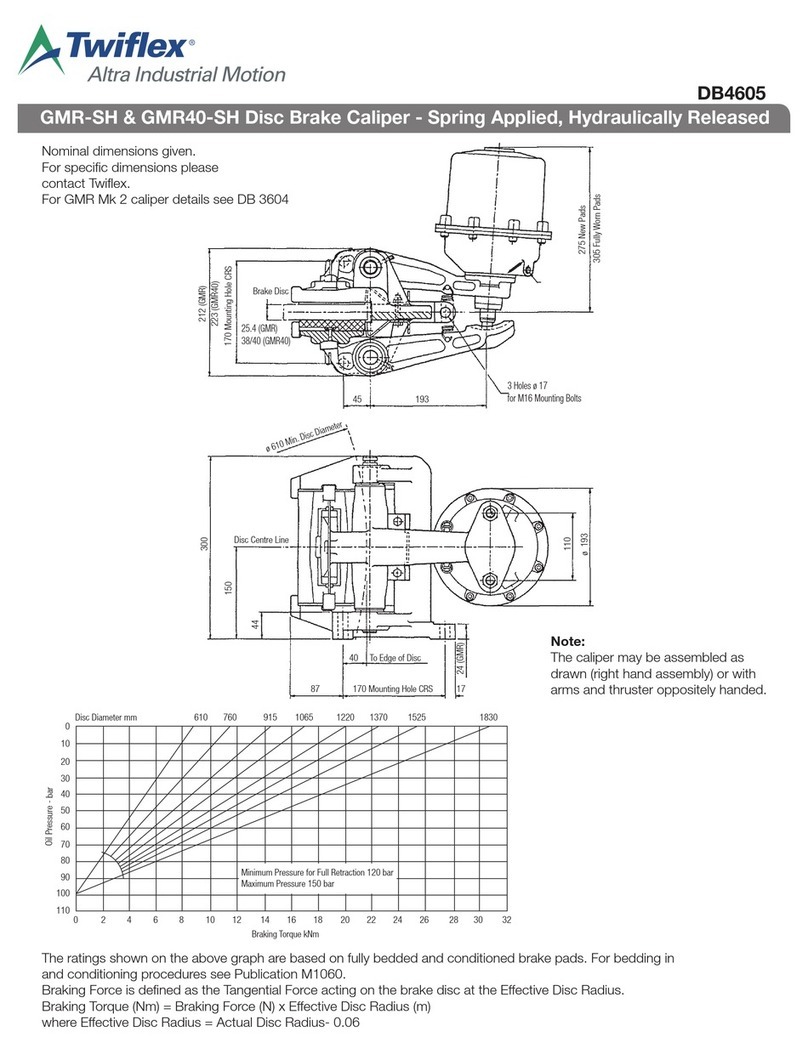
The GMR-H and the GMR40-H calipers are hydraulically applied and spring released. The braking force can be varied
between zero and 36kN maximum by changing the applied oil pressure (see Brake Performance Chart.)
Installation, Operation and Maintenance
1. Installation
1.1 The caliper must be mounted on a suitably rigid support, upon which braking forces of up to 36kN will be imposed.
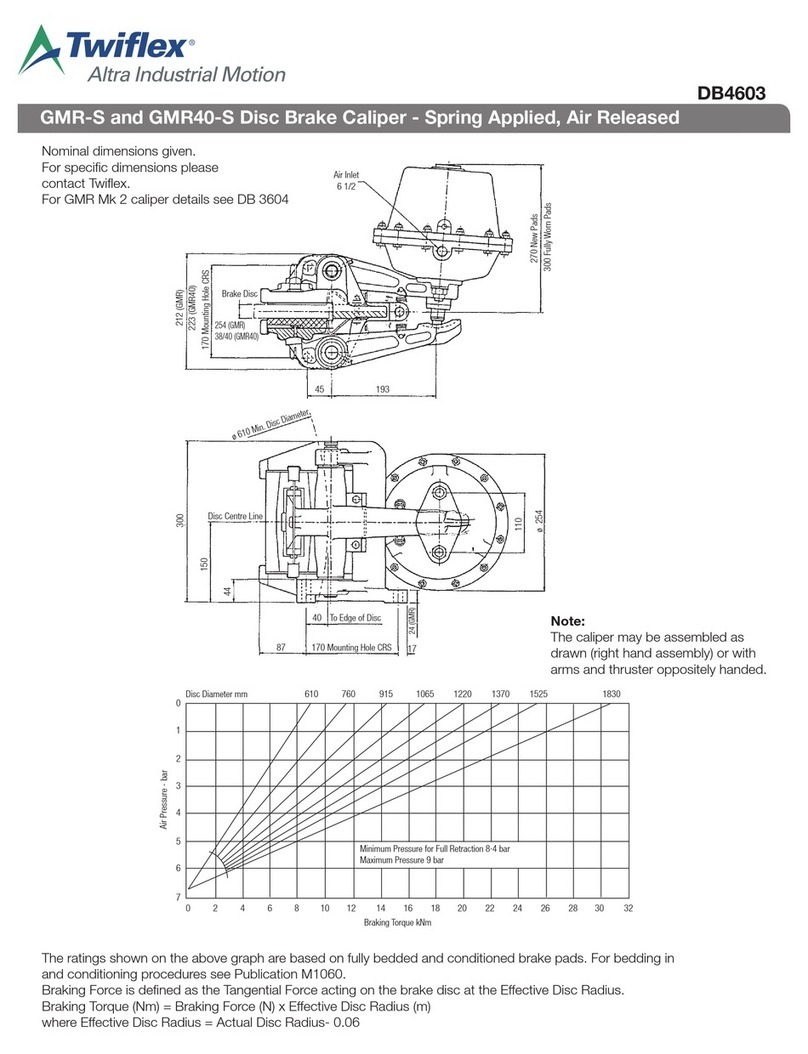
1.2 The caliper should be positioned symmetrically with respect to the disc, as shown on the drawing.
1.3 Three fixing bolts are required, M16 grade 8.8. The bolts should be tightened to a torque of 150Nm.
1.4 If the caliper is to be mounted on an inclined surface, the caliper should be fitted with adjustable stop screw
and bias springs, included in the inclined mounting kit (Part Number 6700458, drawing number A11362).
1.5 Calipers are normally supplied assembled ‘right-handed’, as shown on the drawing, unless otherwise specified.
1.6 The thruster is normally supplied separately from the calipe. Nuts, bolts and washers to fit the thruster to the caliper
arm are supplied for this purpose and should be tightened to 45Nm torque.
1.7 The hydraulic inlet connection on the thruster is tapped G 1/4 (1/4” BSP). The hydraulic supply should be connected
via a length of high pressure (175 bar) flexile hose to accomodate the movement during operation the volume
of hydraulic fluid required for 20mm stroke is 23 ml. Mineral based hyraulic fluids such (such as Shell Tellus 37 or
Catrol Hyspin AWS32) or mineral oil in water should be used.
IMPORTANT NOTE: Vegetable based fluids MUST NOT BE USED.
No special provision made for bleeding.
2. Operation
2.1 The brake is applied by the hydraulic pressure and retracted by the tension springs on the caliper and the internal
return spring in the thruster. Variable braking torque can be achieved by regulating the oil pressure as shown on
the charts. The braking force is proportional to the applied oil pressure. The normal maximum operating
pressure is 140 bar, corresponding to a tangential braking force of 36kN (with standard pads).
2.2 THE THRUSTER STROKE SHOULD BE MAINTAINED AT ABOUT 20mm BY UNSCREWING THE PUSHROD.
To adjust, the brake must be off (i.e. hydraulic pressure). Pull the caliper arm away from the pushrod and turn
the rod as required; one turn gives 2mm adjustment. Releasethe caliper arm, ensuring that the flats on the
push rod are engaged in the slot in the caliper arm. (A 17mm A/F spanner will fit the flats on the pushrod).
N.B. Keep fingers clear of the space between pushrod and caliper arm at all times.
2.3 If an inclined mounting kit is fiteed, the stop screw should be re-adjusted to maintain equal pad clearance on either
side of the disc.
2.4 Pad wear can be monitored by observing the gap between the lugs on the pad pressure plates and the adjacent
machined surfaces on the caliper frame, when the brake is applied. Pads must be replaced (see 3.2) before the gap
is reduced to zero. (The maximum allowable wear on a pad is 10mm).
3. Maintenance
CALIPER
3.1 Ensure that the brake pad and disc remain tree from oil and grease. Clean the disc as require. If the pads
become contaminated they should be replaced. Carry out any periodic statutory testing that is required,
or otherwise check for satisfactory performance.
3.2 Pad replacement is carried out from the rear of the caliper; DO NOT release the spring clips which attach
the pressure plates to the caliper arms. With the brake off remove the caliper return springs and the keep plates.
If an inclined mounting kit is fitted, remove this also. Withdraw the pads to the rear and lift out. (The hole in the end
of the pad retaining plates is provided to assist in withdrawing the pads). Fit the new pads (part number 7080080),
ensuring that the slotted retaining plate is located around the keep disc on the pressure plate; the pads should slide
freely into position. Replace remaining parts. Re-adjust the push rod, as in (2.2), and the stop screw if fitted (as in 2.3).
3.3 The surface of the caliper arm on which the thruster pushrod bears should be kept well greased. The
knuckle joints between the caliper arms and the pressure plates should be cleaned occasionally, and a
small amount of grease applied; the joints may be levered apart slightly against the pressure of the
spring clip. Occasionally, or if caliper is not operating freely, inject a small amount of grease via grease·
nipples to lubricate the pivot pins, then rotate pins to distribute the grease. Any grease exuding past the
‘0’-rings should be wiped off. The pins may be turned by gripping the knurled end at the top of the
caliper.