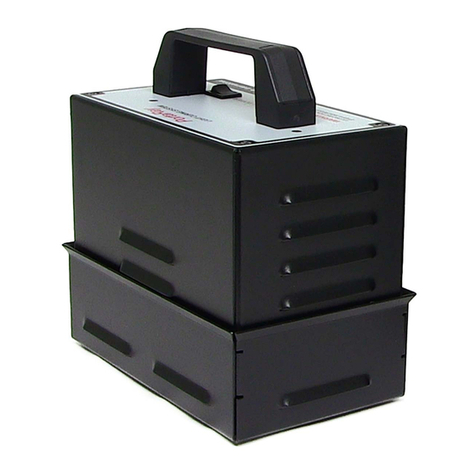
Uvitron International SUNRAY 400SM Instruction Manual, Rev. H
Page 8 of 23
4.1 Light Curing
Ultraviolet Light (UV) exists around us as one of nature's phenomenon, an example of which
is Ultraviolet (UV) rays produced by natural sunlight. Ultraviolet light can also be artificially
produced by an electrical arc lamp enclosed in special glass to allow it passage (a UV arc
lamp).
Reactive materials called photoinitiators are added to resins for adhesive bonding, coating,
sealing, and printing. Ultraviolet light will cure these adhesives by causing the liquid resin to
polymerize, thus becoming a solid. This could be compared to two part epoxies, which when
mixed in the proper proportions, turn from a liquid to a solid. Light curing resins, on the other
hand, are single component products ready to use as received without measuring or mixing,
and cure on-demand when exposed to UV light.
The photoinitiators added to the adhesive chemistry react to a specific range of light
wavelengths, and the speed of the reaction is governed primarily by the intensity (or
irradiance) of the light source for those wavelengths and by the chemistry of the adhesive.
Approximate adhesive cure time can be calculated as follows:
Curing Time [seconds] = Light Energy [Joules/cm2] / Light Intensity [Watts/cm2]
Adhesive manufactures typically specify the energy required for curing, or the required
intensity and time duration. For some adhesive types, the relationship between the speed of
curing and lamp intensity is not linear (doubling the intensity does not offer half the cure
time). The fastest and most complete reaction may occur at high peak intensity for a relatively
short period of time. This may be a more effective type of curing as compared to a similar (or
even a higher) dose of UV light, which is spread over longer period of time.
NOTE: Various types of adhesives, inks and coatings from different manufacturers
have different levels of reactivity which will require adjusting of exposure times for
proper curing. Consult with the adhesive manufacturer for appropriate cure times for
each type of material.
Light curable adhesives are typically cured using electromagnetic energy in the UV and
visible ranges of 250 to 450 nanometers (nm). It should be noted that ultraviolet light is easily
attenuated when attempting its transmission through any materials that are not extremely
transparent or optically pure. Even window glass will have reduced transmission or block
most UV wavelengths, and this attenuation is greater as wavelengths become shorter. For
this reason, applications that call for deep curing through thick adhesives layers require the
longer light wavelengths in the UV-A and visible ranges for maximum penetration. These
longer wavelengths are also required for curing through more opaque or colored adhesives
and substrate materials to reduce the affect of attenuation. Shorter wavelengths in the UV-B