15 EN
Disposal
D
14 EN
Cleaning and care
CC
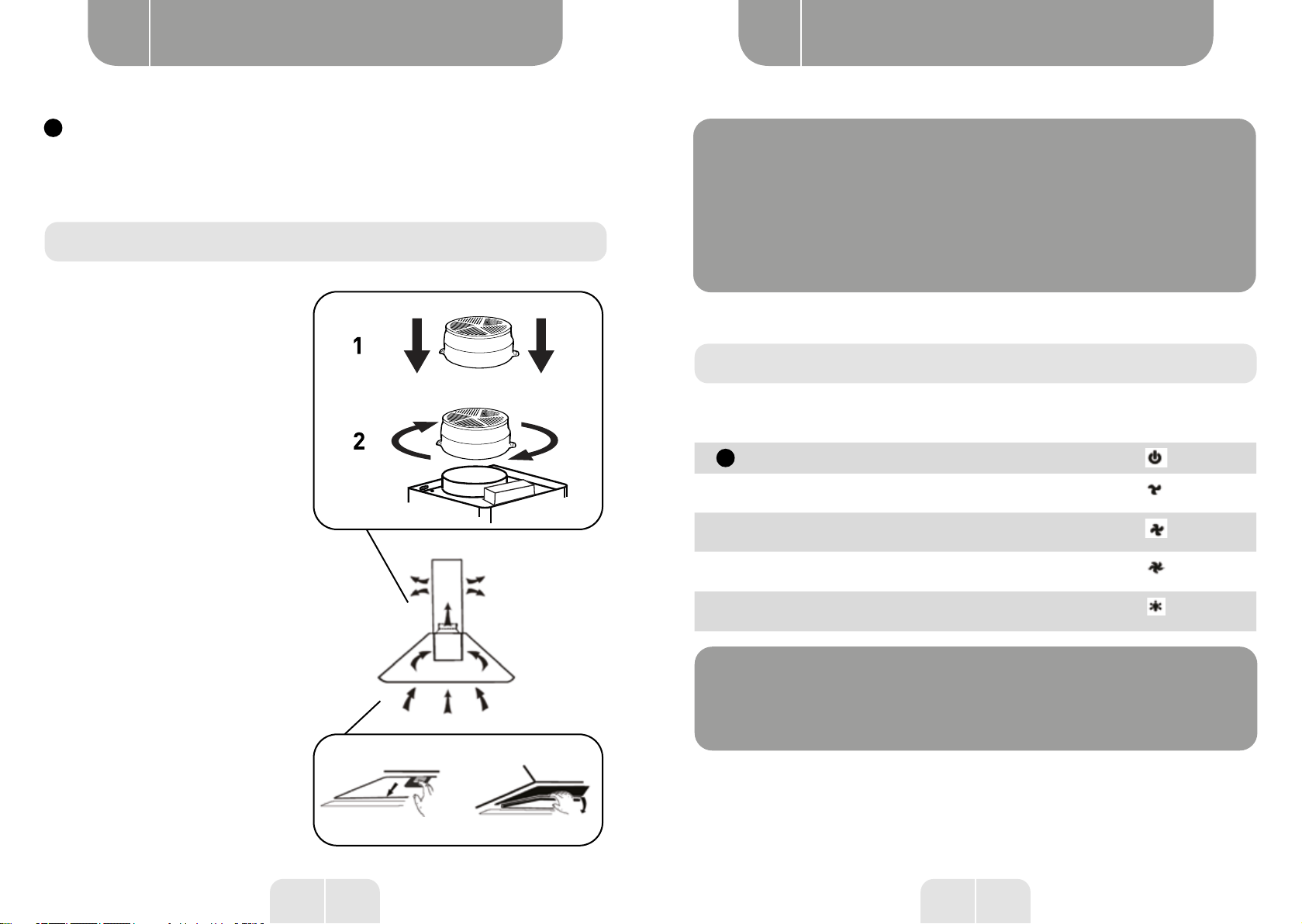
• Dismantle all the parts, complying strictly with the instructions for use when carrying
out maintenance work on the product.
• The eective operation of the hood depends on how frequently it is maintained, particularly
the anti-grease lter and the active carbon lter.
• The purpose of the anti-grease lter is to trap particles of grease suspended in the air.
It may therefore become blocked at dierent frequencies depending on the use of the
appliance.
• The anti-grease filters must be washed by hand using neutral, non-abrasive liquid
detergent or in the dishwasher at a low temperature and on a short cycle a maximum
of every 2 months to prevent the risk of re.
• The colour may change after several washes. This is not a viable reason for requesting
a replacement.
• The active carbon lters purify the air discharged into the room and mitigate the odours
produced by cooking.
• Non-regenerable active carbon lters must be replaced a maximum of every 4 months.
The active carbon saturation depends on the length of time during which the appliance
is used, the type of cooking and how often the anti-grease lter is cleaned.
• Clean the inside and outside of the hood frequently using a cloth dipped in denatured
alcohol or neutral non-abrasive detergent.
• The light is designed for use during cooking and not to light up the room for extended periods.
The average life of the light will be reduced considerably if it is used for extended periods.
CAUTION
Failure to comply with these hood cleaning and filter
replacement instructions could cause a fire hazard.
We therefore recommend that you follow the proposed
instructions.
Cleaning and care
Disposing of packaging materials
Packaging materials protect your appliance from damage that may occur during transport.
These materials are environmentally friendly since they are recyclable. Recycling materials
both saves raw materials and reduces waste production.
SELECTIVE COLLECTION OF ELECTRICAL AND ELECTRONIC WASTE
This device bears the WEEE symbol (Waste Electrical and Electronic Equipment),
meaning that at the end of its life, it should not be thrown away with household
waste, but dropped o at your local sorting centre. Waste recovery helps preserve
our environment.
ENVIRONMENTAL PROTECTION - DIRECTIVE 2012/19/EU
In order to protect the environment and our health, electrical and electronic appliances
must be disposed of at the end of their lifespan according to precise rules, which requires
the involvement of everyone concerned from the supplier to the user.
This is why your appliance must never be disposed of in a public or private refuse bin intended
for the household waste as indicated by the symbol on its label or packaging. The user may
dispose of the appliance at a public collection point where waste is sorted for recycling or
reuse for other applications in accordance with the directive.
Power down the appliance immediately. Disconnect the power supply and cut the electric
cable. Remove or destroy all hinged or spring fasteners before disposing of the appliance.
This prevents children from becoming stuck inside the appliance, which could put their life
at risk. For the safety of children, store your old appliances in a safe place until they are
disposed of, outside your home.
Packaging and the environment
Disposing of your old appliance