CS1 3 0
10/10/2014 © Vellem an nv
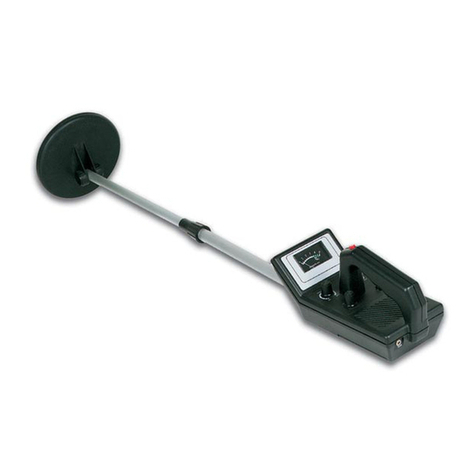
•Hold t he search coil [ I ] about 1 foot (30cm ) from the ground and press and hold the trace
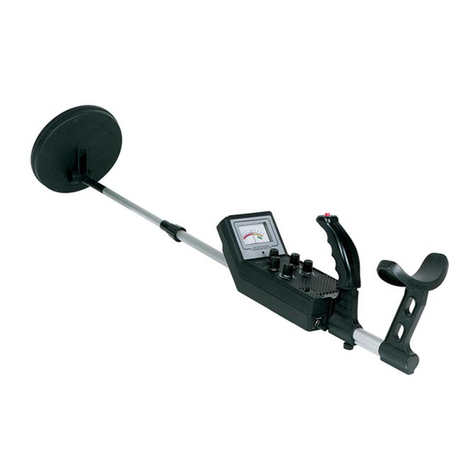
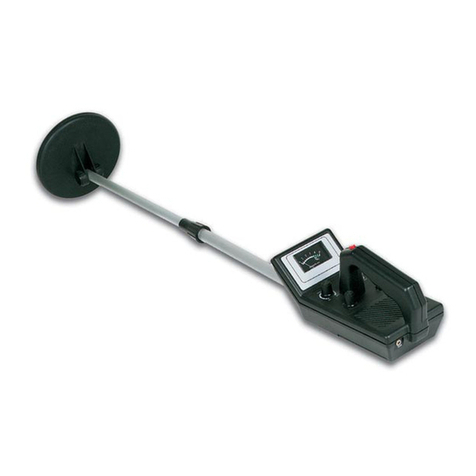
button on the handle [ B] .Turn the TUNE button [ 3 ] until the analogue meter [ 6 ] points to 0
(zero) . Release the trace butt on.
Note: Press the trace button whenever the det ector is drifting away from the sensitivity setting, e.g.
when m oving from dry ground to wet ground. This returns the m et er to zero.
•Slowly sweep the search coil over t he desired area. Refer to §10.
•Slowly turn the discrim ination control [ 5 ] clockwise. The furt her the button is t urned, t he m ore
m et als will be rej ect ed. Refer t o §6 how it w orks – phase shift for m ore inform at ion.
Note: press the t race button after each adjustment.
8 .1 I nterpreting signals
•The detector produces a signal as soon as it is swit ched on.
•The signal varies according to the detected object.
•For ferrous m et als, the tone will be low and the m eter m oves to the left.
•Non-ferrous m etals will produce a higher tone and the m eter m oves to the right.
Oscillating Signal
•An oscillating signal is caused m ost oft en by outside sources such as fluorescent lights, radios,
power lines and the proximity of other m etal detectors. There’s not m uch you can do about it.
I nterm ittent Signal from Speak er
An interm ittent signal can have several origins:
•This could be due to poor batt ery connections. Make sure the batteries are securely clipped in
place.
•A radio transm ission from a passing taxi or another vehicle using radio transm itter equipment.
•The speaker m ay have com e loose. Have your dealer fix the speaker back into place.
False signals
•The detector responds with a signal when it detects most valuable m et al obj ect s. I f a signal does
not repeat after you’ve swept the search coil over the target a few tim es, the target is probably
junk m etal.
•False signals can be caused by trashy ground, electrical interference, or large irregular pieces of
junk m etal.
•False signals are usually broken or non-repeatable.
9 . Recom m endat ions for use
•Treasure hunting can be a profitable and a rewarding hobby, if approached in a patient and
diligent m anner. Tim e spent researching to locat e a worthwhile search site can be tim e wasted if
your search is hasty and erratic. To achieve m aximum results, it is important to decide on your
approach to each particular site, before the act ual search.
•Tactics will be decided by the type of site – it is more profitable to scan a sm all area t horoughly
than to conduct a haphazard search of the total site. However, when the site is too far away for
you t o m ak e several ret urn visit s, a plan should be adopt ed which gives m axim um sit e coverage,
but at the sam e tim e allows som e detailed search.
•It quit e oft en happens that where one find is m ade, ot her finds will be m ade in t he im m ediat e
vicinity. Accordingly, places having the highest density of m arkers represent the m ost likely
spots for further finds.
•The det ailed search is m ade by m ar king out st rips of a width determ ined by the sweep of the
det ect or , and m oving forwards t he approxim at e diam et er of t he search head aft er each sweep
unt il t he ‘st rip’ has been com plet ely cov er ed. The adj acent st rips are covered in sim ilar m anner,
unt il t he com plet e area has been thoroughly searched.
•Wooden pegs and st ring ar e ideal for m arking out areas, but very oft en nat ural landm arks such
as trees, rocks and plants can with practice, prove just as effect ive.
10. Useful tips
•No detector is 100 percent accurat e. Various conditions influence m etal detection. The detector's
reaction depends on a num ber of things:
•the angle at which the object rests in the ground.
•the depth of the object.
•the am ount of iron in the object.
•the size of the object