Page 3
DESCRIPTION
DESIGN
Supplied By: Viessmann Ltd
Maximum inlet pressure to
Pressure reducing valve 12 bar
Operating pressure (PRV setting) 3 bar
Expansion vessel charge pressure 3 bar
Expansion relief valve setting 4.5 bar
Opening pressure of P & T Relief Valve 6 bar
Opening temperature of P & T Relief Valve 92-95°C
Energy cut-out thermostat setting 85°C
Max. working pressure - Primary heat exchanger (Indirect models) 6 bar
Max. working pressure - Solar heat exchanger (Solar models) 10 bar
Immersion heater rating 3kW, 240V AC
All cylinders are manufactured in accordance with the requirements of BS EN 12897
The tundish must be positioned so that it is visible to the occupant and is away from
electrical devices.
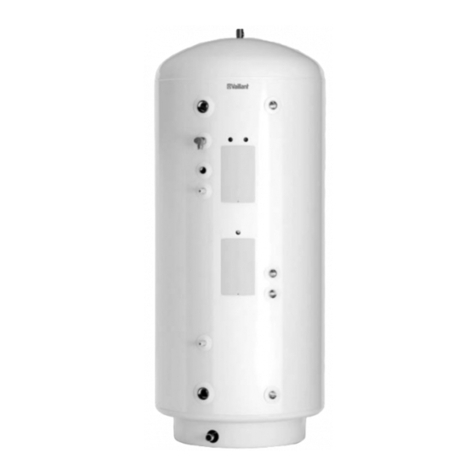
Components supplied with Viessmann Vitocell 200 cylinders
• Cold water inlet PRV combination valve/expansion relief
• Pressure and temperature relief valve
• Tundish
• 3kW Immersion heater including control and cut out thermostats
• Expansion vessel/mounting bracket/exible hose
• Cylinder temperature sensor and retaining clip (ZK00539)
• Technical/user product literature
Optional Extras
• Control thermostat
• Energy cut-out thermostat
• Energy cut-out motorised valve
(Note: Please refer to tables 1 and 2 on pages 6-9 to conrm the quantity of immersion
heaters supplied with the unit)
In any situation where the volume of heated pipework (eg. secondary circulation pipes
or manifold pipework for multiple units) exceeds 10 litres, then an additional expansion
vessel must be tted to accommodate the extra expansion volume.
Handling Before Installation
Viessmann Vitocell 200 Cylinder must be handled with care and stored the correct
way up in a dry place. Any manual handling/lifting operations will need to comply
with the requirements of the Manual Handling Operations Regulations issued by the
H.S.E. The appliance can be moved using a sack truck on the rear face although care
should be taken and the route should be even. In apartment buildings containing a
number of storeys we would recommend that the appliances are moved vertically
in a mechanical lift. If it is proposed to use a crane, expert advice should be obtained
regarding the need for slings, lifting beams etc.
A specic manual handling assessment is shown in Appendix B at the rear of this
manual.
Maintenance
Modifications should not be made to this
product. Replacement parts, including immersion
heaters, should be purchased from Viessmann
Limited, or agents approved by them. Unvented
hot water storage vessels need regular routine
checks, and these are detailed below. It is for
this reason that this manual must always be left
with the Viessmann Vitocell 200 Cylinder.
It is essential that these checks be carried out
at the time of boiler maintenance by a qualied
installer:
1. Manually open the relief valves in turn, and
check that water is discharged from the
valves and runs freely through the tundish
and out at the discharge point. Ensure that
the valves re-seat satisfactorily. (Note - the
water may be very hot).
2. It is important to check that the discharge
pipework is carrying the water away
adequately. Check for blockages etc. if it is
not.
3. Turn the mains water o and remove and
clean the strainer element in the Pressure
Reducing Valve.
4. Check the charge pressure in the expansion
vessel and repressurise if required
5. Re-ll the system and ensure that all relief
valves have re-seated.
6. The Benchmark Service Record should be
updated at each service.
7. Check the water pressure downstream of the
combination valve is 3 bar in static condition.
8. Check and if necessary, descale the heat
exchanger in hard water areas ie. above
200ppm (mg/l).
Note:
The cylinder is factory tted with a temperature
& pressure relief valve that must not be used for
any other purpose or removed.
The cylinder is factory tted with immersion
heaters with thermal cut outs. Immersions
without thermal cut outs must not be tted.