8
Functional Status Indicators:
‘Heating mode’: Indicator B will be lit up which means heating mode is on.
‘Memory function’: In the event of a power failure, the memory function will remember the
previous settings when coming on again.
Forced output: Make sure the receiver’s off and then press down the “Power button” for 8
seconds. Indicator A will light up and if you want to exit just simply press the “power button”
once more.
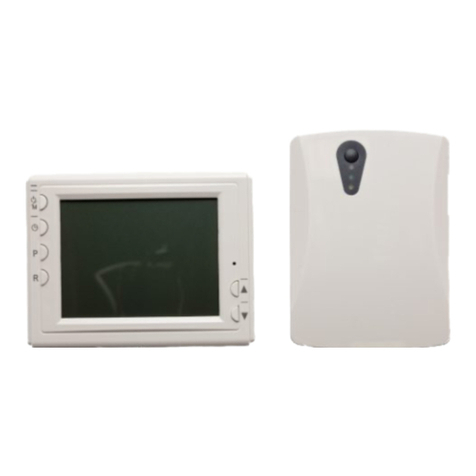
Transmitting signal: When an instruction has been inputted into the controller, indicator
C will flash 2 times on the receiver that means the transmitting signal is communicating
successfully.
Temperature Limitation:
When the temperature is below 5℃, the forced output will start to act as anti-frost
protection. When the temperature is up to 8℃, the forced output will be stopped. In the
event indicator B is rapidly ashing, this means the external sensor has been broken.
Setting the temperature limit - When the receiver has been running, press down the
“Power button” for 3 seconds, then the indicator A (Red LED) will chance to the green LED
flashing. This now means you can set the upper temperature limit for the controller.
•Limit 30℃:The green LED (indicator B) will be flashing.
•Limit 40℃:The yellow LED (indicator C) will be flashing.
•Limit 55℃:The green LED (indicator B) and the yellow LED (indicator C) will be
both ashing.
To then conrm your selection -Press the “Power button” to select the option which is one
of the three modes.
Make sure the receiver’s off, and
then press “Power button” for 3
seconds, the indicator C will be
illuminated.
Make sure the thermostat is off and
press down the button and for
se
3 conds, admitting into coding
status.
If connecting is successful, the
indicator C will flash 6 times and
then a brief code will appear
conrming connection being
successful.
If coding has been unsuccessful,
the thermostat will keep the original
coding value and you will need try
again.