INTRODUCTION
IOM-025 Page 4 of 14
IR-1; IR-2; IR-4; IR-6
Rev: C
Last Updated: 9/8/2009
1. GENERAL
1.1 Introduction
We appreciate your business and your choice of Welker products. The installation,
operation, and maintenance liability for this product becomes that of the purchaser at
the time of receipt. Reading the applicable Installation, Operation, and Maintenance
(IOM) Manual prior to installation and operation of this equipment is required for a full
understanding of its application and performance prior to use. If you have any
questions, please call 1-800-776-7267 in the USA or 1-281-491-2331.
The following procedures have been written for use with standard Welker parts and
equipment. Assemblies that have been modified may have additional requirements and
specifications that are not listed in this manual.
Notes, Warnings, and Cautions
Notes emphasize information or set it off from the surrounding text.
Caution messages appear before procedures that, if not observed, could
result in damage to equipment.
Warnings alert users to a specific procedure or practice that, if
not followed correctly, could cause personal injury.
1.2 Product description
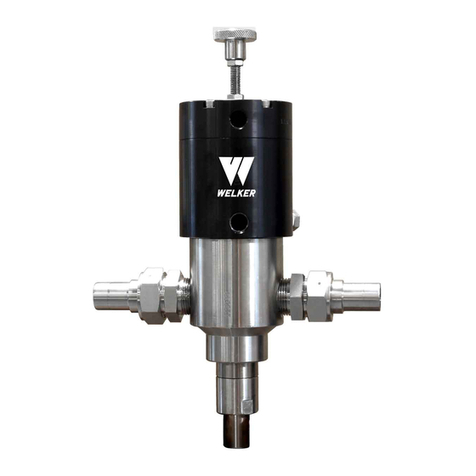
The Welker Instrument Regulators (IR-6, IR-4, IR-2 & IR-1 series) are designed to
provide an adequate output pressure for devices that are unable to sustain high
pressures. Pressure is reduced as it travels from the regulator’s inlet port to its outlet
port. In order to set the desired output pressure, an adjusting screw on the device is
tightened, pushing down on a spring inside the device. The spring then pushes down on
a piston or diaphragm, which, in turn, pushes against a poppet. When high pressure is
applied to the regulator’s inlet port, the poppet is moved up, allowing only the set
amount of pressure to pass through the device.
In addition to the inlet port, the instrument regulator has three common ports on the
body: the gauge, relief, and outlet. All ports are marked on the device accordingly. The
IR-6, IR-2 and IR-1 series regulators are equipped with a piston, while the IR-4 is
equipped with a diaphragm (see Figures 1 and 2). If the regulator is bolted together, it
has a piston assembly.
Model IR-1T is the exception, as it has a diaphragm and is bolted together.