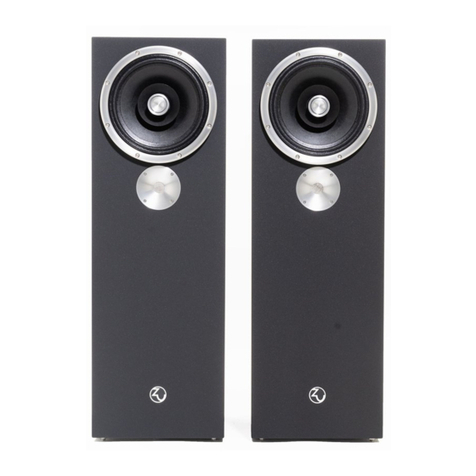
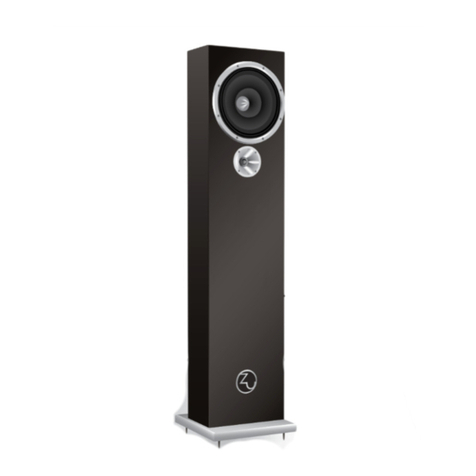
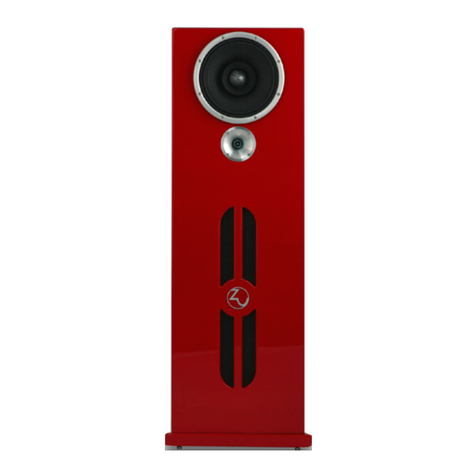
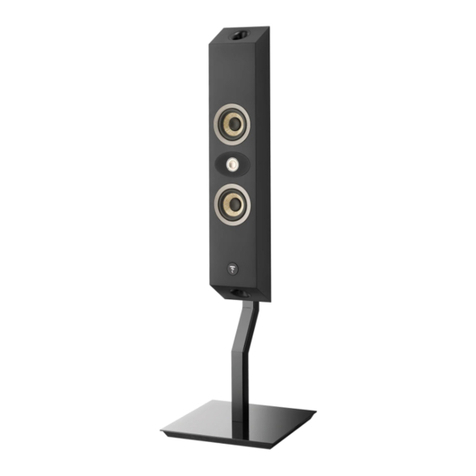
Thank you for your purchase of the Druid Center Mk4 / 08 loudspeaker. Every element is designed for a lifetime of trouble free high
performance playback. It is our desire to exceed your expectations in product performance, quality, durability and service. If we have
simply met your expectations or have fallen short, we would sincerely appreciate knowing how we may improve. Likewise, if we have
exceeded your expectations we hope to hear from you too.
Impressions of new realities struggle and flow—eventual transition.... Awareness of surroundings, songs of tranquility and warning—
history and intuition instruct that patterns of sound have been a fundamental constant. Observance of nature, both physical and
spiritual, teach us of the endless interplay of vibrational forces.
While traveling the line of time we can see many periods of increased awakening and technological advancement but none so
powerful and rapid as that of the Scientific Revolution, Enlightenment and the birth of modern physics. The dramatic increase of
understanding regarding possibility, vibration and energy coincide with our collective ability to listen and express patterns of life.
David Toop in his book Ocean Of Sound paints a powerful image of our modern musical creativity: “...Starting with Debussy in 1889,
is an erosion of categories, a peeling open of systems to make space for stimuli, new ideas, new now, this environment included
sounds of the world—previously unheard musics and ambient sounds of all kinds, urban noise and bioacoustics... unfamiliar tuning
system and structuring principles, improvisation and chance.”
Welcome to Zu,
Sean Casey, Adam Decaria, Chris Thiel, Marty Petersen, James Read, Randy Sandman, and the rest of the Zu team.
WARNING, electrocution through loudspeaker cable is possible (though very unlikely). To avoid electrocution make sure your
amplifying gear is powered down prior to connecting or disconnecting loudspeaker cables. This will also reduce the possibility for
accidental damage to your audio amplifier.
WARNING, the Druid Center loudspeaker drivers create stray magnetic fields that extend far beyond the boundaries of the cabinet.
We recommend you keep magnetically sensitive electronics and media at least 2.5 feet (76cm) from the loudspeaker.
WARNING, Druid Center loudspeakers are capable of extreme sound levels, play responsibly.
Included with each pair of Druid Center Mk4 / 08 loudspeakers
Installed user serviceable hardware: None.
Additional items included in package:
(1) connector polishing kit for copper lugs.
(1) loudspeaker finish care kit.
(1) Guidebook.
Unpacking
Cut banding wrap. Cut tape, open flaps.• Roll the box so the exposed Druid Center is now facing the floor, keeping flaps on the outside of box.• Lift box off the Druid Center.• Remove closed-cell foam plates.• Remove protective wrap.• Remove full-range driver protective cover.•
Connecting and placement
All connections should be made with the equipment switched off.
(+) mark on Druid Center input connectors correlates to positive (outward) driver diaphragm motion.
Druid Center loudspeakers are designed to be placed just below the viewing area. Druid Center should be placed in the center of the
left / right axis of the viewing area. The height should be as closely matched to the main left / right loudspeakers as practical. If you
have a quality acoustically transparent screen, Druid Center should be mounted behind the screen, centered to it but on the same
acoustic axis as the main left / right loudspeakers. It should also be the same distance (depth, Z axis) from the main seat as the left
/ right main loudspeakers.
Placing your center channel speaker much lower than (or higher than) the acoustic center of the left / right main loudspeakers will
decrease your chance for seamless channel fades—as will placing your center much closer or further in depth relative to your left /
right mains.
The face angle of the Druid Center should be perpendicular to the screen and point to the main listening spot. Canting is generally
unnecessary because of the coherent, phase accurate, 35 degree hemispherical wave-front.
All connections should be made with the equipment powered down. Make sure you connected the “+” output of the amplifier to the
“+” (red) input of the loudspeaker and the “–” to the “–”. The Druid Center features Cardas® pure copper unplated binding posts and
are internally terminated using a high pressure crimp system in place of solder. They accept standard and oversized spade lugs, bare
wire and banana plug. While they accommodate a wide array of terminals we recommend spade lugs with strong recommendation
on the use of our unplated pure copper spades. In the European countries, 4mm banana plugs are considered a safety hazard as
banana plugs can be inserted in to many European home power outlets. The binding posts featured on the Druid Center comply with
CE standards regarding loudspeaker binding post inputs and safety.
Break-in
All Zu loudspeakers shipped after September 31, 2006 are manufactured and processed under the Zu burn-in system. This new
aging process cannot be duplicated and ensures your Zu loudspeakers will sound their very best. All Zu loudspeakers now come with
at least 160 hours of conditioning. This puts the loudspeakers in a position to really sound good within a few days, great in a week or
two and awesome in the end. We do not recommend recordings specifically designed for loudspeaker, system or cable burn-in. The
quickest and most enjoyable way to finish the conditioning of your Druid Center loudspeaker is to play music and movie scores that
are fun, dynamic and harmonically dense. No longer do you need to worry about cranking them up either. Let your neighbors know
where they can send tips, that’s Zu in Ogden, Utah....
Break-in Phenomenon: A running-in of driver suspension components is the prime influencing factor in loudspeaker burn-in. Cone
and cabinet changes also happen with play. Another is cable burn-in. Druid Center loudspeakers all leave the shop with factory
burn-in. Loudspeakers generally go through two types of burn-in sound transformations. The first is mechanical effecting bass and
intimacy. We now take care of this at the factory. The second is electrical and primarily effects stereophonics and resolution. We start