manuals.online logo
Brands
  1. Home
  2. •
  3. Brands
  4. •
  5. ADTRAN
  6. •
  7. Network Hardware
  8. •
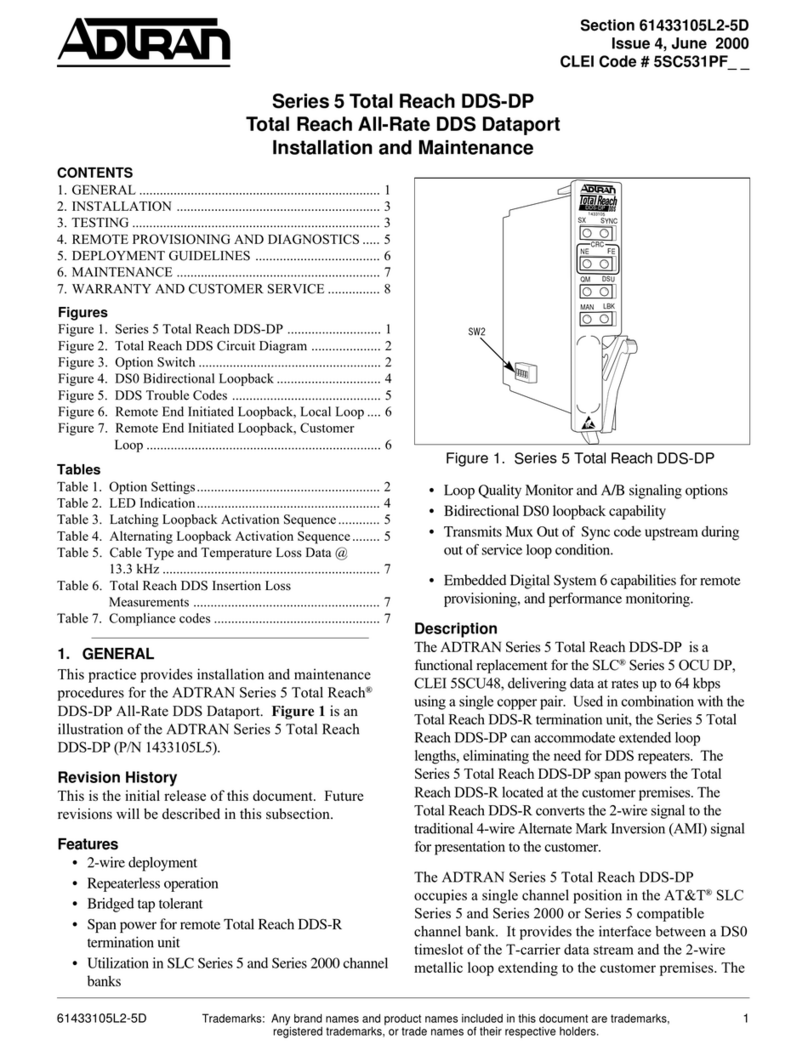
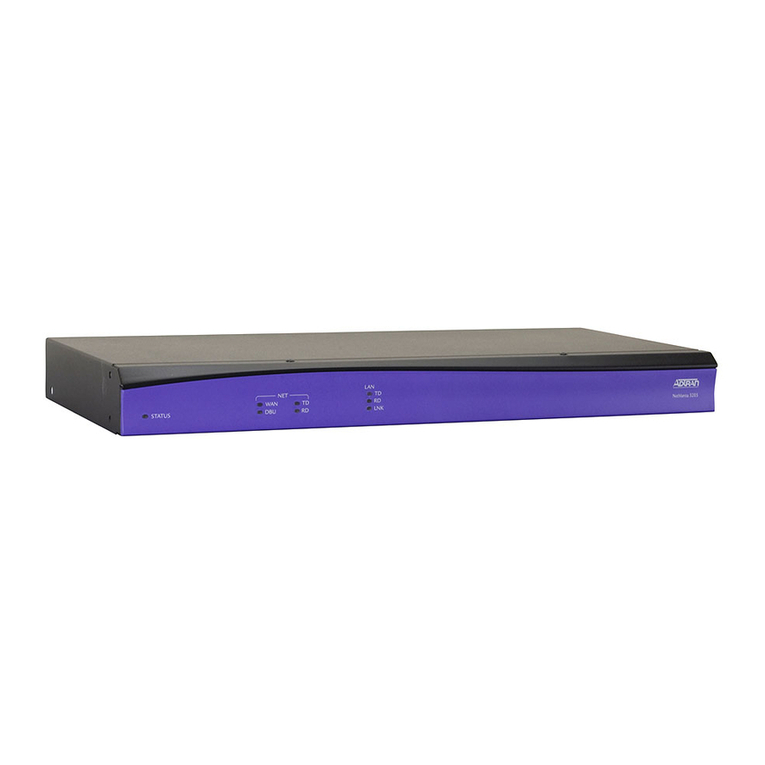
  9. ADTRAN TRACER 64 0 Series User manual

ADTRAN TRACER 64 0 Series User manual

This manual suits for next models

2

Other ADTRAN Network Hardware manuals

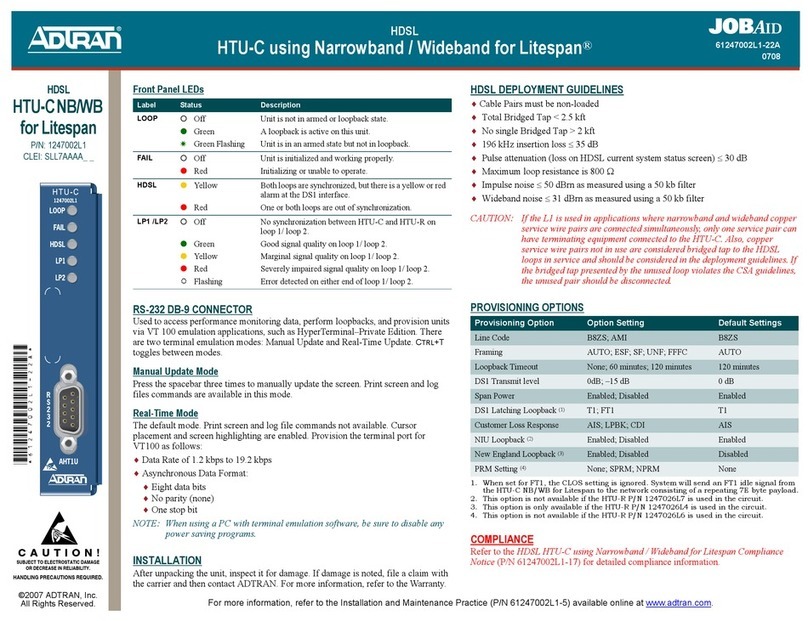
ADTRAN 1700900F2 User manual

ADTRAN

ADTRAN 1700900F2 User manual

ADTRAN 414 RG User manual

ADTRAN

ADTRAN 414 RG User manual

ADTRAN TSU ACE Service manual

ADTRAN

ADTRAN TSU ACE Service manual

ADTRAN Octal IDSL DSLAM Octal IDSL User manual

ADTRAN

ADTRAN Octal IDSL DSLAM Octal IDSL User manual

ADTRAN Total Access 334 User manual

ADTRAN

ADTRAN Total Access 334 User manual

ADTRAN 3192 User manual

ADTRAN

ADTRAN 3192 User manual

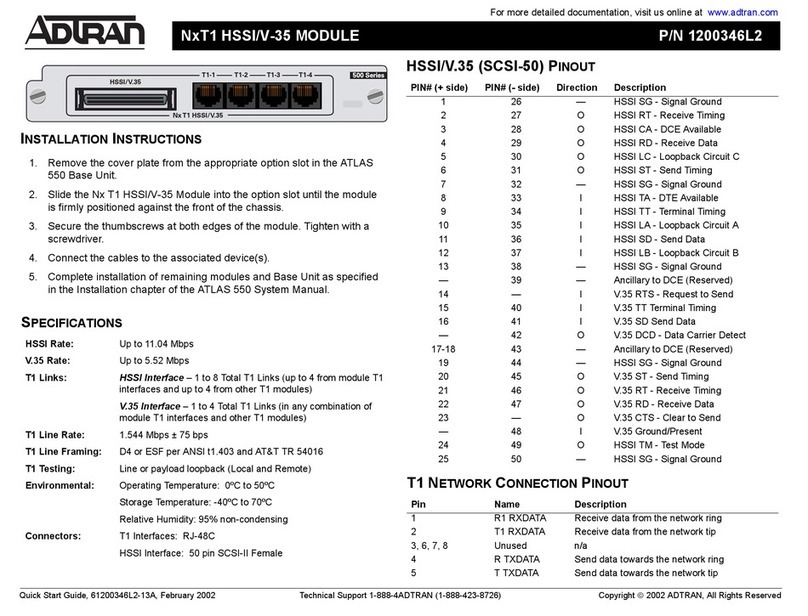
ADTRAN Quad T1 IMA Instruction Manual

ADTRAN

ADTRAN Quad T1 IMA Instruction Manual

ADTRAN MX410 User manual

ADTRAN

ADTRAN MX410 User manual

ADTRAN Smart 16e Shelf User manual

ADTRAN

ADTRAN Smart 16e Shelf User manual

ADTRAN 1200184L1 User manual

ADTRAN

ADTRAN 1200184L1 User manual

ADTRAN 1202295L1 User manual

ADTRAN

ADTRAN 1202295L1 User manual

ADTRAN HD-10 BRI MUX Instruction Manual

ADTRAN

ADTRAN HD-10 BRI MUX Instruction Manual

ADTRAN 17004660F1/F3 Manual

ADTRAN

ADTRAN 17004660F1/F3 Manual

ADTRAN TOTAL ACCESS 600R User manual

ADTRAN

ADTRAN TOTAL ACCESS 600R User manual

ADTRAN Total Access 300 Instruction Manual

ADTRAN

ADTRAN Total Access 300 Instruction Manual

ADTRAN FNID Manual

ADTRAN

ADTRAN FNID Manual

ADTRAN NetVanta Series User manual

ADTRAN

ADTRAN NetVanta Series User manual

ADTRAN DUAL Nx56/64 1200142L1# User manual

ADTRAN

ADTRAN DUAL Nx56/64 1200142L1# User manual

ADTRAN 1442823F1 User manual

ADTRAN

ADTRAN 1442823F1 User manual

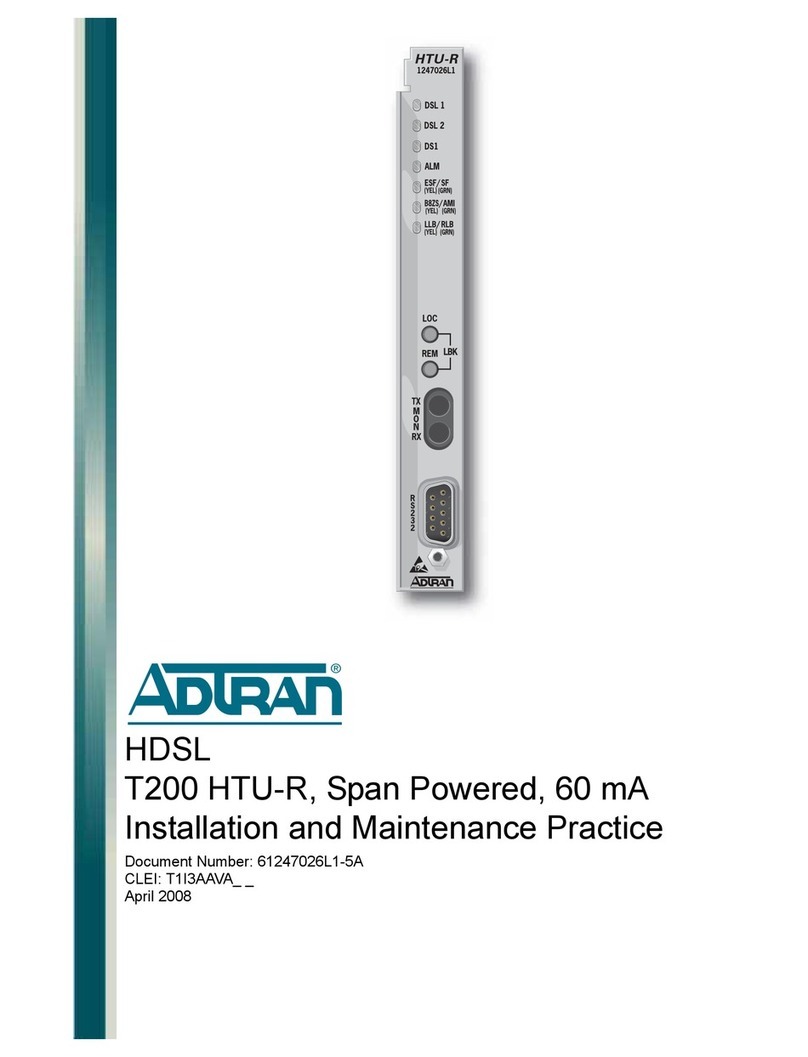
ADTRAN T200 HTU-R User manual

ADTRAN

ADTRAN T200 HTU-R User manual

ADTRAN TSU LT User manual

ADTRAN

ADTRAN TSU LT User manual

ADTRAN 1200312L5 User manual

ADTRAN

ADTRAN 1200312L5 User manual

ADTRAN OSU 300 User manual

ADTRAN

ADTRAN OSU 300 User manual

ADTRAN NetVanta 873 User manual

ADTRAN

ADTRAN NetVanta 873 User manual

Popular Network Hardware manuals by other brands

socomec SNMP Card II quick start guide

socomec

socomec SNMP Card II quick start guide

NVR SYSTEMS 4-CH user manual

NVR SYSTEMS

NVR SYSTEMS 4-CH user manual

Draytek VigorSwitch G1240 quick start guide

Draytek

Draytek VigorSwitch G1240 quick start guide

Westermo TD-34 LV installation manual

Westermo

Westermo TD-34 LV installation manual

LaCie Network Space MAX Quick install guide

LaCie

LaCie Network Space MAX Quick install guide

ZoneVu ZSI-450-IP Installation guide & user manual

ZoneVu

ZoneVu ZSI-450-IP Installation guide & user manual

QNAP Turbo NAS Application notes

QNAP

QNAP Turbo NAS Application notes

OpenEye MV Series quick start guide

OpenEye

OpenEye MV Series quick start guide

Huawei SmartAX MT880a quick start guide

Huawei

Huawei SmartAX MT880a quick start guide

Proxim Tsunami QuickBridge 2454-R installation guide

Proxim

Proxim Tsunami QuickBridge 2454-R installation guide

Bay Networks CLAM quick start guide

Bay Networks

Bay Networks CLAM quick start guide

Innodisk SATADOM-SH 3SE Series manual

Innodisk

Innodisk SATADOM-SH 3SE Series manual

Cisco CGR 1000 Series Getting connected guide

Cisco

Cisco CGR 1000 Series Getting connected guide

Matrix Switch Corporation MSC-HD161DEL product manual

Matrix Switch Corporation

Matrix Switch Corporation MSC-HD161DEL product manual

National Instruments NI 653x user manual

National Instruments

National Instruments NI 653x user manual

B&B Electronics ZXT9-IO-222R2 product manual

B&B Electronics

B&B Electronics ZXT9-IO-222R2 product manual

Yudor YDS-16 user manual

Yudor

Yudor YDS-16 user manual

D-Link ShareCenter DNS-320L datasheet

D-Link

D-Link ShareCenter DNS-320L datasheet

manuals.online logo
manuals.online logoBrands
  • About & Mission
  • Contact us
  • Privacy Policy
  • Terms and Conditions

Copyright 2025 Manuals.Online. All Rights Reserved.

Quick Start Guide, 612806000L1-13A, June 2006 Technical Support 1-888-4ADTRAN (1-888-423-8726) Copyright © 2006 ADTRAN, All Rights Reserved
For more detailed documentation, visit us online at www.adtran.com.
Quick Start Guide
®
TRACER 64x0 Integrated System
SYSTEM DESCRIPTION
The TRACER 64x0 provides license-free scalable connectivity for service providers and corporate
networks. These radios feature two modular network interface slots that can accommodate
various combinations of T1, E1, and Ethernet option cards up to 8x T1/E1 (16.384 Mbps). The
TRACER 6410 and TRACER 6420 provide carrier class point-to-point connectivity up to thirty miles
in the 2.4 GHz and 5.8 GHz license-free Industrial, Scientific, and Medical (ISM) bands, respectively.
The following interface modules are available for use in the TRACER 64x0 system:
• Quad T1 Module (P/N 1280040L1) – Provides four T1 circuits through four RJ-45 connectors.
• Quad E1 Module with 120ΩInterface (P/N 1280044L1) – Provides four E1 circuits through
four RJ-45 connectors.
• Quad E1 Module with 75ΩInterface (P/N 1280044L2) – Provides four E1 circuits through a
single DB-25, 75Ωconnector. An optional breakout panel (P/N 1280060L1) can be used to
provide BNC interfaces for E1 connections.
• Quad Ethernet Switch Module (P/N 1280050L1) – Provides four 10/100BaseT/TX interfaces
through four RJ-45 connectors.
NETWORK TURNUP PROCEDURE
1. After unpacking the unit, inspect it for possible shipping damage. If the equipment has been
damaged in transit, immediately file a claim with the carrier; then contact ADTRAN Customer
Service.
2. Install modules into module slots before powering the unit. TRACER 64x0 modules are not
hot-swappable. Cover any unused module slots with cover plates.
3. Connect an antenna or attenuator to the N-type ANTENNA connector located on the rear
panel of the unit. The TRACER 64x0 is designed for operation with 50Ωof impedance on the
RF connection. Operating the unit without proper termination can result in transmitter damage.
Additionally, ensure that the RF signal level at the TRACER 64x0 receiver is below -30 dBm.
When bench testing TRACER 64x0 systems back to back at full power, 60 dBm attenuation is
required between units. A powerful signal without the proper attenuation can damage the
receiver.
4. Properly ground your system and connect it to an appropriate power source. For more details
on grounding and connecting the TRACER 64x0 to a power source, refer to the power and
grounding Quick Start Guide provided with your system.
Open module slots (slots without installed modules or covers) must be
covered for proper airflow through the TRACER 64x0 system. Do not
operate the unit with open module slots.
NETWORK TURNUP PROCEDURE (continued)
5. To configure the TRACER 64x0 system, connect using a VT100 terminal to the CRAFT port
(located on the front panel) or a 10/100BaseT/TX Ethernet connection to the MGMT port
(located on the rear panel).
Using the Front Panel CRAFT Port
To configure the TRACER 64x0 system using the front panel CRAFT port, you will need a VT100
terminal (or PC with VT100 terminal emulation software) and a straight-through serial cable with a
DB-9 (male) connector on one end and the appropriate interface for your terminal or PC on the
other end. Use the serial cable to connect the CRAFT port on the front panel of the unit to the
VT100 terminal or PC. Configure the VT100 terminal or PC for 9600 baud, 8 data bits, no parity bits,
and 1 stop bit. Press <Enter> until the login password prompt appears. The default password is
password (lowercase).
Using the Rear Panel MGMT Port
To configure the TRACER 64x0 system using the rear panel MGMT port, you will need a
10/100BaseT/TX Ethernet cross-over cable or a straight-through Ethernet cable and a hub. The
TRACER 64x0 default IP address is 192.168.0.10. To establish a Telnet connection between
your PC and the TRACER system, be certain that the IP address of your PC is on the same subnet
as the TRACER MGMT interface (192.168.0.0 /24). Telnet to the TRACER system (192.168.0.10)
and press <Enter> until the login password prompt appears. The default password is password
(lowercase).
TRACER SIGNAL LEVEL VERIFICATION
Real-time signal levels (transmit and received power) for both the local and remote units are
available in dBm on the System Status screen and the RF Link Configuration screen of the
TRACER 64x0 menu system. The received power signal level is displayed within ±5 dBm accuracy
and the transmit power signal level is displayed within ±1 dBm accuracy. The TRACER 64x0 also
provides two bantam interfaces (RSSI and GND) for Receive Signal Strength Indicator (RSSI)
monitoring from the front panel of the unit. The RSSI voltage is a function of the signal strength at
the receiver and is used to measure the received signal strength. RSSI varies from approximately 0
to 5 VDC. An RSSI calibration sheet is shipped with the system to provide the installer a cross-
reference between actual received signal level (in dBm) and RSSI voltage. This sheet is useful for
verifying link budget calculations and ensuring proper equipment installation.
The TRACER 64x0 menu system is not available using the AUX RS232
interface located on the front panel. Refer to the TRACER 64x0 Integrated
System Manual for more details on the AUX RS232 interface.

Quick Start Guide, 612806000L1-13A, June 2006 Technical Support 1-888-4ADTRAN (1-888-423-8726) Copyright © 2006 ADTRAN, All Rights Reserved
For more detailed documentation, visit us online at www.adtran.com.
Quick Start Guide
®
TRACER 64x0 Integrated System
FRONT PANEL LEDs
With the TRACER 64x0 system powered on, the front panel LEDs provide visual
information about the status of the system. The following table describes the LED
operation.
For these LEDs... This color light... Indicates that...
PWR Green (solid) the TRACER is connected to a power source.
Off the TRACER is not currently powered up.
TEMP
*TRACER 64x0 high
power systems only
Green (solid) the TRACER 64x0 high power system
temperature is within normal range.
Red (solid) the TRACER 64x0 high power system has an
active temperature alarm.
FAN
*TRACER 64x0 high
power systems only
Green (solid) the TRACER 64x0 high power system fans
are working properly.
Red (solid) one or more of the TRACER 64x0 high power
system fans are not functioning.
TST
*TRACER 6420 (L1)
only
Amber
(flashes once)
power-up self-test is in progress. If the LED
continuously flashes or remains on (solid)
after 10 seconds, the unit has failed self-test.
STATUS
MOD1 and MOD2
Green (solid) the module is installed and functioning
properly.
Red (solid) at least one port on the installed module is
currently in alarm.
Off no module occupies the slot.
PLAN A Green (solid) the TRACER is transmitting on Frequency
Plan A.
Off the TRACER is not transmitting on Frequency
Plan A.
PLAN B Green (solid) the TRACER is transmitting on Frequency
Plan B.
Off the TRACER is not transmitting on Frequency
Plan B.
RF LO Red (solid) the RSSI level is below suggested minimum
threshold (approximately 10 dBm above the
minimum receive sensitivity).
RF DOWN Red (solid) there is a communication problem between
the local and remote TRACER systems.
TRACER 64x0 MENU TREE
Frequency Plan Site Name
System Status (0) Rx Quality Serial Number 9600
Rx Power System Time 19200 off
System
Configuration (1)
Tx Power System Date 38400 5 min
Elapsed Time 57600 10 min
Craft Port Baud 115200 15 min
Inactivity Logout 30 min
Main
Menu (M)
Password 45 min
Performance Stats Clear 60 min
Factory Default
Rx Power
RF Link
Configuration (2)
Tx Power Band 1
RF Band Plan Band 2
Link Encryption Band 3
Subkey (0 - 2)
RF Link
Performance History (3)
Link Error History
Received Power History
Signal Quality History
Datapath
Provisioning (4)
Total Active Channels IP Address
Module 1 Channels Net Mask
Module 2 Channels Gateway
Module 1 Menus (5) MAC Address
Management/SNMP Port
Configuration (0)
SNMP Mgmt
Module 2 Menus (6) SNMP Get Community
SNMP Set Community
Management/Utilities (7) SNMP Trap Community
SNMP Trap Hose (0 - 4) Ping Address
Ping Utility (1) Number of Packets
Packet Size
File Xfer Method Timeout
TFTP Server Ping Command
Firmware Upgrade (2) Filename
Upgrade Destination Delay
Command (..., Start, Abort) Packets
(Tx, Rx, Lost)
Local Current Status
Previous Status
Remote Current Status
Previous Status
Progress
RF Link Management
Bridge Configuration (3) Bridge Operation
Inactivity Timeout
Link Alarm Fan Alarms
System Alarms (8) Local Unit Temp Alarms
Remote Unit Persistent Alarms Clear