manuals.online logo
Brands
  1. Home
  2. •
  3. Brands
  4. •
  5. ADTRAN
  6. •
  7. Network Hardware
  8. •
  9. ADTRAN 1442940G1 User manual

ADTRAN 1442940G1 User manual

This manual suits for next models

1

Other ADTRAN Network Hardware manuals

ADTRAN NetVanta 2000 Series User manual

ADTRAN

ADTRAN NetVanta 2000 Series User manual

ADTRAN GPON 452 User manual

ADTRAN

ADTRAN GPON 452 User manual

ADTRAN TSU ACE Service manual

ADTRAN

ADTRAN TSU ACE Service manual

ADTRAN Total Access 300 Series User manual

ADTRAN

ADTRAN Total Access 300 Series User manual

ADTRAN Total Access 300 Series Product manual

ADTRAN

ADTRAN Total Access 300 Series Product manual

ADTRAN Total Access 300 Series Product manual

ADTRAN

ADTRAN Total Access 300 Series Product manual

ADTRAN 834-5 User manual

ADTRAN

ADTRAN 834-5 User manual

ADTRAN 1202295L1 User manual

ADTRAN

ADTRAN 1202295L1 User manual

ADTRAN FNID Manual

ADTRAN

ADTRAN FNID Manual

ADTRAN ATLAS 800 Series Module QUAD E1 User guide

ADTRAN

ADTRAN ATLAS 800 Series Module QUAD E1 User guide

ADTRAN HDSL4 Instruction Manual

ADTRAN

ADTRAN HDSL4 Instruction Manual

ADTRAN Total Access 300 Series Product manual

ADTRAN

ADTRAN Total Access 300 Series Product manual

ADTRAN Total Access 300 Series Product manual

ADTRAN

ADTRAN Total Access 300 Series Product manual

ADTRAN 1442823F1 User manual

ADTRAN

ADTRAN 1442823F1 User manual

ADTRAN T200 SHDSL User manual

ADTRAN

ADTRAN T200 SHDSL User manual

ADTRAN T3SU 300 User manual

ADTRAN

ADTRAN T3SU 300 User manual

ADTRAN 850-VoDSL User manual

ADTRAN

ADTRAN 850-VoDSL User manual

ADTRAN NetVanta NetVanta ADSL NIM User manual

ADTRAN

ADTRAN NetVanta NetVanta ADSL NIM User manual

ADTRAN NetVanta SHDSL Network Interface Module User manual

ADTRAN

ADTRAN NetVanta SHDSL Network Interface Module User manual

ADTRAN DSU IV ESP User manual

ADTRAN

ADTRAN DSU IV ESP User manual

ADTRAN TRACER 5045 User guide

ADTRAN

ADTRAN TRACER 5045 User guide

ADTRAN NetVanta 2000 Series User manual

ADTRAN

ADTRAN NetVanta 2000 Series User manual

ADTRAN DSU 5600 User manual

ADTRAN

ADTRAN DSU 5600 User manual

ADTRAN TRACER 64 0 Series User manual

ADTRAN

ADTRAN TRACER 64 0 Series User manual

Popular Network Hardware manuals by other brands

socomec SNMP Card II quick start guide

socomec

socomec SNMP Card II quick start guide

NVR SYSTEMS 4-CH user manual

NVR SYSTEMS

NVR SYSTEMS 4-CH user manual

Draytek VigorSwitch G1240 quick start guide

Draytek

Draytek VigorSwitch G1240 quick start guide

Westermo TD-34 LV installation manual

Westermo

Westermo TD-34 LV installation manual

LaCie Network Space MAX Quick install guide

LaCie

LaCie Network Space MAX Quick install guide

ZoneVu ZSI-450-IP Installation guide & user manual

ZoneVu

ZoneVu ZSI-450-IP Installation guide & user manual

QNAP Turbo NAS Application notes

QNAP

QNAP Turbo NAS Application notes

OpenEye MV Series quick start guide

OpenEye

OpenEye MV Series quick start guide

Huawei SmartAX MT880a quick start guide

Huawei

Huawei SmartAX MT880a quick start guide

Proxim Tsunami QuickBridge 2454-R installation guide

Proxim

Proxim Tsunami QuickBridge 2454-R installation guide

Bay Networks CLAM quick start guide

Bay Networks

Bay Networks CLAM quick start guide

Innodisk SATADOM-SH 3SE Series manual

Innodisk

Innodisk SATADOM-SH 3SE Series manual

Cisco CGR 1000 Series Getting connected guide

Cisco

Cisco CGR 1000 Series Getting connected guide

Matrix Switch Corporation MSC-HD161DEL product manual

Matrix Switch Corporation

Matrix Switch Corporation MSC-HD161DEL product manual

National Instruments NI 653x user manual

National Instruments

National Instruments NI 653x user manual

B&B Electronics ZXT9-IO-222R2 product manual

B&B Electronics

B&B Electronics ZXT9-IO-222R2 product manual

Yudor YDS-16 user manual

Yudor

Yudor YDS-16 user manual

D-Link ShareCenter DNS-320L datasheet

D-Link

D-Link ShareCenter DNS-320L datasheet

manuals.online logo
manuals.online logoBrands
  • About & Mission
  • Contact us
  • Privacy Policy
  • Terms and Conditions

Copyright 2025 Manuals.Online. All Rights Reserved.

DESCRIPTION
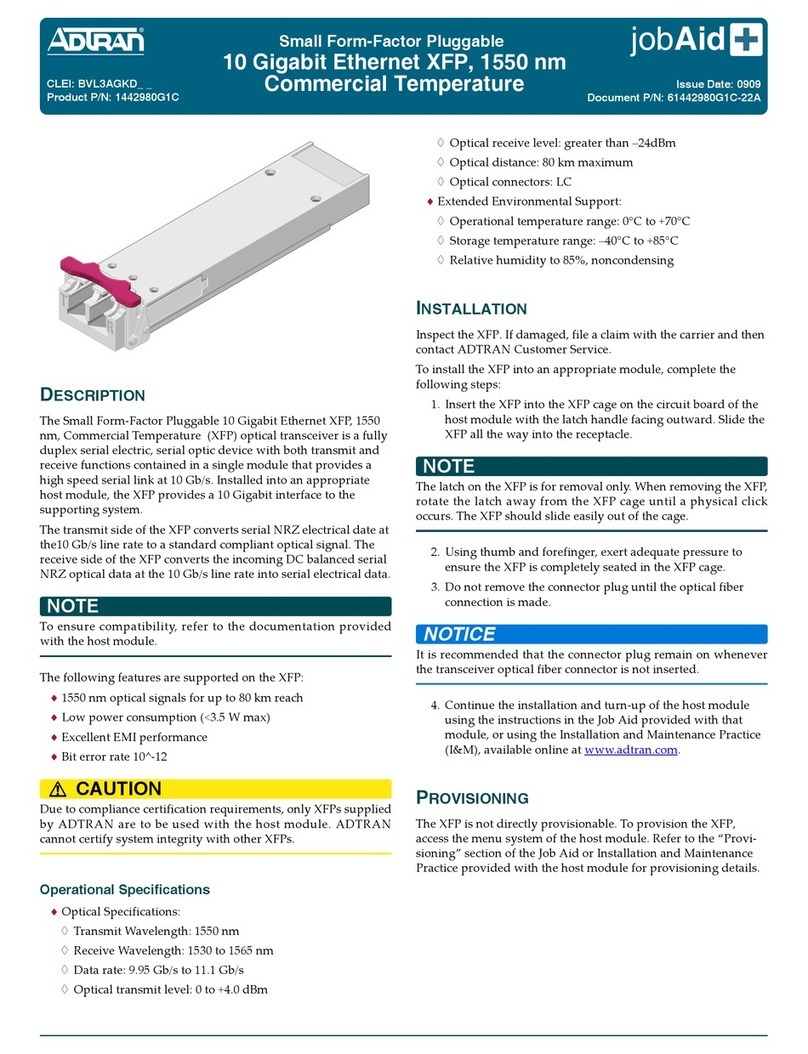
The Small Form-Factor Pluggable 10 Gigabit
Ethernet XFP, 1550 nm, Temperature Hardened
(XFP) optical transceiver is a fully duplex serial
electric, serial optic device with both transmit and
receive functions contained in a single module that
provides a high speed serial link at 10 Gb/s. Installed
into an appropriate host module, the XFP provides a
10 Gigabit interface to the supporting system.
The transmit side of the XFP converts serial NRZ
electrical date at the10 Gb/s line rate to a standard
compliant optical signal. The receive side of the XFP
converts the incoming DC balanced serial NRZ
optical data at the 10 Gb/s line rate into serial
electrical data.
NOTE
To ensure compatibility, refer to the documentation
provided with the host module.
The following features are supported on the XFP:
♦1550 nm optical signals for up to 40 km reach
♦Case temperature hardened range from –40°C to
85°C
♦Low power consumption (<3.5 W max)
♦Excellent EMI performance
Due to compliance certification requirements, only
XFPs supplied by ADTRAN are to be used with the
host module. ADTRAN cannot certify system integrity
with other XFPs.
Small Form-Factor Pluggable
10 Gigabit Ethernet XFP, 1550 nm,
Temperature Hardened
Operational Specifications
♦Optical Specifications:
◊Transmit Wavelength: 1550 nm
◊Receive Wavelength: 1530 to 1565 nm
◊Data rate: 9.95 Gb/s to 11.35 Gb/s
◊Optical transmit level: –4.7 to +4.0 dBm
◊Optical receive level: –15.0 to –11.3 dBm
◊Optical distance: 40 km maximum
◊Optical connectors: LC
♦Extended Environmental Support:
◊Operational temperature range: –40°C to +85°C
◊Storage temperature range: –40°C to +85°C
◊Relative humidity to 85%, noncondensing
INSTALLATION
Inspect the XFP. If damaged, file a claim with the
carrier and then contact ADTRAN Customer Service.
To install the XFP into an appropriate module,
complete the following steps:
1. Insert the XFP into the XFP cage on the circuit
board of the host module with the latch handle
facing outward. Slide the XFP all the way into the
receptacle.
NOTE
The latch on the XFP is for removal only. When
removing the XFP, rotate the latch away from the XFP
cage until a physical click occurs. The XFP should
slide easily out of the cage.
2. Using thumb and forefinger, exert adequate
pressure to ensure the XFP is completely seated
in the XFP cage.
3. Do not remove the connector plug until the
optical fiber connection is made.
It is recommended that the connector plug remain on
whenever the transceiver optical fiber connector is
not inserted.
4. Continue the installation and turn-up of the host
module using the instructions in the Job Aid
provided with that module, or using the
Installation and Maintenance Practice (I&M),
available online at www.adtran.com.
CLEI: BVL3ADMD_ _
Product P/N: 1442940G1
Issue Date: 0810
Document P/N: 61442940G1-22A
C A U T I O N
C A U T I O N
!
SUBJECT TO ELECTROSTATIC DAMAGE
OR DECREASE IN RELIABILITY.
HANDLING PRECAUTIONS REQUIRED.
For more information, refer to the Installation and Maintenance Practice (P/N 61442940G1-5)
available online at www.adtran.com.
Warranty: ADTRAN will replace or repair this product within the warranty period if it does not
meet its published specifications or fails while in service. Warranty information can
be found online at www.adtran.com/warranty.
©2008 ADTRAN, Inc. All Rights Reserved.
PRICING AND AVAILABILITY 800.827.0807
TECHNICAL SUPPORT 800.726.8663
RETURN FOR REPAIR 256.963.8722
*61442940G1-22A*
PROVISIONING
The XFP is not directly provisionable. To provision
the XFP, access the menu system of the host module.
Refer to the “Provisioning” section of the Job Aid or
Installation and Maintenance Practice provided with
the host module for provisioning details.
COMPLIANCE
♦ Electrostatic Discharge (ESD) can damage
electronic modules. When handling modules, wear
an antistatic discharge wrist strap to prevent
damage to electronic components. Place modules
in antistatic packing material when transporting
or storing. When working on modules, always
place them on an approved antistatic mat that is
electrically grounded.
♦ The XFP meets or exceeds all the applicable
requirements of NEBS, Telcordia GR-63-CORE,
and GR-1089-CORE. The XFP is intended for
deployment in Central Office type facilities, EEEs,
EECs, and locations where the NEC applies (for
example, Customer Premises). The XFP is to be
installed in ADTRAN products in Restricted Access
Locations only, and installed by trained service
personnel.
This device complies with FCC 47 CFR Part 15, Class
B. Operation is subject to the following two condi-
tions:
1. This device may not cause harmful interference.
2. This device must accept any interference
received, including interference that may cause
undesired operation.
Changes or modifications not expressly approved by
ADTRAN could void the user's authority to operate
this equipment.
♦ Per GR-1089-CORE, the ADTRAN system in which
the SFP is being deployed is designed and intended
for installation as part of a Common Bonding
Network (CBN). The ADTRAN system in which the
SFP is being deployed is not designed nor intended
for installation as part of an Isolated Bonding
Network (IBN).
♦ Per GR-1089-CORE Section 9, the XFP does not
have an internal DC connection between battery
return and frame ground. The XFP can be installed
in a DC-I (isolated) or DC-C (common) installation.
For installations where other cards or the host
system have internal connections between battery
return and frame ground, the system would be
intended for deployment only in a DC-C
installation.
♦ The ADTRAN system chassis frame ground
terminal must be connected to a reliable earth
ground to ensure that the metal enclosure of the
XFP is properly grounded via the backplane
connector.
The XFP is a Class 1 Laser Product and complies with
the Laser Safety requirements of FDA 21CFR
1040.10 and 1040.11, and EN60825-1 and -2. The
XFP is NRTL listed and CB Certified to all applicable
American and European safety standards.
For continued compliance with the above laser safety
standards, only approved Class 1 modules from our
approved vendor list, located on the ADTRAN website,
should be installed in ADTRAN products.
NOTE
The Gigabit Ethernet port(s) are optical and therefore
are not classified as any type of port as defined in
Appendix B of GR-1089-CORE Issue 4.
The XFP is designed to meet the following environ-
mental classes:
♦ETSI EN 300 019-1-1 “Classification of
environmental conditions; Storage,” Class 1.2
♦ETSI EN 300 019-1-2 “Classification of
environmental conditions, Transportation,” Class
2.3
♦ETSI EN 300 019-1-3 “Classification of
environmental conditions, Stationary use at
weather-protected locations,” Class 3.3
The equipment is designed to function without degra-
dation during exposure to all test severities per Class
3.3.