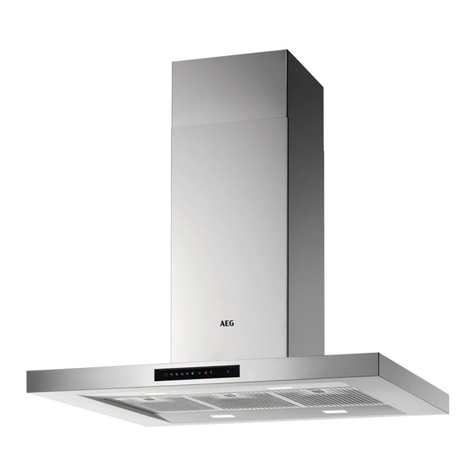
AEG 9600 D Specification sheet

9600 D
Cooker hood
Operating and Installation Instructions

2
Contents
Safety warnings 4
fortheuser 4
fortheinstaller 4
Description of the Appliance 6
Extractorversion 6
FilterVersion 6
Control Panel 7
LEDIndicatorlightsforverifyingthesaturationoffilters 8
Led–IndicatorforgreasefilterC 8
Led-indicator for charcoal filter D 8
Resettingthesaturationindicator 8
Maintenance and care 9
Metalgreasefilter 9
Openthemetalgreasefilter 9
Charcoalfilter 10
Removetheupperglasspanel 11
Changingthelightbulb 11
Cleaning 12
Special accessories 12
Technical assistance service 12
Technical Specifications 13
Mountingaccessoriesincluded 13
13
Electrical connection 14
Safetywarningsfortheelectrician 14
Mounting 15
Printedonrecycledpaper
AEG - putting words into action

3
Safety warnings
for the user
• Alwayscoverlighted elements, to prevent excessheatfrom
damaging the appliance. In the case of oil, gas and coal fired
cookers it is essential to avoid open flames.
• Also, when frying, keep the deep frying pan on the cooker top/cooker
undercarefulcontrol.
• Thehotoil in the fryingpanmight ignite due tooverheating.
• The risk of self-ignition increases when the oil being used is dirty.
• It is extremely important to note that overheating can cause a fire.
•Never carry out any flambé cooking under the hood.
•Always disconnect the unit from the power supply before
carrying out any work on the hood, including replacing the
light bulb (take the cartridge fuse out of the fuse holder or switch off
theautomatic circuit breaker).
•It is very important to clean the hood and replace the filter at
the recommended intervals. Failure to do so could cause
grease deposits to build up, resulting in a fire hazard.
• Theapplianceis not intended for useby young children or infirm
personswithoutsupervision.
• Young children should be supervised to ensure that they do not play
withtheappliance.
•WARNING - Ensurethat the appliance is switched offbefore
replacing the lamp to avoid the possibility of electric shock.
for the installer
• When used as an extractor unit, the hood must be fitted with a
150mmdiameterhose.
• Should there already be a pipe of diameter 125 mm that ducts to the
outside through the walls or roof, it is possible to use the 150/125
mm reduction flange provided. In this case the hood will be slightly
morenoisy.
•When installing the hood, make sure you respect the following
minimum distance from the top edge of the cooking hob/ring
surfaces:
electric cookers 500 mm
gascookers 650 mm
coal and oil cookers 700 mm min.
• ThenationalStandardonfuel-burning systems specifies a maximum
depression of 0.04 bar in such rooms.

4
• The air outlet must not be connected to chimney flues or combustion
gas ducts. The air outlet must under no circumstances be connected
toventilationductsforroomsinwhichfuel-burningappliancesare
installed.
• Itisadvisabletoapplyforauthorizationfromtherelevantcontrolling
authority when connecting the outlet to an unused chimney flue or
combustion gas duct.
The air outlet installation must comply with the regulations laid down
bytherelevantauthorities.
• When the unit is used in its extractor version, a sufficiently large
ventilationholemustbeprovided,withdimensionsthatare
approximately the same as the outlet hole.
• Nationalandregionalbuildingregulationsimposeanumberof
restrictionsonusinghoodsandfuel-burningappliances connected to
a chimney, such as coal or oil room-heaters and gas fires, in the
sameroom.
• Hoods can only be used safely with appliances connected to a
chimneyiftheroomand/orflat(air/environmentcombination)is
ventilatedfromoutsideusingasuitableventilationholeapproximately
500-600cm2 largeto avoid the possibility ofadepression being
createdduringoperationofthehood.
• Ifyouhaveany doubts, contact the relevant controllingauthorityor
buildinginspector’soffice.
• Since the rule for rooms with fuel burning appliances is “outlet hole of
the same size as the ventilation hole”, a hole of 500-600 cm2, which
is to say a larger hole, could reduce the performance of the extractor
hood.
• If the hood is used in its filtering function, it will operate simply and
safelyin the above conditions without the need for any of the
aforementionedmeasures.
• When the hood is used in its extractor function, the following rules
mustbefollowedto obtain optimal operation:
— short and straight outlet hose
— keep bends in outlet hose to a minimum
— never install the hoses with an acute angle, they must
always follow a gentle curve only
— keep the hose as large as possible (preferably the same diameter
as the outlet hole).
• Failure to observe these basic instructions will drastically reduce the
performanceandincreasethenoiselevelsoftheextractorhood.

5
Description of the Appliance
Extractor version
• The hood is supplied as an
extractor unit and can also be
used with a filtering function by
fittingone charcoal filter
(special accessory).
• You will need original AEG
charcoalfilterforthis function
(see Special Accessories).
• The air is discharged to the out-
side through a pipe, which must
befitted to connection flange A.
Fig. 1.
• In order to obtain the best
performancethehoseshouldhaveadiameter equal to the outlet
hole.
Should there already be a pipe of diameter 125 mm that ducts to the
outside through the walls or roof, it is possible to use the 150/125
mm reduction flange provided. In this case the hood will be slightly
noisier.
Fig. 1
Filter Version
• Theairisfilteredthrough a charcoal
filterand returned to the kitchen
through the top grill of the outlet
pipe.
• You will need an original AEG KF8
charcoalfilterforthefiltering
function.(SeeSpecial
Accessories).
• Fix the deflector using 4 screws Ø
3,5x6.5 mm. Fig. 2.
• Optionally, the position of the
chimneyelements can be changed.
When using the hood in the filter
versionthe chimney must be fixed
at the top, with the air outlet grill at
the side.
A
Fig. 2

6
Control Panel
• Best result are obtained by using a low speed for normal conditions
andahighspeedwhenodoursaremoreconcentrated.
Turn the hood on a few minutes before you start cooking, you will
then get an under pressure in the kitchen. The hood should be left on
aftercookingfor about 15 minutesoruntil all the odourshave
disappeared.
The control switches are located on the unit’s front panel:
A- Mainswitch,hoodon/off.
B- Start and choice of motor speed 1-2-3-1-2.........
C- Indicatesspeed1(LED) and indication of the grease
saturationforthefilter(flashingindicator).
D- Indicatesspeed2 (LED) and indication ofthecharcoal
saturationforthefilter(flashingindicator).
E- Indicatesspeed3(LED)
F- IndicatesIntensivespeed(LED).
G- Intensivespeedon/off.TheIntensivespeed runsfor5
minutes:
Ifthe hood is onwhen the Intensive speedis activated, the
hoodrevertsto previous speed after 5 minutes.
Ifthehood is off when theIntensivespeed is activated, the
hoodwillbe turned off after 5minutes.
To interrupt the Intensive speed, press button A or B.
H- LightON/OFF
Should the hood or the controls fail to operate: disconnect the power
supply for at least 5 seconds, then turn the hood back on again.

7
LED Indicator lights for verifying the saturation
of filters
This hood is supplied without a charcoal filter. If the hood is to be used
in the recirculation mode with a charcoal filter, the saturation indicator
must be activated as follows:
Depress and hold the A and B buttons simultaneously for 3 seconds.
Initially only the LED indicator signal for the grease filter C is activated,
shortly after the LED indicator for the charcoal filter D will activate, at
this point the saturation detection has been enabled.
To switch off the saturation detection : depress and hold the A and B
buttons for 3 seconds until the LED indicator for the active carbon filter
isflashing.
Led – Indicator for grease filter C
TheLEDindicator for the grease filter willflashwhen it requires
cleaning.
Followthemaintenanceinstructions.
Led - indicator for charcoal filter D
TheLEDindicatorfor the charcoal filter illuminateswhenthefilter
requiresreplacing.
Thisoccursafterabout160workinghoursfromwhentheactivecarbon
filter was first put into operation.
Resetting the saturation indicator
Aftercleaning or replacing the filter depress and hold the G and H
buttons again for 3 seconds until the grease filter LED or the charcoal
indicatorLEDare no longer flashing.

8
Maintenance and care
•The hood must always be disconnected from the electricity
supply before beginning any maintenance work.
Metal grease filter
• Thepurpose of the grease filters is to aspirate grease particles which
form during cooking and it must always be used, either in the
externalevacuationor internal recycling function.
Attention:themetal grease filters must beremoved and washed,
eitherbyhandor in the dishwasher,every four weeks.
Open the metal grease filter
• First, push the metal grease filter stop backwards, then extract the
filter, pullingdownwards.Fig. 3.
Hand washing
Soakgreasefiltersforaboutonehour
inhotwaterwithagrease-loosening
cleaner,thenrinseoffthoroughly with
hotwater. Repeat the process if
necessary.Refit the grease filters
whenthey are dry.
Dishwasher
Place grease filters in dish washer.
Selectmostpowerfulwashing
programmeand highesttemperature,
at least 65°C. Repeat the process.
Refitthegrease filters when they are
dry.
Whenwashingthemetal grease filter
in the dishwasher a slight
discoloration of the filter can occur,
this does not have any impact on its performance.
• Clean the inner housing using a hot detergent solution only
(never use corrosive, abrasive or flammable cleaning
products).
Fig. 3

9
Charcoal filter
• The charcoal filter should only be used if you want to use the hood in
itsfilteringfunction.
• To do this you will need an original AEG charcoal filter (see special
accessories).
•Cleaning/replacing the charcoal filter
Unlikeothercharcoal filters, the LONGLIFE charcoalfiltercan be
cleanedandreactivated. At normal use the filtershould be cleaned
every second month. The best way to clean the filter is in the
dishwasher.Usenormaldetergentandchoosethehighesttempera-
ture (65º C). Wash the filter separately so that no food parts gets
stuck on the filter and later causes bad odours. To reactivate the
charcoal, the filter should be dried in an oven for 10 minutes with a
temperatureofmaximum100ºC.
After approximately three years of use, the charcoal filter should be
replaced with a new, as the odour reduction capacity will be reduced.
•Mounting
Fit the charcoal filter first on the rear side, then use its red lock-keys
A to fix to the body of the hood. Fig. 4.
•To dismount proceedinreverseorder.
• Alwaysspecifythe hood model code numberandserial number
whenorderingreplacementfilters.Thisinformationisshownonthe
registration plate located on the inside of the unit.
• The charcoalfilter can be ordered from the AEG technical
assistanceservice.
Fig. 4
AA

10
Remove the upper glass panel
Theupper glass panel can beremovedforcleaning.
• Removethe greasefilters.
• Pull the handle L down. Fig. 5.
• Removethe glass panel.
L
Fig. 5
Warning
• Failuretoobserve the instructions on cleaningtheunit and changing
thefilters will cause a fire hazard. You are therefore strongly
recommendedtofollowtheseinstructions.
• Themanufacturerdeclinesall responsibility for any damage tothe
motororanyfiredamagelinkedtoinappropriatemaintenanceor
failureto observetheabovesafetyrecommendations.
Changing the light bulb
• Disconnect the cooker hood from the main supply.
• Removethelampcover, use a screw driver asalever. Fig. 6.
• Replace the old bulb with a new one of the same type.
• Remountthe lamp cover.
• If the light does not come on, make sure the bulb has been inserted
in correctly before contacting the technical assistance service.
Fig. 6
Table of contents
Other AEG Ventilation Hood manuals