6
SERVICE
CLEANING
The Smokemaster Air Cleaner works by
electrically charging and collecting airborne
contaminants. As these contaminants collect, the
collector plates and prefilter become extremely
dirty. With an excessive amount of contamination
built up on the collector plates and the prefilter, the
electronic air cleaner’s efficiency decreases. Also,
as dirt builds up, the snapping noise will occur with
greater frequency.
To prevent this loss of efficiency, the electronic
cell and prefilter must be cleaned regularly. How
often will depend on usage. Variables, such as,
number of occupants, pets, and smoke, will
determine how often the air cleaner requires
cleaning. Usually the cleaning interval will be
between once a month to once every six months.
CLEANING THE PREFILTER
Remove the prefilter and shake out or brush off
the accumulated dust and lint. If this is not
adequate, a vacuum cleaner may be used or the
prefilter can be cleaned with an all-purpose
alkaline detergent to remove tobacco smoke and
cooking grease stains. A thorough rinsing is
required after each cleaning.
CLEANING THE ACTIVATED CARBON FILTER
Occasionally, the carbon filter will need cleaning.
Use a vacuum cleaner to remove the dirt. The
odor absorption capabilities of the carbon lasts
between three to six months. Once the carbon
filter can no longer remove odors from the air, the
filter will have to be replaced.
CLEANING THE ELECTRONIC CELL
CAUTION
Sharp edges can cause injury.
Handle the cell carefully to avoid cuts from the
sharp metal edges.
The cell can be washed in many automatic
dishwashers or manually washed using
Smokemaster Liquid Cell Cleaner.
Automatic Dishwasher
CAUTION
Burn hazard--can cause personal injury.
Allow the cell to cool in the dishwasher at the end of
the wash cycle or wear protective gloves to avoid
burns. Hot water may accumulate in the tubes
supporting the collector plates. Tip the cell so these
tubes will drain.
IMPORTANT
•Check your dishwasher owner’s manual. Some
manufacturers do not recommend washing
electronic cells in their dishwasher.
•If the dishwasher has upper and lower arms,
position the cell carefully to allow good water
circulation.
•Use care to avoid damaging or bending the cell
plates when placing it in the dishwasher. If bent,
arcing will result.
•A very dirty cell, especially from tobacco or
cooking smoke, may discolor the plastic parts and
lining of the dishwasher. The discoloration is not
harmful. To minimize it, wash the cell more
frequently or try a different brand of detergent.
•Do not allow the dishwasher to run through the dry
cycle. This will “bake on” any contaminants not
removed during the wash cycle and reduce air
cleaner efficiency.
1. Put the cell on the lower rack of the
dishwasher with the directional arrow pointing
up. It may be necessary to remove the upper
rack. Don’t block the water flow to the upper
arm, if provided on the dishwasher.
2. Using the detergent that works best for normal
dishwashing, allow the dishwasher to run
through the complete wash and rinse cycle.
Do not use the dry cycle. To avoid burns, let
the cell cool completely before removing or
wear protective gloves when removing the
cell. Remember that water may be trapped in
the tubes that support the collector plates. Tip
the cell so these tubes can drain.
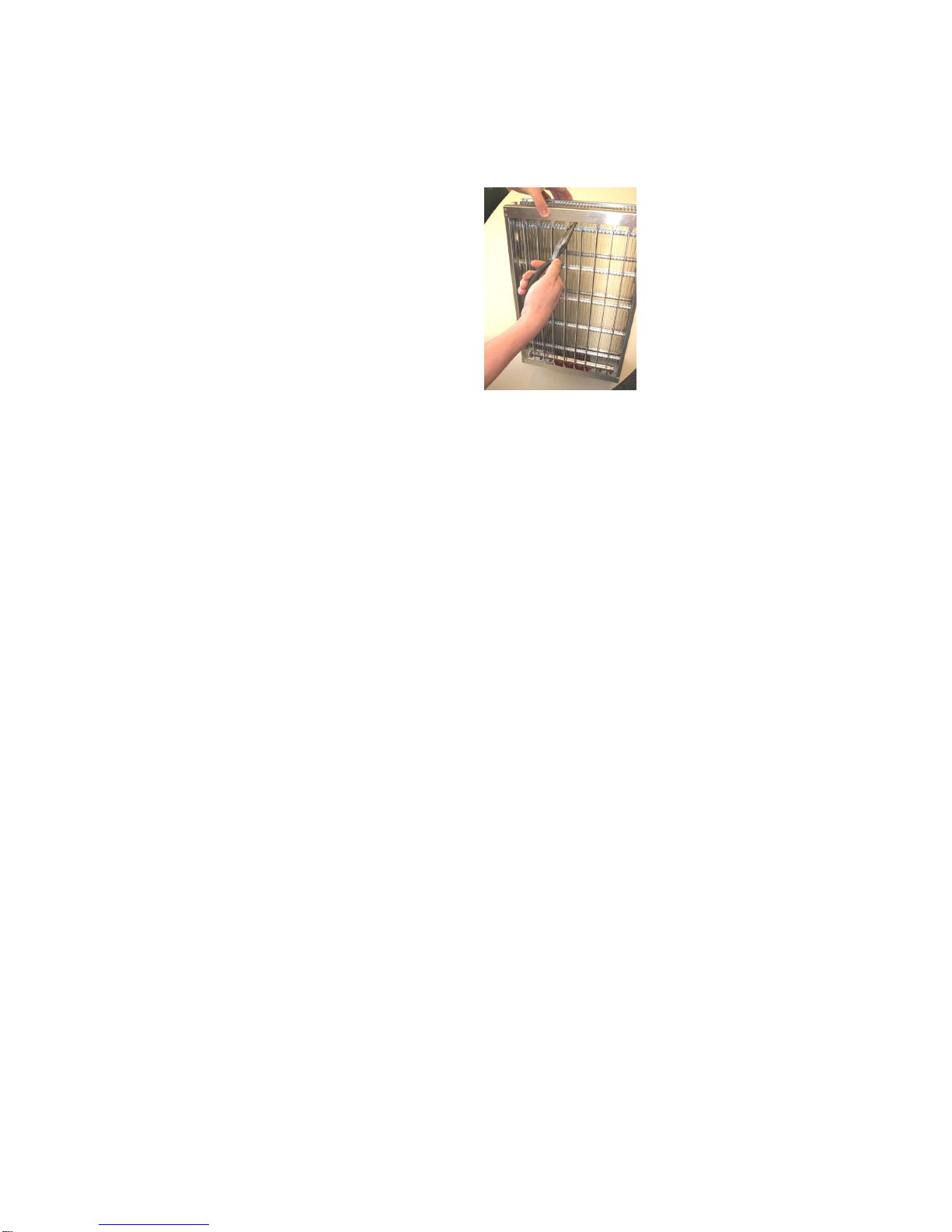
3. Wipe the ionizer wires and red contact board
on the end of the cell with your thumb and
forefinger holding a small, damp cloth.