ENG Ι10
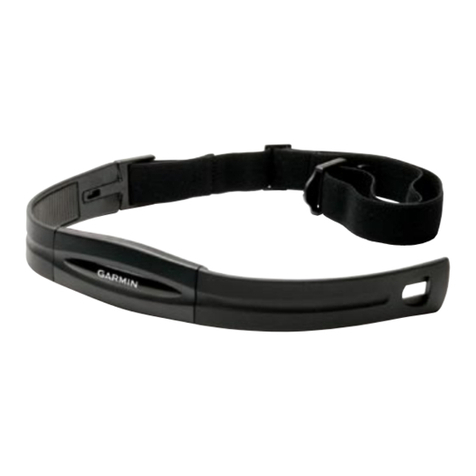
•If the device cannot receive the heart rate signal, the heart rate value for
the HRM displayed will change into zero in about 15 seconds, and after
60 seconds the screen will automatically go to the exercise results display.
When this situation happens, please re-check whether the Transmitter is
still tight and fit with your body or whether the two electrode areas on the
reverse of the Transmitter are well moistened.
With reference to Training Intensity
The table below is for your reference to find or calculate your exercise
intensity of bpm1 (which is also called training heart rate) in the Exercise
Mode, being suit to your workout. It is estimated based on age in 5-year
intervals and calculated by the %HRmax formula.
1. Heart rate (abbreviated as “HR”) is calculated as the number of heart
beats in one minute and expressed as “beats per minute, bpm”.
2. HRmax = 220 — Age
Maximum Heart Rate (MHR), or HRmax, which is the highest number
of heart beats per minute (bpm) during maximal physical exertion.
It is frequently used to calculate THR (which is a helpful index when
prescribing your training intensity range). The most accurate way of
measuring HRM is via an Exercise Stress Test by an electrocardiogram
(ECG) in the laboratory with the presence of experts or doctors. Instead,
“Age Formula” is the common way to estimate MHR.
Age
HRmax
2
Training Intensity
3
(unit: bpm
1
)
(unit: bpm
1
)
Light Zone
4
(60~70 %HRmax)
Moderate Zone
(70~80 %HRmax)
Hard Zone
(80~90 %HRmax)
10~20 200 120~140 140~160 160~180
25 195 117~137 137~156 156~176
30 190 114~133 133~152 152~171
35 185 111~130 130~148 148~167
40 180 108~126 126~144 144~162
45 175 105~123 123~140 140~158
50 170 102~119 119~136 136~153
55 165 99~116 116~132 132~149
60 160 96~112 112~128 128~144
65~99 155 93~109 109~124 124~140