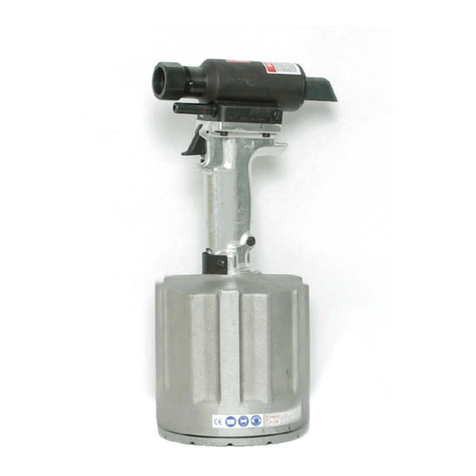
Alcoa 257 User manual

07-28-2006
HK1017
INSTRUCTION MANUAL
257
PNEUDRAULIC INSTALLATION TOOL
256/257
U.S. PAT. 4597263
HUCK

2
257 Series Tooling Alcoa Fastening Systems
EU Declaration of Conformity
Manufacturer:
Huck International, Inc., Installation Systems Division, 1 Corporate Drive, Kingston, NY,
12401, USA
Description of Machinery:
Model number 256 fastener installation tool
Relevant provisions complied with:
Council Directive related to Machinery, (89/392/EEC), (91/368/EEC), (93/44/EEC),
(93/68/EEC)
European Representative:
Rob Pattenden, Huck International, Ltd. Unit C Stafford Park 7, Telford Shropshire TF3
3BQ, England, United Kingdom
Authorized Signature/date:
I, the undersigned, do hereby declare that the equipment specified above conforms to
the above Directive(s) and Standard(s).
Signature: ___________________________________
Full Name: Henk Rosier
Position: Engineering Manager,
Installation Systems Division
Place: Kingston, New York, USA
Date: August, 1998
Huck Model 256 Sound Level
The sound level of the 256 tool cycling without fastener is
Sound Exposure Level (SEL) =84.2 dB (A)
Peak Value = 97.1 dB (C)
The noise of the fastener being installed in structure is
considered process noise, not tool noise. Sound
measurements of simulated process noise are available
upon written request from Huck International in Kingston,
NY, USA.
Huck Model 256 Vibration Level
For an eight hour work day, installing 3000 typical
Huck fasteners will result in an equivalent weighted
RMS vibration level (Aeq) of 5.0m/s2.
To calculate the equivalent vibration level for other
quantities of fasteners in an eight hour period, use the
formula:
Equivalent Vibration Level, Aeq (m/s2) = (n/480) x 0.8
where n = number of fasteners in eight hours, and
0.8(m/s2) = Aeq for 60 seconds.
Test data to support the above information is on file at
Huck International, Inc., Kingston, NY, USA. Vibration
measurements are frequency weighted in accordance with
ISO 8041 (1990).

3
257 Series Tooling Alcoa Fastening Systems
EU DECLARATION OF CONFORMITY . . . . . . . . . . . . . . . . . . . . . . . . . . . . .2
SAFETY . . . . . . . . . . . . . . . . . . . . . . . . . . . . . . . . . . . . . . . . . . . . . . . . . . .4
SPECIFICATIONS . . . . . . . . . . . . . . . . . . . . . . . . . . . . . . . . . . . . . . . . . . . . .5
PRINCIPLE OF OPERATION . . . . . . . . . . . . . . . . . . . . . . . . . . . . . . . . . . . . .6
PREPARATION FOR USE . . . . . . . . . . . . . . . . . . . . . . . . . . . . . . . . . . . . . .7
SERVICING THE TOOL
General . . . . . . . . . . . . . . . . . . . . . . . . . . . . . . . . . . . . . . . . . . . . . .7
Daily . . . . . . . . . . . . . . . . . . . . . . . . . . . . . . . . . . . . . . . . . . . . . . . . .7
Weekly . . . . . . . . . . . . . . . . . . . . . . . . . . . . . . . . . . . . . . . . . . . . . . .7
Disassembly . . . . . . . . . . . . . . . . . . . . . . . . . . . . . . . . . . . . . . . . .8-9
Assembly . . . . . . . . . . . . . . . . . . . . . . . . . . . . . . . . . . . . . . . . .10-11
Fill and Bleed . . . . . . . . . . . . . . . . . . . . . . . . . . . . . . . . . . . . . .11-12
Assembly Drawing . . . . . . . . . . . . . . . . . . . . . . . . . . . . . . . . . . . . .13
Parts List . . . . . . . . . . . . . . . . . . . . . . . . . . . . . . . . . . . . . . . . . . . .14
TROUBLESHOOTING . . . . . . . . . . . . . . . . . . . . . . . . . . . . . . . . . . . . . . . . .15
ACCESSORIES . . . . . . . . . . . . . . . . . . . . . . . . . . . . . . . . . . . . . . . . . . . . .15
SERVICE NOTES . . . . . . . . . . . . . . . . . . . . . . . . . . . . . . . . . . . . . . . . . . .16
CONTENTS

4
257 Series Tooling Alcoa Fastening Systems
SAFETY
This instruction manual must be read with particular
attention to the following safety guide lines, by any
person servicing or operating this tool.
1. Safety Glossary
WARNINGS - Must be understood
to avoid severe personal injury.
CAUTIONS - show conditions that will
damage equipment and or structure.
Notes - are reminders of required
procedures.
Bold, Italic type and underlining -
emphasizes a specific instruction.
2. Huck equipment must be maintained in a safe
working condition at all times and inspected on a
regular basis for damage or wear. Any repair
should be done by a qualified repairman trained
on Huck procedures.
3. Repairman and Operator must read manual prior
to using equipment and understand any Warning
and Caution stickers/labels supplied with
equipment before connecting equipment to any
primary power supply. As applicable, each of the
sections in this manual have specific safety and
other information.
4. See MSDS Specifications before servicing the
tool. MSDS Specifications are available from
you Huck representative or on-line at
www.huck.com. Click on Installation Systems
Division.
5. When repairing or operating Huck installation
equipment, always wear approved eye
protection. Where applicable, refer to ANSI
Z87.1 - 1989
6. Disconnect primary power source before doing
maintenance on Huck equipment.
7. If any equipment shows signs of damage, wear,
or leakage, do not connect it to the primary
power supply.
8. Make sure proper power source is used at all
times.
9. Never remove any safety guards or pintail
deflector.
10. Never install a fastener in free air. Personal
injury from fastener ejecting may occur.
11. When using an offset nose always clear spent
pintail out of nose assembly before installing the
next fastener.
12. If there is a pinch point between trigger and
work piece use remote trigger. (Remote
triggers are available for all tooling).
13. Do not abuse tool by dropping or using it as a
hammer. Never use hydraulic or air lines as a
handle. Reasonable care of installation tools by
operators is an important factor in maintaining
tool efficiency, eliminating downtime, and in
preventing an accident which may cause severe
personal injury.
14. Never place hands between nose assembly and
work piece.
15. Tools with ejector rods should never be cycled
with out nose assembly installed.
16. When two piece lock bolts are being used
always make sure the collar orientation is
correct. See fastener data sheet of correct
positioning.
!
Product complies with requirements
set forth by the relevant European
directives.
Read manual prior to using
equipment.
Eye protection required while
using this equipment.
Hearing protection required while
using this equipment.

5
257 Series Tooling Alcoa Fastening Systems
ø
ø
3.957
100.51
4.640
117.8
6.018
152.8
14.886
378.1
1.920
48.77
959
24.36
7.823
198.7
257
U.S. PAT. 4597263
HUCK
4°
T
TOOL
OOL S
SPECIFICA
PECIFICATIONS
TIONS
• Stroke: .875
• Weight: 11.1 lbs
• Air Pressure: 90-100 psi
• Capacity: 5282 lbs @ 90 psi
• Speed/Cycles: 30 per minute
• Noise Level: 85 dBA @ 90 psi
INCHES
MM

6
257 Series Tooling Alcoa Fastening Systems
EXHAUST
HYDRAULIC
PIST N
AIR PIST N
RELIEF
VALVE CHECK
VALVE
PULL PIST N
THR TTLE
VALVE
RESERV IR
When the trigger is depressed, the throttle valve
moves to down position, and pressurized air is
directed to the bottom of the air piston, causing the
piston to move upward. The air above the piston
is exhausted and directed through the center of the
throttle valve and out the bottom of the tool. The
air piston has a rod and a hydraulic piston
attached. When the air piston rod moves upward,
a column of pressurized fluid is forced into head,
which moves the pull piston back. The attached
nose assembly moves with the pull piston to start
fastener installation.
When fastener installation is completed, the trigger
is released. Air pressure, with the assistance of a
spring, causes the throttle valve to return to its up
position. Pressurized air is re-directed to the top of
the air piston, causing the piston to move
downward. The air from below the piston is
exhausted through bottom of tool. The rod and
hydraulic piston move downward, hydraulic
pressure is reversed and the pull piston is returned
forward. Return pressure relief valve protects tool
against pressure spikes. The reservoir replenishes
hydraulic system as needed.
PRINCIPLE OF OPERATION
PULL RETURN

7
257 Series Tooling Alcoa Fastening Systems
The Model 257 Installation Tool is shipped with a plastic
plug in the air inlet connector. The connector has 1/4-18
female pipe threads to accept the air hose fitting. Quick
disconnect fittings and 1/4” inside diameter air hose are
recommended. An air supply of 90-100 psi capable of 20
CFM must be available. Air supply should be equipped with
a filter-regulator-lubricator unit.
1. Remove plastic shipping plug from Air Inlet Connector
and put in a few drops of Automatic Transmission
Fluid, DEXRON III, or equivalent.
2. Screw quick disconnect fitting into Air Inlet Connector.
CAUTION: Do not use TEFLON tape on threads - - use
TEFLON in stick form only. (Huck P/N 503273)
3. Set air pressure on regulator to 90-100 psi.
4. Attach optional Air Hose (38), supplied with tool, to air
inlet connector.
5. Connect air hose to tool.
6. Cycle tool a few times by depressing and releasing
trigger.
7. Disconnect air hose from tool.
8. Remove Retaining Nut and Stop.
9. Select proper Nose Assembly from SELECTION
CHART for fastener to be installed.
10. Screw Collet Assembly (including lock collar and shim
if applicable) onto Spindle holding Pull Piston (11) with
3/8 hex key. (Wrench Tight)
11. Slide Anvil over Collet Assembly and into counterbore.
12. Slide Stop and Retaining Nut over Anvil and screw Nut
onto Head.
13. Connect air hose to tool and install fastener(s) in test
plate of proper thickness with proper size holes.
Inspect fastener(s).
NOTES:
1 Air quick disconnect fittings and air hoses are not
available from Huck International, Inc.
2 VIBRA-TITE should be used on collet threads for nose
assemblies without lock collars. All other noses should
be staked (please refer to nose assembly data sheets).
PREPARATION FOR USE
GENERAL
1. The efficiency and life of any tool depends upon proper
maintenance. Regular inspection and correction of
minor problems will keep tool operating efficiently and
prevent downtime. The tool should be serviced by
personnel who are thoroughly familiar with how it
operates.
2. A clean, well-lighted area should be available for
servicing the tool. Special care must be taken to
prevent contamination of pneumatic and hydraulic
systems.
3. Proper hand tools, both standard and special, must be
available.
4. All parts must be handled carefully and examined for
damage or wear. Always replace Seals, when tool is
disassembled for any reason. Components should be
disassembled and assembled in a straight line without
bending, cocking, or undue force. Disassembly and
assembly procedures outlined in this manual should
be followed.
5. Service Parts Kit 257KIT includes consumable parts
and should be available at all times. Other components,
as experiece dictates, should also be available.
DAILY
1. If a Filter-Regulator-Lubricator unit is not being used,
uncouple air disconnects and put a few drops of
Automatic Transmission Fluid or light oil into the air
inlet of the tool. If the tool is in continuous use, put a
few drops of oil in every two to three hours.
2. Bleed the air line to clear it of accumulated dirt or water
before connecting air hose to the tool.
3. Check all hoses and couplings for damage or air leaks,
tighten or replace if necessary.
4. Check the tool for damage or air/hydraulic leaks,
tighten or replace if necessary.
5. Check the nose assembly for tightness or damage,
tighten or replace if necessary.
6. Check oil level in tool reservoir, replenish if necessary.
WEEKLY
1. Disassemble and clean nose assemblies and
reassemble per applicable NOSE ASSEMBLY DATA
SHEET.
2. Check the tool and all connecting parts for damage or
oil/air leaks, tighten or replace if necessary.
SERVICING THE TOOL

!
WARNING: Inspect tool for damage or wear
before each use. Do not operate if damaged or
worn, as severe personal injury may occur

8
257 Series Tooling Alcoa Fastening Systems
MODEL 257 DISASSEMBLY INSTRUCTIONS
For component identification and Parts list, refer to
Figure 9.
Disassembly
(Refer to Figures 1 thru 4 and 9)
NOTE:
The following procedure is for complete disassembly of
tool. Disassemble only components necessary to
replace damaged O-rings, Quad rings, Back-up rings, and
worn or damaged components. Always use soft jaw vice
to avoid damage to tool.
1. Disconnect air hose from tool.
2. Remove nose assembly. Follow instructions on Nose
Assembly Data sheet.
3. Insert Fill Tool P/N 112465 through reservoir housing
and screw into Reservoir Plunger (79) locking it in the
out position. (Fig. 1)
4. Unscrew Cap Screws (69) with 5/32 hex key.
Carefully lift Head Assembly (89) straight up
from Handle (1), remove Pull Gland
Assembly (90) and Return Gland Assembly
(22) from separated assemblies. Remove
seals from glands. (Fig. 1)
5. Unscrew Plug (83) of return Pressure Relief
Valve from front of head. Remove Spring
(84), Valve Guide (86), Sleeve (85) and Steel
Ball (87). A small magnet is helpful. (Fig. 1)
6. Unscrew Bleed Plug (64). Hold over waste oil
container and release fill tool slowly. (Fig. 1)
7. Unscrew Reservoir Housing (81) from head.
Remove two Springs (82). Slide Reservoir
Plunger (79) from head. Remove spacer and
Quad Ring (80). A pick may be used to
remove the quad ring. (Fig. 1)
8. Unscrew Plug (71) of reservoir check valve
from side of head. Remove Spring (75),
check Valve Guide (76) and Stainless Steel
Ball (77). (Fig. 1)
9. If check Valve Seat (78) is damaged contact your Huck
representative. If Seat (88) is damaged it can be
removed by using the following procedure.
NOTE: If seat is taken out it can not be reused, it must
be replaced. (Fig. 9)
10. Seat (88) Removal: NOTE: All parts in the reservoir
check valve must be removed before Plug (70) can be
removed. Unscrew Plug (74), insert a #10 screw in the
thread of Plug (70). Pull to remove. Using a small drift
and hammer, from the rear side of the head, drive Seat
(88) out towards the front of the head. (Fig. 9)
11. Pintail Deflector (21) can be pulled off barbed end at
rear of Pull Piston (11).
12. Unscrew Cylinder Cap (20) from Head Assembly (89)
with 1 9/16 open end wrench. (Fig. 9)
13. Place Spacer (123112-1) on Pull Piston (11), and
screw Assembly/Disassembly Bullet (123111-1) onto
piston. Tap or press piston assembly out of head.
NOTE: This will push out front and rear gland assemblies
and wiper and wiper housing. (Fig. 2)
WARNING: Be sure air hose is disconnected
from tool before cleaning, or performing
maintenance. Severe personal injury may
occur if air hose is not disconnected.
!
64
7982 (2)8081
SPACER
FILL T L
112465
LOCK-OUT POSITION
70
74
90
22
69 (4)
1
75 777671
85 87 86 84 83
89
20
21
256/257
U.S. PAT. 4597263
HUCK
FIG. 1

9
257 Series Tooling Alcoa Fastening Systems
14. Remove Screw (67) from Throttle Arm (66). Remove
throttle arm. Pull Throttle Valve (36) out of cylinder.
Remove Spring (40). (Fig. 9)
15. With a small punch and hammer, drive Roll Pin (5)
that retains the trigger from Handle (1). Remove
Trigger Pin (4). Remove ball end of cable (2) from
Throttle Arm (66), and pull cable out of handle. (Fig. 9)
16. Remove Bleed Plug (64) from handle. (Fig. 1)
17. Hold tool inverted in vice. Unscrew three Button Head
Screws (45) with 1/8 hex key. (Fig. 3)
18. Remove Muffler End Cap (42), Bottom Exhaust
Gasket (46), Muffler (43) and O-ring (44). (Fig. 3)
19. Remove Retaining Ring (47) from Cylinder Assembly
(53). (Fig. 3) NOTE: Tap cylinder head down into
cylinder for easier removal of retaining ring.
20. Screw Button Head Screws (45) into Cylinder Head
(49). Carefully pry under screws to remove cylinder
head.
21. Push air piston all the way down in cylinder and lay
tool on its side. Hold Self-locking Nut (41) with a 9/16
socket and extension and, with 7/64 hex key, remove
piston Screw (32). (Fig. 4 & 9)
22. Turn cylinder and handle upside down and secure in a
vise.
23. Grip Self-locking Nut (41) under Air Piston (51) with
pliers and pull piston and rod assembly from handle
and cylinder assembly. (Fig. 3 & 4)
CAUTION: Care must be taken not to scratch piston
rod or cylinder during removal.
24. With a 1 3/8 socket and extension, remove Gland
Assembly (54). Handle and cylinder will now separate.
(Fig. 3)
25. Push Hydraulic Piston (31) out of handle. Push out
from top to bottom.
CAUTION: A plastic or wooden drift must be used to
avoid damaging the handle bore.
26. To remove Variseal (61) from Gland Assembly (54).
Remove Retaining Ring (59) and Spacer (60). (Fig. 9)
1
54
53
52
50
51
48
49
47
44
43
46
42
45
FIG. 3
9
91
92
15 14
10 (Note
orientation
of polyseal)
123111-1
ASSEMBLY
BULLET
123112-1
SPACER
HUCK
U.S. PAT. 4597263
256/257
FIG. 2

10
257 Series Tooling Alcoa Fastening Systems
Assembly
(Refer to Figures 1 thru 5 and 9.)
Clean components with mineral spirits, or similar solvent.
Inspect for wear/damage and replace as necessary.
Replace all seals of disassembled components. Use O-
rings, Quad rings and Back-up rings in Service Parts Kit,
P/N 257KIT Smear LUBRIPLATE 130AA or PARKER-O-
LUBE on O-rings, Quad rings, Back-up rings and mating
parts to ease assembly. Assemble tool taking care not to
damage O-rings, Quad rings, or Back-up rings.
1. Holding handle inverted in a vice, Place Cylinder (53)
on handle with Timing Pin positioned in matching hole.
Assemble Gland Assembly (54). (Fig. 9) Screw
complete gland assembly into handle. Torque to 100 -
120 ft. lbs. using 1 3/8 socket wrench.
2. Push Air Piston/Rod assembly with Quad Ring (50) in
place into air cylinder until it bottoms at top of cylinder.
(Fig. 3)
3. Turn tool upright. Install Hydraulic Piston Assembly
(31) (with O-ring (33) and Back-up Rings (93) in place)
in handle. Press in from top of handle taking care not
to damage seals. (Fig. 4)
4. Push Screw (32) with O-ring (35) in place through
Hydraulic Piston (34) and screw into top of piston rod.
Hold Nut (41) with 9/16 socket and extension and
torque Screw (32) using 7/64 hex key to 55 - 60 in. lbs.
5. Hold handle in vise with bottom facing up. Push
Cylinder Head (49) with O-ring (48) in place squarely
into cylinder. Install Retaining Ring (47). (Fig. 3 & 9)
6. Position O-ring (44) and Muffler (43) on center of
Cylinder Head (49). Place Gasket (46) on Cylinder
Assembly (53). NOTE: Lip must face Muffler End
Cap (42). Place Muffler End Cap (42) on top of
Gasket (46), and secure with 3 Button Head Screws
(45) using 1/8 hex key. (Fig. 3)
7. Turn tool upright. Drop Spring (40) into Throttle valve
hole in cylinder. Push Throttle Valve (36) with O-rings
(37 & 39) in place into cylinder. (Fig. 9)
8. Assemble Trigger (3) Cable (2) and Trigger Pin (4),
and slide cable into Handle (1). Align hole in trigger
with hole in handle and install Roll Pin (5) with a
hammer and punch. (Fig. 9)
9. Slide Throttle Arm (66) onto ball end of throttle cable.
Swing arm until other end fits over throttle valve. Push
Screw (67) through Throttle Arm (66). Tighten with
5/32 hex key.
10. If Air Hose Assembly (38) was removed, reinstall in
Cylinder Assembly (53).
11. {If Seat (88) is being replaced}: Push Plug (70) (with
O-ring 72 & Back-up Ring 25 in place) into head.
Install Screw (74). (Fig. 9)
12. Install O-ring (72) and Back-up Rings (25) onto seat.
Drive seat and seal assembly in using soft drift taking
care not to damage ball seat surface. (Fig. 1 & 9)
13. Assemble Pull Piston (11) with new Seals (12 & 13).
Lubricate with LUBRIPLATE or PARKER SUPER-O-
LUBE. (Fig. 9)
14. Thread Assembly Bullet (123111-1) onto Pull Piston (11),
and push entire assembly into head. (Fig. 2)
NOTE: Spacer (123112-1) is not needed for this
procedure.
15. Push Front Gland (92) with O-ring (14), Back-up Ring
(15), Polyseal (10), Wiper Housing (91) and Wiper
Seal (9) in place onto Pull Piston (11). (Fig. 2)
MODEL 257 ASSEMBLY INSTRUCTIONS
41
31 Piston Assembly

11
257 Series Tooling Alcoa Fastening Systems
16. Install O-rings (16 & 18) and Back-up Rings (17 & 19)
on Rear Gland (94). Push complete assembly into
head, screw in Cylinder Cap (20) and tighten. (Fig. 9)
17. Install O-ring (72) & Back-up Ring (25) on Plug (83).
Install Ball (87), Valve Guide (86), Sleeve (85), Spring
(84) and Plug (83) into head. (Fig. 1 & 9)
18. Install O-ring (65) on Plug (71). Install Ball (77), Guide
(76), Spring (75) and Plug (71) into head.
19. Push Pintail Deflector (21) onto barbed end of Pull
Piston (11). (Fig. 9)
20. Place O-ring (65) on Bleed Plug (64) and screw
assembly into Handle (1). (Fig. 9)
21. Install O-rings (24 & 30) & Back-up Rings (25 & 29) on
Pull Gland (28). Install O-rings (24 & 26) and Back-up
Rings (25 & 27) on Return Gland (23). Push Gland
Assemblies (22 & 90) into handle. Push Head Assembly
(89) down on glands. Place tool in a vise, head down,
and install 4 Screws (69) and torque to 170 inch pounds.
(Fig. 5)
22. Tool is now completely assembled and ready for Fill &
Bleed.
FILL AND BLEED MODEL 257
Equipment Required:
- Shop airline with 90 - 100 psi max.
- Air regulator
- Fill bottle, 120337, (supplied with tool).
- Large flat blade screwdriver
- Optional Stall Nut 120824
- Nose assembly
- Fasteners (Optional)
Preparation:
1. Install air regulator
in airline and set
pressure to 20-40
psi.
2. Fill bleed bottle
almost full of
DEXRON III - ATF
or equivalent.
(Fig.6)
Refill tool only when red line on plunger drops below the
red line on the reservoir housing or when tool is rebuilt.
USE: AUTOMATIC TRANSMISSION FLUID DEXRON III,
OR EQUIVALENT.
Step 1
Screw Fill Tool P/N 112465 into Reservoir Plunger, pull
Plunger into Housing and lock Fill Tool in full forward
position by tilting handle (long side touching tool) and
locking in place. (Fig. 7)
Step 2
Remove Plugs (83) and (71) and all guides, springs and
balls from ports in head. Reinstall Plug (83) in head in
Relief Valve port (front of tool). (Fig. 7 & 8).
Step 3
Screw retaining nut onto head assembly. Screw Stall Nut
(optional see note:) onto Piston and tighten to ensure full
thread engagement. Back off retaining nut until it engages
stall nut. Check Piston location. Piston must be all the way
forward and locked with stall nut and retaining nut.
Note: If Stall Nut is not used, piston must be pushed to the
full forward position before installing valves.
Step 4
Attach the tool air source momentarily to seat air piston at
bottom of cylinder. Disconnect tool. With fill port facing up,
(check valve on side) lay tool on its side.
Step 5
Install fill bottle in head fill port (check valve hole).
(Fig. 7 & 8)
89
1
69 (4)
22 90
FIG. 5
WARNING: Avoid contact with hydraulic fluid.
Hydraulic fluid must be disposed of in
accordance with Federal, State and Local
Regulations. Please see MSDS for Hydraulic
fluid shipped with tool.
!
FILL P INT
120337 FILL B TTLE
ASSEMBLY
FIG. 6

12
257 Series Tooling Alcoa Fastening Systems
Step 6
Connect tool to shop air regulated to 20 to 40 psi. Cycle
tool 20-30 times. Watch for air bubbles escaping from the
tool into bottle. (You may rock the tool to free trapped air
in the tool.) Do not allow the air to re-enter the tool.
Step 7
When air bubbles no longer appear in bottle, remove fill
bottle while tool is lying on its side.
Step 8
Install the check valve Ball (77), Guide (76) and Spring
(75). Replace the Plug (71). (Fig. 7)
Note: When cycling tool, always hold bottle up as shown
in Figure 8 to prevent drawing in air from empty part of
bottle.
Step 9
Turn tool so front of head faces you and remove the relief
valve Plug (83). Prior to removing Plug (83), it is advisable
to back out setscrew inside of plug by approximately 1/2
turn counterclockwise. (See Figure 7a). This ensures that
the Piston will remain in full-forward position. Install relief
valve Ball (87), Guide (86), Sleeve (85) and Spring (84).
Replace the Plug (83).
Step 10
Unlock Fill Tool and check Reservoir red line. At this point
cycle tool with Stall Nut attached (Optional. See note)
and retaining nut locked in the full forward position (“Dead
Stall”). Reservoir should not drop below the red line on
the reservoir housing.
NOTE: Dead Stalling is not necessary if Optional Stall nut
was not used; just cycle tool.
Step 11
Re-lock the fill tool in out position.Lay tool on its left side
and remove Bleed Plug (64). Top off reservoir by placing
a few drops of oil in hole and wait for air bubbles to
escape. Push a pin or a scribe into hole to check for
trapped air bubbles. Replace plug. (Fig. 7)
Step 12
Unlock the fill tool and cycle tool as in step 10. Reservoir
may drop slightly. If so, repeat step 11 until, when you
touch the fill tool handle, it has no pressure against it and
it drops out of the lock position, and the plunger does not
drop when tool is cycled. NOTE: This usually requires 3
to 4 times topping off.
Step 13
Remove fill tool and stall nut (if used). Install a nose
assembly and pull several fasteners to test function.
!
WARNING - Failure to re-lock the fill tool will
result in oil being ejected from the head under
pressure during the topping off of the
reservoir. Severe personal injury may result.
STALL NUT 120824 8
HUCK
U.S. PAT. 4597263
256/257
8384868785
71 76 7775 1
FILL T L 112465
RED LINE
INDICAT R
64
FIG. 7
83
FIG. 8
WARNING: Air pressure MUST be set to 20 to
40 psi to prevent possible injury from high
pressure spray. If plug (71) is removed, fill
bottle must be in place before cycling tool.
!
SECTION A-A
from figure 9
Using a 3/32 Allen
wrench, loosen
setscrew inside Plug by
approx. 1/2 turn.
FIG. 7a

13
257 Series Tooling Alcoa Fastening Systems
67
2120
17
1619181113121415929198
7
10
94
6
89
A
A
82 81
80 79 6564
78 77 76 75
74
73
25
72657170656484 85 86 87 88 25 72
83
25 72
SECTION A-A
66
68
63
65
64
1
3
5
2
4
RETURN GLAND
ASSEMBLY (22)
PULL GLAND
ASSEMBLY (90)
PISTON ASSEMBLY (31)
GLAND ASSEMBLY (54)
69
25
24
26
27
23
25
24
30
29
28
34 35
32
33 93
95
96
60
56
62
59
61
55
22
90
31
54
53
51
50
49
48
47
46
45 44 43 42 41
40
39
38
37
36
52
10
91
14
15
Note orientation
of Polyseal (10)
92
58
57
ASSEMBLY DRAWING
FIG. 9

14
257 Series Tooling Alcoa Fastening Systems
51 100315 Piston, Air 1
52 113344 Piston Rod 1
53 115556 Cylinder Assembly 1
54 127326 Gland Assembly 1
55 500786 O-ring 1
56 500779 O-ring 1
57 127327 Back-up Ring 1
58 500784 O-ring 1
59 502821 Retaining Ring 1
60 127324 Gland 1
61 127329 Polyseal 1
62 127325 Gland Housing 1
63 502482 Screw 2
64 100309 Bleed Plug 3
65 505438 O-ring 4
66 127889 Throttle Arm 1
67 127029 Bushing and Screw Assy 1
68 125656 Guard 1
69 500102 Screw, Cap 4
70 120204 Plug 1
71 111068 Plug 1
72 505446 O-ring 3
73 120203 Pin 1
74 120129 Screw 1
75 100874 Spring 1
76 111067 Guide 1
77 502929 Ball 1
78 111139 Seat 1
79 112405 Reservoir Plunger 1
80 501408 Quad Ring 1
81 112403 Housing/Spacer Assembly 1
82 505864 Spring 2
83 114530 Plug 1
84 505863 Spring 1
85 120127 Sleeve 1
86 120128 Valve Guide 1
87 502506 Ball 1
88 114528 Seat 1
89 126098 Head Assembly 1
90 113532 Pull Gland Assembly 1
91 123138 Wiper Housing 1
92 126081 Front Gland 1
93 501086 Back-up Ring 2
94 126085 Rear Gland 1
95 500781 O-ring 1
96 127328 Back-up Ring 1
1 125642 Handle & Sleeve Assembly 1
2 125643 Cable Assembly 1
3 124333-2 Trigger 1
4 505496 Trigger Pin 1
5 500621 Roll Pin 1
6 126087 Pintail Tube 1
7 110670 Stop 1
8 117824 Retaining Nut 1
9 505894 Wiper Seal 1
10 506160 Polyseal 1
11 126100 Piston, Pull 1
12 113251 Back-up Ring 2
13 500851 O-ring 1
14 500823 O-ring 1
15 126088 Back-up Ring 1
16 505887 O-ring 1
17 113253 Back-up Ring 1
18 505791 O-ring 1
19 113754 Back-up Ring 1
20 112491 Cylinder Cap 1
21 124211 Pintail Deflector 1
22 112502 Return Gland Assembly 1
23 112427 Return Gland 1
24 500776 O-ring 2
25 501082 Back-up Ring 6
26 500778 O-ring 2
27 501084 Back-up Ring 1
28 113341 Gland 1
29 501090 Back-up Ring 1
30 500784 O-ring 1
31 118866 Hydraulic Piston Assembly 1
32 117773 Screw 1
33 503770 O-ring 1
34 117775 Hydraulic Piston 1
35 500773 O-ring 1
36 127888 Throttle Valve 1
37 504408 O-ring 2
38 115436 Air Hose Assembly 1
39 504407 O-ring 1
40 116272 Spring 1
41 121241 Self-locking Nut 1
42 116585 Muffler End Cap 1
43 115554 Muffler 1
44 500777 O-ring 1
45 504127 Screw, Button Head 3
46 126941-2 Gasket 1
47 505025 Retaining Ring 1
48 500873 O-ring 1
49 111959 Cylinder Head 1
50 501460 Quad Ring 1
ITEM PART# DESCRIPTION QTY ITEM PART# DESCRIPTION QTY

15
257 Series Tooling Alcoa Fastening Systems
Always check out the simplest possible cause of a
malfunction first. For example, an air hose not connected.
Then proceed logically, eliminating each possible cause
until the cause is located. Where possible, substitute
known good parts for suspected bad parts. Use
TROUBLESHOOTING CHART as an aid in locating and
correcting malfunction.
NOTE:
“Piston drift” is when the air piston is in the down position,
but the hydraulic pull piston is not in the full follward
position. This causes an out of sequence condition.
1 Tool fails to operate when trigger is depressed.
a) Air line not connected
b) Throttle Valve O-rings (37 & 39) worn or
damaged.
c) Throttle Valve Cable (2) is broken.
2 Tool does not complete fastener installation and
break pintail.
a) Air pressure too low
b) Air Piston Quad ring (50) worn or damaged.
c) Reservoir empty or low, refer to Fill and Bleed
section.
d) Air in hydraulic system, refer to Fill and Bleed
section.
e) Reservoir Springs (82) worn or damaged
f) Check for piston drift
3 Pintail stripped and/or swaged collar not ejected.
a) Check for broken or worn jaws in nose assembly,
refer to nose assembly data sheet.
b) Check for loose Retaining Nut (8)
c) Check for piston drift.
4Tool has piston drift.
a) Loose collet crashing into the front of the anvil
causes the relief valve to open allowing the
piston to drift. Tighten the collet and refer to Fill
and Bleed section.
b) Worn or damaged Return Pressure Relief Valve
in tool, inspect Seat (88), O-ring (72), Back-up
Rings (25), Steel Ball (87) and Valve Spring (84).
Replace if necessary.
c) Worn or damaged Piston Assembly (31): Inspect
O-ring (33), O-ring (35) and Back-up Rings (93).
Replace if necessary.
5Hydraulic fluid exhausts with air or leaks at base of
handle.
a) Worn or damaged Gland Assembly (54), inspect
Variseal (61), O-rings (55, 56 & 58), Quad-ring
(48) and Back-up Ring (57). Replace if necessary.
6. Hydraulic fluid leaks at rear of Pull Piston (11)
a) Worn or damaged Rear Gland (94): Inspect
O-rings (16 & 18) and Back-up Rings (17 & 19).
Replace if necessary.
7. Hydraulic fluid leaks at front of Pull Piston (11).
a) Worn or damaged Front Gland : Inspect Polyseal
(10). Replace if necessary.
8. Pull Piston (11) will not return.
a) Throttle Valve (36) stuck: Lubricate O-rings (37 &
(39).
b) Throttle Arm (66), Cable (2) or Trigger (3) binding.
9. Air leaks at air Cylinder Head (49).
a). Worn or damaged O-ring (48). Replace if
necessary.
ACCESSORIES
Stall Nut (Fig. 7) - 120824
Service Tool Kit - 126104
Includes:
Assembly Bullet (Fig. 2) - 123111-1
Spacer (Fig. 2) - 123112-1
Pintail Collection Bag - 125655
TROUBLESHOOTING

16
257 Series Tooling Alcoa Fastening Systems
SERVICE NOTES:

257 Series Tooling Alcoa Fastening Systems
LIMITED WARRANTIES
Tooling Warranty: Huck warrants that tooling and other
items (excluding fasteners, and hereinafter referred as
"other items") manufactured by Huck shall be free from
defects in workmanship and materials for a period of
ninety (90) days from the date of original purchase.
Warranty on "non standard or custom manufactured
products": With regard to non-standard products or
custom manufactured products to customer's
specifications, Huck warrants for a period of ninety (90)
days from the date of purchase that such products shall
meet Buyer's specifications, be free of defects in
workmanship and materials. Such warranty shall not be
effective with respect to non-standard or custom products
manufactured using buyer-supplied molds, material,
tooling and fixtures that are not in good condition or repair
and suitable for their intended purpose.
THERE ARE NO WARRANTIES WHICH EXTEND
BEYOND THE DESCRIPTION ON THE FACE HEREOF.
HUCK MAKES NO OTHER WARRANTIES AND
EXPRESSLY DISCLAIMS ANY OTHER WARRANTIES,
INCLUDING IMPLIED WARRANTIES AS TO
MERCHANTABILITY OR AS TO THE FITNESS OF THE
TOOLING, OTHER ITEMS, NONSTANDARD OR
CUSTOM MANUFACTURED PRODUCTS FOR ANY
PARTICULAR PURPOSE AND HUCK SHALL NOT BE
LIABLE FOR ANY LOSS OR DAMAGE, DIRECTLY OR
INDIRECTLY, ARISING FROM THE USE OF SUCH
TOOLING, OTHER ITEMS, NONSTANDARD OR
CUSTOM MANUFACTURED PRODUCTS OR BREACH
OF WARRANTY OR FOR ANY CLAIM FOR
INCIDENTAL OR CONSEQUENTIAL DAMAGES.
Huck's sole liability and Buyer's exclusive remedy for any
breach of warranty shall be limited, at Huck's option, to
replacement or repair, at FOB Huck's plant, of Huck
manufactured tooling, other items, nonstandard or custom
products found to be defective in specifications,
workmanship and materials not otherwise the direct or
indirect cause of Buyer supplied molds, material, tooling
or fixtures. Buyer shall give Huck written notice of claims
for defects within the ninety (90) day warranty period for
tooling, other items, nonstandard or custom products
described above and Huck shall inspect products for which
such claim is made.
Tooling, Part(s) and Other Items not manufactured by
Huck.
HUCK MAKES NO WARRANTY WITH RESPECT TO
THE TOOLING, PART(S) OR OTHER ITEMS
MANUFACTURED BY THIRD PARTIES. HUCK
EXPRESSLY DISCLAIMS ANY WARRANTY
EXPRESSED OR IMPLIED, AS TO THE CONDITION,
DESIGN, OPERATION, MERCHANTABILITY OR
FITNESS FOR USE OF ANY TOOL, PART(S), OR
OTHER ITEMS THEREOF NOT MANUFACTURED BY
HUCK. HUCK SHALL NOT BE LIABLE FOR ANY LOSS
OR DAMAGE, DIRECTLY OR INDIRECTLY, ARISING
FROM THE USE OF SUCH TOOLING, PART(S) OR
OTHER ITEMS OR BREACH OF WARRANTY OR FOR
ANY CLAIM FOR INCIDENTAL OR CONSEQUENTIAL
DAMAGES.
The only warranties made with respect to such tool, part(s)
or other items thereof are those made by the manufacturer
thereof and Huck agrees to cooperate with Buyer in
enforcing such warranties when such action is necessary.
Huck shall not be liable for any loss or damage resulting
from delays or nonfulfillment of orders owing to strikes,
fires, accidents, transportation companies or for any
reason or reasons beyond the control of the Huck or its
suppliers.
Huck Installation Equipment
Huck International, Inc. reserves the right to make
changes in specifications and design and to discontinue
models without notice.
Huck Installation Equipment should be serviced by trained
service technicians only.
Always give the Serial Number of the equipment when
corresponding or ordering service parts.
Complete repair facilities are maintained by Huck
International, Inc. Please contact one of the offices listed
below.
Eastern
One Corporate Drive Kingston, New York 12401-0250
Telephone (845) 331-7300 FAX (845) 334-7333
Canada
6150 Kennedy Road Unit 10, Mississauga, Ontario,
L5T2J4, Canada.
Telephone (905) 564-4825 FAX (905) 564-1963
Outside USA and Canada
Contact your nearest Huck International Office, see back
cover.
In addition to the above repair facilities, there are
Authorized Tool Service Centers (ATSC's) located
throughout the United States. These service centers offer
repair services, spare parts, Service Parts Kits, Service
Tools Kits and Nose Assemblies. Please contact your
Huck Representative or the nearest Huck office listed on
the back cover for the ATSC in your area.

Americas
Alcoa Fastening Systems
Aerospace Products
Tucson Operations
3724 East Columbia
Tucson, AZ 85714
800-234-4825
520-747-9898
FAX: 520-748-2142
Alcoa Fastening Systems
Aerospace Products
Carson Operations
PO Box 5268
900 Watson Center Rd.
Carson, CA 90749
800-421-1459
310-830-8200
FAX: 310-830-1436
Alcoa Fastening Systems
Commercial Products
Waco Operations
PO Box 8117
8001 Imperial Drive
Waco, TX 76714-8117
800-388-4825
254-776-2000
FAX: 254-751-5259
Alcoa Fastening Systems
Commercial Products
Kingston Operations
1 Corporate Drive
Kingston, NY 12401
800-431-3091
845-331-7300
FAX: 845-334-7333
www.hucktools.com
Alcoa Fastening Systems
Commercial Products
Canada Operations
6150 Kennedy Road, Unit 10
Mississagua, Ontario L5T2J4
Canada
905-564-4825
FAX: 905-564-1963
Alcoa Fastening Systems
Commercial Products
Latin America Operations
Avenida Parque Lira. 79-402
Tacubaya Mexico, D.F.
C.P. 11850
FAX: 525-515-1776
TELEX: 1173530 LUKSME
Far East
Alcoa Fastening Systems
Commercial Products
Australia Operations
14 Viewtech Place
Rowville, Victoria
Australia 3178
03-764-5500
Toll Free: 008-335-030
FAX: 03-764-5510
Europe
Alcoa Fastening Systems
Commercial Products
United Kingdom Operations
Unit C, Stafford Park 7
Telford, Shropshire
England TF3 3BQ
01952-290011
FAX: 0952-290459
Alcoa Fastening Systems
Aerospace Products
France Operations
Clos D’Asseville
BP4
95450 Us Par Vigny
France
33-1-30-27-9500
FAX: 33-1-34-66-0600
For the Long Haul™
A Global Organization
Alcoa Fastening Systems (AFS) maintains company
offices throughout the United States and Canada,
with subsidiary offices in many other countries.
Authorized AFS distributors are also located in
many of the world’s
industrial and Aerspace centers, where they provide
a ready source of AFS fasteners, installation tools,
tool parts, and application assistance.
For The Long Haul, The Future of Fastening Technology,
The Future of Assembly Technology, The Future of Tooling
Technology, and Tools of Productivity are service marks of Huck
International. Huck provides technical assistance regarding the use
and application of Huck fasteners and tooling.
NOTICE:The information contained in this publication is only for
general guidance with regard to properties of the products shown
and/or the means for selecting such products, and is not intended
to create any warranty, express, implied, or statutory; all warranties
are contained only in Huck’s written quotations,
acknowledgements, and/or purchase orders. It is recommended
that the user secure specific, up-to-date data and information
regarding each application and/or use of such products.
HWB898 1003-5M
© 2003 Alcoa Fastening Systems
1 Corporate Drive, Kingston, NY 12401 • Tel: 800-431-3091 • Fax: 845-334-7333 • E-mail: hk[email protected]om • www.alcoafasteningsystems.com
Alcoa Fastening Systems world-wide locations:
One Great ConnectionSM
Table of contents
Other Alcoa Power Tools manuals

Alcoa
Alcoa 243 User manual

Alcoa
Alcoa Huck 2600 Series User manual

Alcoa
Alcoa HUCK 588RR User manual

Alcoa
Alcoa BTT20SF User manual

Alcoa
Alcoa MP-3V 39045 User manual

Alcoa
Alcoa HUCK HK480 User manual

Alcoa
Alcoa 244BT User manual

Alcoa
Alcoa 2025 SERIES User manual

Alcoa
Alcoa ERT7 User manual

Alcoa
Alcoa 2013 User manual