10x Networking White Paper
300 Main Street • East Rochester, NY 14445 • Toll Free 1-866-ALLWORX • 585-421-3850 • www.allworx.com
© 2006 InSciTek Microsystems, Inc. All rights reserved. Allworx is a registered trademark of InSciTek Microsystems. All other names may be
trademarks or registered trademarks of their respective owners.
Revised: February 8, 2007
Page 6
5 Dynamic Host Configuration Protocol (DHCP)
There is usually much confusion over DHCP. This is particularly ironic because the DHCP protocol is intended
to make the life of the users and administrators easier. While the protocol is quite involved, what it does is
actually really simple to understand. The confusion arises because of the notion of DHCP client and server
modes. Let’s clear this all up now!
Recall that all hosts on the Internet have to have a unique IP address, a netmask and a gateway setting to
participate on the Internet. Historically, this was all set manually on each computer when the operating system
is installed and the host is placed on a network. This is referred to as “static IP addressing”. This creates two
potential difficulties, one for the end user and one for the administrator:
• For the administrator this means every computer has to be configured and maintained manually. A
network or ISP change may affect every computer on the network and each would have to be updated
by hand, separately!
• For the end user they can’t relocate a computer to other networks without manually re-configuring each
time. For a desktop PC this is potentially not a concern, but for a laptop computer you move between
offices or work and home…it’s a real inconvenience!
The DHCP protocol addresses these problems through two pieces of software.
1) A DHCP server program maintained by the network administrator; and
2) A DHCP client program that is usually part of the operating system for any network driver/adapter.
Using DHCP and the laptop computer example you simply plug into any network drop and once Ethernet link is
acquired the DHCP client automatically queries for the local DHCP server on the network who then answers
the client’s query and automatically provides the correct settings for that particular LAN. IP addresses are still
unique to each computer, but they are maintained in a pool and re-circulated, as needed, using leases.
There is only one real drawback to DHCP – Your IP address can change over time! This is especially true
when you turn off your computer for the lease duration or if you have a laptop and it moves around between
networks often. While this is not generally of concern for a regular PC or laptop this is a problem for servers,
especially public ones! You want to always have people find your servers at a known “address”. This facilitates
the need to still maintain tables of “statically assigned” IP addresses.
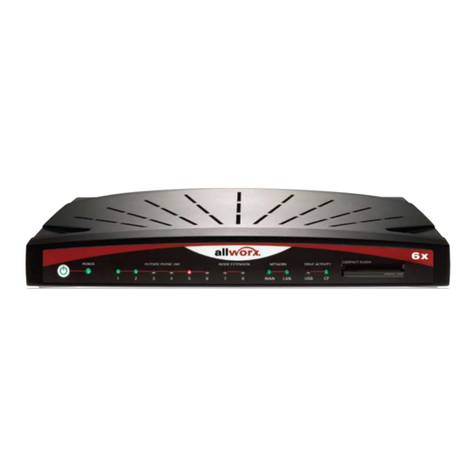
Relative to Allworx, because of its extensive breadth of capabilities it can provide the role of both DHCP server
and DHCP client, simultaneously, depending on the particular application. The DHCP server mode applies to
Allworx providing the DHCP service to computer hosts on your private LAN. While the default settings of the
Allworx DHCP server are generally sufficient, there is quite a bit of control over its behavior, including disabling
the server. These settings can be manipulated through the “Servers – DHCP” page of the administrative tools.
Note there should only be one DHCP server enabled per LAN network.
To make the DHCP server as seamless as possible, most settings the DHCP server provides to LAN clients
are determined automatically for you! This is one of the ways Allworx simplifies configuration and setup of your
network. However, for the more curious or technically inclined, we’ll describe how Allworx decides what values
to assign:
• IP Address – The IP Address is always a LAN address from the available pool. Allworx defaults to
assigning addresses from the dynamic range of “1” through “100” on the LAN subnet, skipping its own
address if it overlaps. This range can be adjusted on the DHCP server settings page if desired. Allworx
will assign addresses for up to 254 hosts on the LAN.