manuals.online logo
Brands
  1. Home
  2. •
  3. Brands
  4. •
  5. Bakers Pride
  6. •
  7. Oven
  8. •
  9. Bakers Pride GP-51 Series User manual

Bakers Pride GP-51 Series User manual

Other manuals for GP-51 Series

3

This manual suits for next models

1

Other Bakers Pride Oven manuals

Bakers Pride P24-BL Quick start guide

Bakers Pride

Bakers Pride P24-BL Quick start guide

Bakers Pride P-44S User manual

Bakers Pride

Bakers Pride P-44S User manual

Bakers Pride EHE series User manual

Bakers Pride

Bakers Pride EHE series User manual

Bakers Pride Vantage 100 Series User manual

Bakers Pride

Bakers Pride Vantage 100 Series User manual

Bakers Pride Y-600-DSP User manual

Bakers Pride

Bakers Pride Y-600-DSP User manual

Bakers Pride COC-E Series Installation manual

Bakers Pride

Bakers Pride COC-E Series Installation manual

Bakers Pride GP-51 Series User manual

Bakers Pride

Bakers Pride GP-51 Series User manual

Bakers Pride 251 User manual

Bakers Pride

Bakers Pride 251 User manual

Bakers Pride SUPER DECK Y-600 User manual

Bakers Pride

Bakers Pride SUPER DECK Y-600 User manual

Bakers Pride SUPER DECK Y-600 User manual

Bakers Pride

Bakers Pride SUPER DECK Y-600 User manual

Bakers Pride VH-1828G-1 User manual

Bakers Pride

Bakers Pride VH-1828G-1 User manual

Bakers Pride Superdeck Y600 Series User manual

Bakers Pride

Bakers Pride Superdeck Y600 Series User manual

Bakers Pride D-125 DSP Single Manual

Bakers Pride

Bakers Pride D-125 DSP Single Manual

Bakers Pride BK-18 User manual

Bakers Pride

Bakers Pride BK-18 User manual

Bakers Pride APC-18 User manual

Bakers Pride

Bakers Pride APC-18 User manual

Bakers Pride Y-800 User manual

Bakers Pride

Bakers Pride Y-800 User manual

Bakers Pride P-44S Quick start guide

Bakers Pride

Bakers Pride P-44S Quick start guide

Bakers Pride EP-2-2828 Single User manual

Bakers Pride

Bakers Pride EP-2-2828 Single User manual

Bakers Pride P-44BL User manual

Bakers Pride

Bakers Pride P-44BL User manual

Bakers Pride BAKERS PRIDE D-125 User manual

Bakers Pride

Bakers Pride BAKERS PRIDE D-125 User manual

Bakers Pride BPCV-1 User manual

Bakers Pride

Bakers Pride BPCV-1 User manual

Bakers Pride DS-805 Single User manual

Bakers Pride

Bakers Pride DS-805 Single User manual

Bakers Pride V600 User manual

Bakers Pride

Bakers Pride V600 User manual

Bakers Pride PX-14 User manual

Bakers Pride

Bakers Pride PX-14 User manual

Popular Oven manuals by other brands

Brandt FC 222 user manual

Brandt

Brandt FC 222 user manual

aumate TOA20M04N-1E instruction manual

aumate

aumate TOA20M04N-1E instruction manual

Maytag CWE4100AC - 24" Single Electric Wall Oven Dimension Guide

Maytag

Maytag CWE4100AC - 24" Single Electric Wall Oven Dimension Guide

Kernau KBO 1076 S PT B instruction manual

Kernau

Kernau KBO 1076 S PT B instruction manual

Bosch HB 37 N Series User manual and installation instructions

Bosch

Bosch HB 37 N Series User manual and installation instructions

Electrolux EOD5420AA user manual

Electrolux

Electrolux EOD5420AA user manual

Mx Onda MX-HC2183 instruction manual

Mx Onda

Mx Onda MX-HC2183 instruction manual

Daewoo F6EV19SM2 Service manual

Daewoo

Daewoo F6EV19SM2 Service manual

Blodgett MT3870 Specifications

Blodgett

Blodgett MT3870 Specifications

GE ZET2F owner's manual

GE

GE ZET2F owner's manual

GE JK3000DF3WW owner's manual

GE

GE JK3000DF3WW owner's manual

eka EKF 523 NT Operating and instruction manual

eka

eka EKF 523 NT Operating and instruction manual

AEG Electrolux E3191-5 user manual

AEG Electrolux

AEG Electrolux E3191-5 user manual

Pratica Rocket Express quick start guide

Pratica

Pratica Rocket Express quick start guide

Viking Professional VGSO260T user guide

Viking

Viking Professional VGSO260T user guide

FM RX203 instruction manual

FM

FM RX203 instruction manual

Bosch HBN331 9B Series instruction manual

Bosch

Bosch HBN331 9B Series instruction manual

NEFF B95M42N0MK Instructions for use

NEFF

NEFF B95M42N0MK Instructions for use

manuals.online logo
manuals.online logoBrands
  • About & Mission
  • Contact us
  • Privacy Policy
  • Terms and Conditions

Copyright 2025 Manuals.Online. All Rights Reserved.

BAKERSBAKERS
PRIDEPRIDE
INSTALLATION AND OPERATING INSTRUCTIONS
COUNTER TOP GAS DECK OVENS
MODELS: GP-51 and GP-61
INTENDED FOR OTHER THAN HOUSEHOLD USE
RETAIN THIS MANUAL FOR FUTURE REFERENCE
OVEN MUST BE KEPT CLEAR OF COMBUSTIBLES AT ALL TIMES
IMPORTANT INSTRUCTIONS
After the gas supply has been connected to your unit, it is extremely important to check piping for possible
leaks. To do this, use soap and water solution or solutions which are expressly made for this purpose.
DO NOT USE matches, candles, flames, or other sources of ignition since these methods are extremely
dangerous. Post in a prominent location instructions to be followed in the event you smell gas. Obtain these
instructions from your local gas supplier.
P/N U4128A 1/08
BAKERS PRIDE OVEN CO., INC.
30 Pine Street
New Rochelle, NY 10801
(914) 576-0200 Phone (800) 431-2745 US & Canada
(914) 576-0605 Fax www.bakerspride.com Web Address
Note: Only Pizza or Bread can have direct contact with ceramic decks. All other food products must be
placed in a pan or container to avoid direct contact with ceramic decks.
This equipment has been engineered to provide you with year round dependable service when used
according to the instructions in this manual and standard commercial kitchen practices.
For Your Safety: Do not store or use flammable liquids or vapors in the vicinity of this
or any other appliance.
!
!
Warning: Improper installation, adjustment, alteration, service or maintenance can
cause property damage, injury or death. Read the Installation, Operating and
Maintenance instructions thoroughly before installing or servicing this equipment.
!! Initial heating of oven may generate smoke or fumes and must be done in a well-
ventilated area. Overexposure to smoke or fumes may cause nausea or dizziness.
1
D
E
S
I
G
N
C
E
R
T
I
F
I
E
D
G -5
P1
GP-61
I. INSTALLATION INSTRUCTIONS
SECTION ITEM PAGE
1. Receiving 2
2. Clearances 3
3. Set-up 3
(a) Counter Top Installation 3
(b) Installation with Casters 3
4. Deck Assembly 4
(a) Pizza Deck 4
(b) Steel Deck 4
5. Gas and Electric Connections 4
6. Flue connection-Ventilation 5
(a) Under Ventilation Hood 5
(b) Direct Venting 5
7. Main Burner Safety Pilot Operation 5
(a) Pilot Burner Lighting Procedure 5
(b) Pilot Burner Flame Adjustments 5
8. Burner Operation 6
(a) Main Burner 6
(b) Aeration & By-Pass Flame Adjustment 6
9. Thermostat Calibration 6
10. Heat Baffle Assembly 6
CONTENTS
II. OPERATING INSTRUCTIONS
1. Lighting Procedure 7
2. Breaking In 7
3. Baking 7
4. Recommended Operating Procedure 7
5. Helpful Hints 7
III. CLEANING AND MAINTENANCE
1. (a) Oven Exterior 8
(b) Painted Surfaces 8
2. Control Panel 8
3. Flue Vent 8
4. Oven Interior 8
(a) Baking Chamber 8
(b) Baking Decks 8
(c) Burner Compartment 8
5. Troubleshooting Chart 9
PARTS LISTS & WARRANTY
GP-51 Parts List w/Exploded Views 10
GP-61 Parts List w/Exploded Views 13
Warranty 16
1. RECEIVING:
Read the notice on the outside carton
regarding damage in transit. Damage
discovered after opening the crate(s)
/carton(s) is 'CONCEALED DAMAGE' and
the carrier must be notified immediately to
send an inspector and also to furnish forms
for the consignee's claim.
When the oven arrives, it should consist of:
A carton containing your new oven (Two for
a stacked unit).
Installation must conform with local
codes and/or to the latest edition of the
ANS Z-223.1 National Fuel Gas Code in
USA ( CAN/CGA-B 149.1 or 2 Installation
Code in Canada).
This appliance must be installed
by a competent person in accordance
with the rules in force. In the U.K. Corgi
In MASSACHUSETTS: All gas
products must be installed by a
“Massachusetts” licensed plumber or
gas fitter. Ventilation hoods must be
installed in accordance with NFPA-96,
current edition, with interlocks as
described in that standard.
I. INSTALLATION INSTRUCTIONS
2
Models Covered
GP-51 40,000 11.71
GP-52 Consists of two GP-51 Ovens
GP-54 32,000 9.37
GP-55 Consists of two GP-54 Ovens
GP-61 45,000 13.18
GP-62 Consists of two GP-61 Ovens
GP-61-H 60,000 17.57
GP-62-H Consists of two GP-61-H Ovens
GP-64 42,000 12.30
GP-65 Consists of two GP-64 Ovens
These model numbers may be followed by a suffix (-1), indicating
units with one door on the Baking Chamber.
I
Model BTU/hr kw
For North America:
Type of Gas
Natural
LP
Manifold Pressure
3.5” Water Column
10.0” Water Column
EN 437
Gas
Cat.
Gases and Supply
Pressures A
T
B
E
D
K
F
I
F
R
G
R
D
E
I
E
I
T
L
U
N
L
P
T
E
S
S
E
G
B
G20 @ 20mbar ÿ ÿ
ÿ
ÿ
ÿÿ ÿ ÿ
ÿ
G25 @ 25mbar
ÿ
G20 @ 20mbar
ÿ
ÿ
I2H
I2L
I2E
I2E+
G20/25 @ 20/25mbar
ÿ
ÿ
Designated European Market = ÿ
For European Community Countries:
registered installers (including the regions of British Gas) undertake to work to safe and
satisfactory standards. This appliance must be installed in accordance with the current Gas Safety
(Installation and Use) Regulations and the relevant Building Regulations / IEE Regulations.
Detailed recommendations are contained in the British Standard Codes Of Practice BS 6172, BS
5440:Part 2 and BS 6891.
Place the oven and parts as close as possible to the area of final installation before un-crating.
IMPORTANT FOR FUTURE REFERENCE
Please complete this information and retain this manual for the life of the equipment. For
Warranty, Service and/or Parts, this information is required.
_____________________ ______________________ _____________________
Model Number Serial Number Date Purchased
2. CLEARANCES:
Minimum Clearance from Combustible Construction Non-Combustible Construction
Left Side 2" (51mm) 2” (51mm)
Right Side 1" (25mm) 0
Rear 5" (127mm) 2" (51mm)
3. SET UP: The oven must be installed in a well-ventilated area.
Your oven is packed in a carton and strapped to a skid. Remove the oven and carton from the skid before
unpacking. Unpack carefully to avoid damage to the oven. If concealed damage is found, follow the
instructions detailed in Section 1.
Keep the area around the oven free and clear of combustible materials. Do not store any materials on top of
or under any oven. The provision of an adequate air supply to your oven for ventilation and proper gas
combustion is essential. As a minimum, observe the clearances detailed in Section 2. Provide adequate
ventilation and make up air in accordance with local codes.
Fit the flue diverter (See fig.1) and the flue transition piece into the rectangular opening located at top near
the middle rear of the oven for installing the oven under a ventilation hood. For Direct Venting, Optional
Draft Hood (Fig. 2) must be used instead of the flue diverter. Direct Venting not available for European
Community Countries. Local inspectors and ventilation specialists should be consulted to make sure that
the installation of the hood conforms to the local codes and requirements (See fig. 3). In UK ventilation
requirements as detailed in BS 5440 should be followed.
Figure #3
VentHood
Draft Hood
ith(For use w
Direct Venting)
Figure #2
Flue Diverter
ith(For use w
Collection Hood)
Figure #1 Access to the bottom front door and left side control panel
is required for day-to-day operation of the oven and for
servicing. Make sure that these areas are kept
unobstructed for easy access.
A. COUNTER TOP INSTALLATION:
Oven is shipped with standard 4” legs installed.
(1) Move the oven to its final location keeping the
minimum clearance detailed in section 2
above. This clearance is essential to provide
adequate airflow to the burner chamber and for
safe operation of the oven.
(2) Level the oven by making required adjustments
to the legs.
B. INSTALLATION WITH CASTERS (OPTIONAL):
Four casters (two with wheel brakes) and the mounting
hardware is packed and included in the shipment if
ordered. Install casters with wheel brakes on the
front of the unit.
3
NOTE: Installation should be made with a connector that complies with the latest edition of the
Standard for Connectors for Movable Gas Appliances ANSI Z21.69 in the USA (CAN CGA -6.16 in
Canada) and a quick disconnect device that complies with the latest edition of the Standard for Quick
Disconnect Devices for use with gas fuel ANSI Z21.41 in the USA (CAN CGA1-6.9 in Canada) and
adequate means must be provided to limit the movement of the appliance without depending on the
connector and any quick disconnect device or its associated piping.
The restraint should be attached to the rear legs of the oven on which casters are mounted. If disconnection
of the restraint is necessary to move the oven for servicing needs, the restraint should be reconnected after
the appliance has been returned to its originally installed position.
NOTE: Use your hand to support the
deck from below, until deck is fully
installed in it’s final position.
Figure #4
DO NOT LET
DECKS DROP
INTO POSITION.
4. DECK ASSEMBLY:
A. PIZZA DECK:
(a) Remove all packing material, samples, shims, etc.
from the baking chamber.
(b) Two slabs of the Pizza Deck are provided with the
oven. Each deck is wrapped separately. Remove
the wrapping and handle the decks carefully. The
material is heavy and fragile.
Slab Installation (Fig. 4):
(a) Slide one deck into the oven over the bottom hearth
pan.*
(b) Slide the second deck onto the support angles on the
sides and back.*
B. STEEL DECK INSTALLATION:
Steel decks come installed in the oven from the factory and
no assembly is required. Before use, remove all packing
material and samples etc. from the baking chamber.
5. GAS AND ELECTRIC CONNECTIONS:
Propane gas units are not available in the European Community Countries.
(a) The appliance when installed, must be electrically grounded in accordance with local codes and/or
the latest edition of the National Electric Code ANSI/NFPA 70 in USA (Canadian Electric Code CSA
C22.2 in Canada).
(b) In Europe, appliance must be connected by an earthing cable to all other units in the complete
installation and thence to an independent earth connection in compliance with EN 60335-1 and/or
local codes
(c) The ovens should not be installed on the same line with space heaters, boilers or other gas
equipment with high intermittent demand.
(d) Use a pipe joint compound that is resistant to the action of liquefied petroleum gases when
making gas connections.
(e) For Propane gas, use at least 1/2" (13 mm) pipe or tubing with a 5/8" (16 mm) inside diameter. For
Natural gas, use 3/4" (19 mm) pipe.
(f) The appliance must be isolated from the gas supply piping system by closing its manual
shut-off valve during any pressure testing of the gas supply piping system at test pressures
equal to or less than 1/2" psig (3.45kpa).
(g) The appliance and its shut-off valve must be disconnected from the gas supply piping system during
any pressure testing of that system at test pressures in excess of 1/2" psig (3.45kpa).
(h) The gas pressure regulator is part of the combination valve and is adjusted to yield a pressure of
3.5" water column (9mbar) for Natural Gas. If the oven is ordered for use on Propane Gas, the
pressure regulator in the combination valve is preset at the factory to yield a pressure of 10" water
column (25 mbar). Units for use on Propane Gas are not available for European Community
Countries.
(i) A separate shut-off valve for each oven must be provided. It should be as close as possible
to the place where the gas supply line goes into the oven. It must be located such that it is
4

Figure #3
VentHood
Draft Hood
ith(For use w
Direct Venting)
Figure #2
Flue Diverter
ith(For use w
Collection Hood)
Figure #1
easily accessible.
(j) When stacking with another oven, two shut-off
valves, one for each of the two ovens, must be
provided.
After the Gas Supply has been connected, it is
extremely important to check all the piping for leaks.
Use a soap and water solution or a product expressly
made for this purpose. Do not use Matches, Candles
or a flame etc to check leaks since these methods are
extremely dangerous.
6. FLUE CONNECTION - VENTILATION:
(a) INSTALLATION UNDER VENTILATION HOOD
(STANDARD):
If the oven is not vented directly and is installed
under a collection hood, use the flue diverter
(fig.1) supplied. Local inspectors and ventilation
and environmental specialists should be
consulted so that the design and the installation of the hood conforms to the local / municipal codes
(see fig.3).
(b) DIRECT VENTING (Optional) NOT AVAILABLE FOR EUROPEAN COMMUNITY COUNTRIES:
If direct venting, it is necessary to install a draft hood (fig.2). The flue pipe from the draft hood must
not run downwards at any point from the oven to the final outlet. It should always slant slightly
upwards. For best results it should rise straight up.
NOTE: Do not put a damper in the flue and do not connect a blower directly to the flue. If the flue
runs directly to the free air outside the building, use a wind deflector or a UL listed vent cap at the end of the
flue pipe. Termination of the vent must be at least 2 feet above the highest part of the roof within 10 feet (Ref:
American Gas Association Catalog No. Xh0474)
7. MAIN BURNER SAFETY PILOT OPERATION:
The purpose of the safety pilot system is to lock the gas supply to the main burner at the combination
valve, if for any reason the pilot burner is not lit. Oven should be relighted by following the steps
given below. However, in normal service, the pilot flame stays lit indefinitely, day and night or
weekends. This prolongs the life of the safety valve.
The safety pilot valve is in effect a two-stage control. After initial lighting, the pilot burner stays on without
the gas cock dial being held pressed in. After 1-2 minutes, the valve opens fully to let the gas
flow past the safety pilot valve into the burner system.
A. PILOT BURNER LIGHTING PROCEDURE:
(a) Partially depress and turn the gas cock dial to 'OFF'() position.
(b) Wait for five minutes to allow gas, which may have accumulated in the burner compartment, to
escape.
(c) Turn gas cock dial to 'PILOT'( ) position.
(d) Depress gas cock dial and light Pilot Burner. Hold in pressed position for about ½ minute (30
Seconds), and release the gas cock dial. The Pilot Burner should now remain lit.
If Pilot Burner fails to ignite or does not remain lit, repeat the steps (a) through (d).
B. PILOT BURNER FLAME ADJUSTMENT:
It is important to have the correct Pilot Burner Flame size as shown in Fig.5. If necessary, adjust the
Pilot Burner Flame by turning Pilot Adjust Screw (See fig. 6) clockwise to reduce or counter-clockwise
to increase.
.
5
8. BURNER OPERATION:
(a) MAIN BURNER:
After the pilot burner is ignited, when heat is desired, turn gas cock dial to 'ON' () position and set the
thermostat dial to the desired temperature. The oven burner flame should always have a blue
appearance. That indicates a good mixture of gas and air. When using LP gas, the flame will have a
blue-yellow appearance.
Should the Burner fail to light, check to see if there is a problem with the gas supply. If there are other
appliances on the same line, shut them off temporarily and see if the burner comes back on, or it
fluctuates as other gas appliances are turned on and off. That would indicate overloading of the gas
supply lines or a faulty gas pressure regulator. Contact an authorized Service Agency or your local
Gas Supply Company.
(b) AERATION AND BY-PASS FLAME ADJUSTMENT:
Flame and air mixer adjustments and the By-Pass Flame adjustment for the Main Burner are done
at the factory. These adjustments are sealed before the oven leaves the factory. Contact an
authorized Service Agency if you need help.
9. THERMOSTAT CALIBRATION:
No attempt should be made to calibrate the thermostat because it is accurately calibrated and sealed by
the manufacturer. Contact an authorized Service Agency if you need help.
10. HEAT BAFFLE ASSEMBLY:
The Heat Baffle Assembly distributes the heat evenly below the baking deck. It must be in good
condition in order to be effective. A damaged Heat Baffle will adversely affect the oven performance.
Check it periodically and replace as necessary.
II. OPERATING INSTRUCTIONS
NOTE: Only Pizza and Bread Products can have direct contact with Ceramic Decks. All other food
products must be placed in a pan or containers to avoid direct contact with Ceramic Decks.
If gas odor is detected at any time, immediately shut-off the gas supply valve for the oven. Do not
permit any open flames in the area of the oven. Immediately contact an authorized Service Agency
or your local Gas Supply Company.
Initial heating of the oven must be done in a well-ventilated area as it may generate smoke or fumes.
Over exposure to smoke or fumes may cause nausea or dizziness
3/8”-1/2”
Correct Flame
Figure #5 Figure #6
Thermostat
Pilot
Feed
Gas
Cock
Dial
Pressure
Regulator
Pilot
Adjust
Screw
6
1. LIGHTING PROCEDURE:
(a) Light the Main Burner following the instructions in Section 7A of the Installation Instructions.
2. BREAKING IN:
It is important to break-in, to dry out the deck and the insulation, before baking in a new oven:
(a) Allow the oven to warm to 300°F(150°C) for 5 hours or at least till all the smoke and fumes have
disappeared. The smoke and fumes are from the moisture in the deck and insulation and a light coat
of oil.
(b) Set the thermostat at least 50°F (10°C) lower than your baking temperature.
(c) Pre-heat the oven for 1 to 1½ hours before use.
(d) After pre-heating, raise the temperature to your baking temperature.
(e) Experiment baking until you get the feel of the oven and the speed of the bake.
3. BAKING:
Pizza can be baked on the deck, on a screen or in a pan. When you determine the combination of
method, ingredients and temperature that gives the right bake for your crust, sauce and cheese
combination and your customer's taste, mark and keep it.
Deck baking refers to baking Pizza directly on the deck. Generally it is a thin product that requires
temperature of at least 550°F (290°C).
Screen baking refers to baking Pizza on a screen. The screen lifts the Pizza off the deck. The screen
may be removed near the end of the bake time to give the bottom of the Pizza crispier crust and a
darker color. Bake temperatures range from 500°F (260°C) to 550°F (290°C).
Pan baking refers to baking Pizza in pans. Crusts can be thick or thin and toppings range from light
to heavy. Bake temperatures for pan baking range from 450°F (235°C) to 500°F (260°C).
4. RECOMMENDED OPERATING PROCEDURE:
It is very important that at the end of day's operation, the gas cock dial of the Main Burner is
turned to the pilot position, leaving only the pilot burner 'ON' overnight.
Preheating:
(a) Turn the gas cock dial of the main burner to the 'ON' position.
(b) Preheat the oven for 1 to 1 ½ hours at 50°F (10°C) lower than your baking temperature.
Baking:
(a) When ready to bake, raise the thermostat setting to your baking temperature.
5. HELPFUL HINTS:
(a) If the oven is up to Pizza baking temperature and has not been used for a while, there is a tendency
for the baking deck to get hotter. In this condition, when you put in one Pizza, TURN THE
THERMOSTAT UP, so that the main burner flame is burning at it's fullest, providing the extra heat
needed to balance the bottom heat. The thermostat should be turned down back to the normal
setting as soon as you have baked the Pizza.
(b) Top section takes longer to bake as compared to the bottom section. Allow 1 to 2 minutes extra bake
time for the items placed there.
(c) Frequently scrape and brush off decks to remove burnt residue which can cause an “off” flavor and
bake times to increase.
(d) Heavily topped Pizza or Pan Pizza requires lower bake temperatures and longer bake times as
compared to a regular thin Pizza with light toppings.
(e) Bubbles in fresh dough indicate under proofed or cold product. Allow the dough balls to proof to
double in size and warm temperature before baking.
(f) Any type of Pan or Screen may be used in this oven. When choosing pans, be sure to pick a pan
which is closest in height of your product. Dark color pans and screens transfer heat better than
light colored aluminum pans or screens. They must be seasoned before use.
7
III. CLEANING AND MAINTENANCE
This appliance must be serviced by an Authorized Service Technician only. Disconnect the power
supply before cleaning or servicing the oven.
Regular and thorough cleaning will help to keep the ovens operating properly. If service is required, contact
an Authorized Service Agency, your dealer or the factory to obtain a qualified technician for the required
maintenance/service.
1A. OVEN EXTERIOR:
(a) Deposits of baked-on splatter and grease, or discoloration may be removed with the stainless steel
cleaner sample supplied or by using any commercial cleaner recommended for stainless steel.
Bakers Pride offers a stainless steel cleaner expressly for this purpose. RINSE WELL
(b) A thin coat of light oil will add to the appearance of the oven.
NOTE: Apply stainless steel cleanser only when the oven is cold. Always rub with the grains
and apply very light pressure.
1B. PAINTED SURFACES:
(a) Washing with mild soap and water solution is adequate to keep the painted surfaces clean.
(b) Apply a thin coat of oil to protect and enhance the finish
2. CONTROL PANEL:
Every six months (more frequently if the oven is used heavily) the bottom door spring mechanism
and all moving parts must be inspected for wear.
Do not apply grease to spring lever shoulder bolt, spring roller or the door rod and the door
pin. They have a self-lubricating insert that will be damaged if lubricated.
3. FLUE VENT:
Ventilation system must be inspected every six months and maintained clean and free of obstructions.
4. OVEN INTERIOR:
Clean the oven interior only when the oven is cold. Use only the detergent solutions and cleaners that
meet the national and / or local codes.
(a) BAKING CHAMBER:
Clean the ceiling and the walls of the baking chamber with a mild soap and water solution. Do not
use oven cleaners, caustic solutions or mechanical means as they will damage the interior
aluminized surface.
(b) BAKING DECKS:
The baking decks are heavy and fragile. They should be handled carefully.
The baking decks should be cleaned by using a long-handled scraper and stiff wire brush. At the end
of each day, turn the thermostat up to its maximum setting and let the oven sit at that temperature for
at least ½ hour. This will burn off the food spilled onto the baking decks during day's production and
turn it into ash. This ash can be brushed off the next day before turning the oven on. The baking
decks should be scraped and brushed during the day also to help keep them clean. To remove
excessive crumbs or carbon, the baking decks and the oven cavity may vacuumed when the oven is
cold. Do not use water or other liquids on the baking decks as that may cause them to crack.
After long use, heavily soiled baking decks may be cleaned by turning over after scraping down and
brushing off. This will burn off the heavily soiled side of the baking decks. This procedure may be
repeated as needed.
(c) BURNER COMPARTMENT:
Vacuum out any carbon, crumbs or residue in the burner compartment and all around the doors. The
holes and louvers on the outer surfaces of the oven must be kept free of obstructions to allow free
movement of air into the controls and for proper combustion. The burner ports and crossover holes
should be kept free of carbon and other deposits.
8
No Pilot Light
Main Burner(s) do
not light
Oven too Hot
Bottom of pies are
undercooked
Bottom of pies burn
before toppings are
cooked
Pies cook unevenly
Oven does not turn
On or Off on time.
(Ovens equipped
w/auto oven starter
only)
Unit takes too long
to reach
temperature
Gas valve feeding oven may
be in the closed position.
Gas valve feeding oven may
be in the closed position
Thermopile may not be
positioned in pilot flame.
Thermopile may be
defective.
Thermostat set too high.
Thermostat or thermocouple
may be defective.
If the same area of the deck
is used repeatedly, the deck
temperature in that area will
be reduced.
Deck temperature too hot -
especially during slow
periods.
Oven was left "ON"
overnight.
Exhaust fan too powerful.
Area's adjacent to oven
walls are generally hotter.
Power cord not plugged in.
Electrical outlet fuse/circuit
breaker is tripped.
Timer incorrectly set.
Gas volume or gas pressure
may be inadequate.
Thermostat or thermocouple
may be defective.
Turn gas valve on. Relight pilot.
Ensure that the tip of thermopile is in pilot flame.
Call local authorized Bakers Pride Service Agent.
Lower the thermostat setting and see if flame
reduces in size. Allow several hours for heat to
regulate.
Call local authorized Bakers Pride Service Agent.
Rotate pies to unused areas of the bake deck
that are hotter and will cook the bottoms faster.
Reduce Thermostat setting by 50° - 75° below
normal bake temperature. When decks cool
begin cooking and immediately increase the
thermostat setting by 50° - 75°.
Oven must be turned to "Pilot" position overnight.
It should not be left on a high temperature
setting.
Reduce fan speed.
Rotate pies (180°), once during each bake or
keep to the center of oven.
Plug unit in.
Replace fuse or reset circuit breaker.
Reset Timer.
Contact gas supplier.
Call local authorized Bakers Pride Service Agent.
PROBLEM PROBABLE CAUSE REMEDY
5. TROUBLESHOOTING CHART
9
GP-51
Counter Top Gas Oven
30 Pine Street • New Rochelle • New York • 10801
914 / 576 - 0200
914 / 576 - 0605
1 - 800 - 431 - 2745
www.bakerspride.com
fax
US & Canada
web address
BAKERS
PRIDE
1
2
3
4
5
6
7
8
9
10
11
12
13
14
15
16
17
18
19
20
21
22
23
24
25
26
27
28
29
30
31
32
33
34
35
36
37
38
39
40
41
43
44
47
45
46
47
48
49
50
51
53
52
42
54
55
56
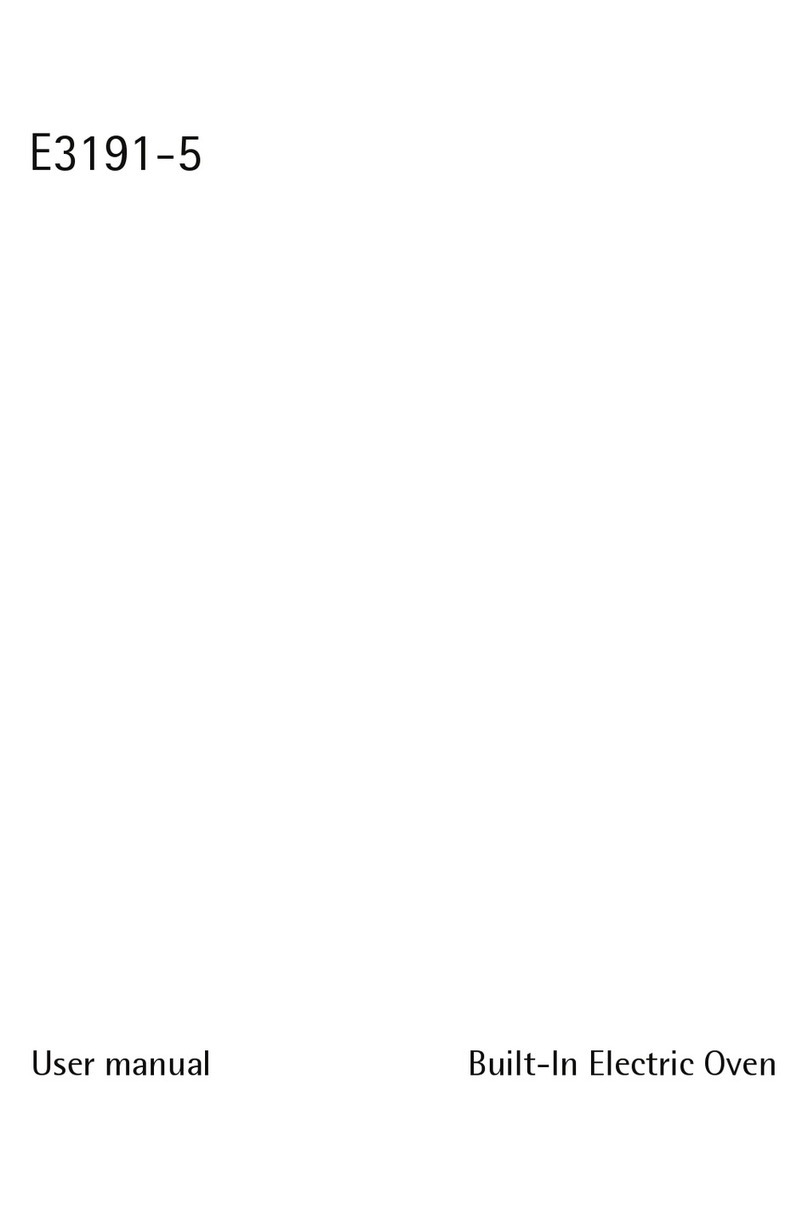
Figure A Exterior / Decks / Burner Compartment / Door Rod / Interior Trim
Page 2 of 4 Note: When ordering, ALWAYS specify Part #, Model #, Serial # and type of gas. 9/05
27
20
19
18
17
16
15
14
13
12
11
10
9
8
7
6
5
4
3
2
1
40
39
38
37
36
35
34
33
32
31
30
29
28
26
25
24
23
22
21
45
44
41
54
55
43
47
47
56
49 53
48
46
42
52
50
51
10