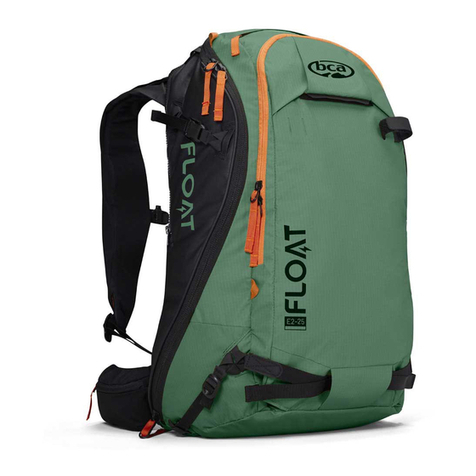
bca Float series User manual

Owner’s Manual
Bedienungsanleitung
Manuel D’Utilisation
Manuale di istruzioni

2
Why do I need an avalanche airbag?
Preventing or minimizing burial depth is the key to reducing avalanche fatalities. That’s because the
majority of time in an avalanche rescue is spent on excavating the victim. An airbag is designed to
keep you at or near the surface, minimizing excavation time.
Disclaimer
The Float system is designed to help improve your chances of surviving an avalanche. It must be
used correctly, following the guidelines in this manual. Perform a practice deployment at least once
a year. Do not modify any aspect of this product or perform any operations not described in this
manual.
Your Float cannot prevent the release of an avalanche or guarantee survival under any conditions.
Any airbag must be used in conjunction with a beacon, shovel, probe, and helmet to increase your
chance of survival. As with other avalanche rescue tools, your airbag should not promote taking
more risks.
In addition to these rescue tools, you should acquire the necessary skills to avoid avalanche
situations before heading into the backcountry. Take an avalanche safety course, practice with your
equipment, and plan your route according to the regional avalanche forecast.
Warranty
The manufacturer, Backcountry Access, Inc. (BCA), expressly warrants the workmanship and
components of this product for three years after the date of retail purchase. All parts will be either
repaired or replaced free of charge, including labor, by the manufacturer. This warranty does not cover
damage to the product caused by improper use or excessive wear and tear. Direct all warranty claims
to BCA or your airbag retailer. All claims must include proof of purchase and a return authorization
number.
To ensure warranty protection and periodic technical updates please register online at:
www.backcountryaccess.com/warranty
Theory of Operation / Disclaimer / Warranty

3
Instructions and Warnings
Failure to follow these instructions and warnings may result in death or serious personal injury.
• ThepurposeoftheFloatAvalancheAirbagistoreducethelikelihoodofburialduringan
avalanche. Any avalanche can be deadly.
• Itisimportanttopracticebeforetakingthesysteminthefield.Apracticedeploymentat
least once a year is recommended.
• BeforetakingtheFloatAvalancheAirbagintothefield,inspectalltriggerandhose
connections and ensure they are properly attached as described in this manual.
• Thepressuregaugeonthecylindermustreadbetween2500psi–2700psiat70°F
(21°C)orthesystemmaynotfullyinflate.
• Thewaistbeltandlegstrapmustbeworntoensurethebackpackstaysinitsintended
position in the event of an avalanche.
• Avoidplacingsharpobjectsuchascrampons,icetools,polesorexposedski/snowboard
edges near or on top of the airbag compartment. Only carry skis using the diagonal ski
carry. Do not use the side compression straps for A-frame carry, as they may obstruct the
airbag’sdeploymentand/ordamagetheairbag.
• Alwaysfoldtheairbagaccordingtothedirectionsdetailedinthismanual.Failuretodoso
may prevent the system from inflating properly.
• Toreducethelikelihoodofinadvertentinflation,storethetriggerhandlezippedinthe
shoulder strap. This is recommended when you or others could be harmed by the system
such as when on chairlifts, gondolas, helicopters, buses, trains, cars, etc.
• Whennotinuse,keepthesysteminacool,dryplaceawayfromdirectsunlight.
• Neverattempttoalterorrepairthesystem.OnlyBackcountryAccess,Inc.authorized
service centers may work on or repair the system. Any unauthorized work or alterations
will void the warranty.

4
Equipment Check
ejector assembly
release valve cover
coupler gauge
quick
connecttting
air cylinder
air hose
trigger cover
pressure gauge
trigger cable
Compressed Air System
|
w
u
v
y
z
x

5
1.Removepackagingcapsfrompressurizedaircylinder.Toreachthecompressedairsystem,unzip
the main storage compartment and fold back the fabric compressed air system cover.
2.Connectthequickconnectfittingontheairhoseuby pulling the large ring toward the pressure
gauge . It should click back into place when air hose wis properly connected. Coupler gauge x
should fit in place to ensure air hose is connected properly. WARNING: If the coupler gauge will
not fit in place, the system may not inflate.
X
uu
x
xx
u
u
3. IMPORTANT! Screw the trigger cable nut onto the trigger pin 11 . To expose the trigger
cable nut before threading it on the trigger pin, it might be necessary to push the trigger handle 12
back into the shoulder strap. WARNING: Failure to screw the cable nut onto the trigger pin will
prevent the system from inflating.
4. Screw the trigger cover zover the trigger cable nut .
5. Once cylinder is placed in
the sleeve, secure the Velcro
closure on the cylinder
compartment.
6. To disconnect an empty
cylinder, follow the above
steps in reverse.
Installing Compressed Air Cylinder
TRIGGER CABLE NUT ATTACHED
TRIGGER COVER ATTACHED
z
z
z
11

6
Equipment Check – Before Every Use Check the Following:
System Fittings
Follow the previous “Installing Compressed Air Cylinder” steps to verify connections are correct.
Verify the trigger cable nut connection by unscrewing the trigger cover zand making sure the
trigger cable nut is attached securely to the trigger pin 11 .Replacetriggercover.
Air Cylinder
Check the pressure gauge {onthecompressedaircylinderandmakesureitisbetween2500and
2700psi(172to186bar)atroomtemperature(approximately70°For21°C).Pressuremust
be checked at room temperature for the reading to be accurate. Check pressure before every use.
WARNING: PRESSURE MUST BE IN THIS RANGE OR THE SYSTEM MAY NOT FUNCTION
PROPERLY. Once the system is exposed to cold, the pressure will drop. If the pressure is ever
observedbelow2000psi(138bar),atanytemperature,theairbagmaynotfillcompletely.
Inspect the cylinder. Do not use a cylinder that is dented or damaged.
Pack
Make sure the Velcro flap on the top of the
airbag compartment is securely fastened.
This will ensure that the airbag is
completely stored and secure.
Only the airbag and ejector are meant
to be stored in the airbag compartment. WARNING: Never store any additional items in this
compartment; items may prevent the airbag from deploying.
Check that nothing is loose inside the compressed air system or blocking the ejector assembly.
Make sure the compartment is zipped completely shut.
Check to make sure that nothing is obstructing the airbag compartment on the outside of the pack.
WARNING: Avoid placing sharp object such as, crampons, ice tools, poles or exposed ski/
snowboard edges near or on top of the airbag compartment. Only carry skis using the diagonal
ski carry. Do not use the side compression straps for A-frame carry, as they may obstruct the airbag’s
deploymentand/ordamagetheairbag.
Perform visual inspection of stitching and fabric of the backpack. Ensure that the carrying system of
the backpack is not torn, abraded, or worn. Damaged gear must be retired.
Using the Avalanche Airbag
WRONG SECURE

7
Pack Adjustments
Your pack should be properly fitted before you head into avalanche terrain. The
forces of an avalanche can rip the pack from your back if it is not secured to your
body.
Attaching Leg Strap
The leg strap is an important component of this system, and must always be worn
by passing it between your legs and threading the loop over one end of the waist
buckle. For more information please reference the Components and Features section
in this manual.
Waist Buckle
There are two parts to the buckle: male and female. Insert the male part into the widest opening of
thefemalepart.Tightenthewaiststrapuntilsnug.Whenattachedcorrectly,thewebbingandthe
buckle should lay flat against your body. WARNING: The waist belt must be fastened for the
system to function.
Deployment
Before entering avalanche terrain, unzip the pocket where the trigger handle
is stored (see image on right). In case of an avalanche, pull the trigger handle
quickly in a downward motion, reaching across your body with the hand
opposite the trigger. Try skiing or riding to the flanks of the avalanche to escape
the debris. In the event that you are buried, preserve your airway by covering
your mouth with your hand or elbow when the avalanche slows down.
What to Expect
The airbag should exit the backpack and fill completely in approximately
three seconds. The airbag will continue to build pressure for a few seconds
longer until the system pressure equalizes. The airbag will hold air for several
minutes until the threat of the avalanche has passed.
After Deployment
Releasetheairfromtheairbagbypressingthereleasevalvewithyourfinger.Tolocatethevalve
open the mesh cover on the ejector |, the valve is underneath the orange release valve cover .
Neverusehardorsharpobjectstoholdthereleasevalveopen.Makesurethereleasevalvereturns
totheoriginalpositionafterdeflation.Re-packtheairbagintotheairbagcompartment.See“Packing
the Airbag” below for details.
Using the Avalanche Airbag
12

8
WARNING: If you have deployed your airbag in an avalanche, the airbag must be inspected
by the manufacturer before additional use. Please contact BCA for a free airbag inspection and
cylinder refill. Contact information can be found on the back cover.
Packing the Airbag
The airbag must be folded into the airbag compartment. DONOTROLLORSTUFFTHEAIRBAG
ORTHESYSTEMMAYNOTDEPLOYPROPERLY. If the airbag is wet, dry it completely before
packing. Empty any residual air from the airbag using the release valve (you may need to do
this periodically as you pack the bag). It is very important that all residual air has been released.
Reseat the orange valve cover. Pull the mesh cover back over the ejector and cinch the draw
string. Disconnect the air hose from the cylinder before folding the airbag.
1.Completelyseparatethezippersothesliderisonlyattachedtoonesetofteeth.
2.Bringzippersliderbacktotheoppositesideofpackwherethezipperbegins(a).
3. Begin by laying out the deflated airbag flat on the ground. Make one vertical accordion fold on
each side of the airbag (b).
4.Nextmaketwohorizontalaccordionfoldsontheairbag(c).Afterthisstep,yourairbagisready
to be zipped inside the airbag compartment.
5.Withtheairbagfoldedinsidethecompartment,re-engagethezipper(d)andzipthe
compartment past the Velcro flap at the top of the compartment (e). Fasten Velcro and finish
zippingthecompartmentclosed(f).Neverreversethezipperpulloverthebreakawaysectionon
the airbag compartment zipper as this may cause the zipper to jam or break.
Maintenance
a
b
c
d
e
f

9
Empty Cylinder
The Float airbag will not deploy again until the cylinder is refilled or replaced. This can be done at a
FloatRefillorExchangeCenter(seewww.backcountryaccess.com/refillcenters).Toinstallthefilled
cylinder, see “Installing Compressed Air Cylinder.”
Removing and Installing the Airbag System
The Float packs feature a removable and interchangeable airbag system. The airbag components
canbeswappedbetween2012-13ornewerpacks,orremovedentirely.
Removing
1.Toremovetheairbag,opentheairbagcompartmentbypullingthebreakawayzipperapart
undertheVelcroflap.Nevertryto“unzip”theairbagcompartmentzipper.Doingsocouldresultin
damage to the breakaway zipper.
2.Disconnectthetriggercableandairhosefromthecylinder(a).
3. Unfasten the black Velcro holding the loose end of the orange rope in place. Un-thread the rope
from the webbing loops (b).
4. Once the rope is no longer threaded through the webbing loops, the airbag, ejector, trigger
cable and air hose are free to remove (c). The trigger cable stays with pack, but can be removed
as noted later in the section “Moving the Trigger.”
a
b
c
Maintenance

10
Installing
1.Withtheairbagunfolded,laytheejectorintheairbagcompartmentwiththeorangereleasevalve
cover facing up (a). The air hose should be fed through the designated opening (b) into the main
storage compartment where the cylinder is kept.
2.Startingonthesidewiththefixedendoftheorangerope,threadtheropedownwardthroughthe
first slit in the airbag. Thread the rope through the first webbing loop then upward back through the
firstslit.Repeatthisstepwitheachslit(c)untilyoureachtheejectortube.
3. Once the threading is complete up to the ejector tube, pull the rope tight. This action will pull the
webbing loops up through the attachment slits in the airbag.
4. Bring rope over ejector tube.
5.Repeatthreadingtechniquethroughremainingslitsandwebbingloops.
6. Secure the loose end of the orange rope by running it up through the black Velcro loop, then loop
it back down and fold the Velcro flap over it.
7.Repackairbagandclosecompartment(seeaboveinstructionsforrepacking).
8.Reconnecttriggercableandairhosetocylinder(d).
Installing
ab
c
d
Table of contents
Other bca Accessories manuals