Rev_01_29.05.2013 Bruce Goldsmith Design GmbH, Hügelweg 12, 9400 Wolfsberg, Austria 8
Rapid descent maneuvers
BGD must point out that these manoeuvres should only be learnt under the supervision of a qualified
instructor and always used with caution. Please keep in mind that properly analysing the conditions before
launch will help avoid the need to use these techniques.
Wing Tip Area Reduction (Big Ears)
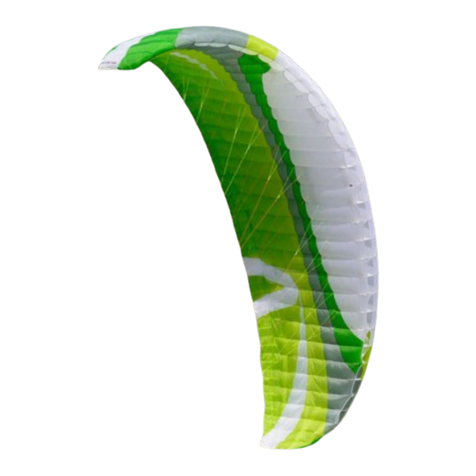
The ‘baby A riser’ allows the LUNA to be ‘big eared’. The big ear device does not allow you to fly in stronger
winds, but is a device which allows the pilot to descend quickly without substantially reducing the forward
speed of the canopy (as is the case with B lining). To engage big ears the pilot will grasp the ‘baby A riser’
(one in each hand) at the karabiner and then pull the riser out and down until to collapse the tips of the glider.
It is very important that the other Alines are not effected when you do this as it could cause the leading edge
to collapse. Steering is possible by weight shifting with big ears in. If the big ears do not come out quickly on
their own then brake gently one side at a time until tips regain pressure.
Never try to pull big ears during powered climb, as can lead to increase of the angle of attack and a
dangerous parachutal stall.
Never try to pull the Big Ears in with the speed bar on already. This can lead to a major asymmetric deflation.
Do not combine Big ears and spiral dive as the high forces applied to the lower lines could exceed the
breaking strength of the lines leading to equipment failure!
B-Line Stall
For emergency situations only is B-Line stall a fast descent method. With both hands through the brake
handles, the pilot takes hold of the top of the B risers, one in each hand, and pulls them down. Executing a
B-stall on LUNA is hard due to specific suspension lines location in stabilizers area.
This will stall the canopy and forward speed will drop to zero and the descent rate should be around 6 m/sec.
When pulling the B-Lines too far the glider may horse shoe and start to oscillate a lot. Make sure you have
plenty of height. For exiting the B-Line stall you should release the B riser fairly quickly as the pitching
movement of the canopy is necessary to get it flying properly again - releasing too slowly may result the
glider entering a deep stall. Always release the riser symmetrically as an asymmetric release from a B line
stall may result in the glider entering a spin.
The pitching movement on exiting the B stall is small but necessary. We recommend you do not apply brake
to the glider until you are sure that the wing is flying fully again; let the reflex profile to dampen the movement
of pitch.
This manoeuvre is useful when losing a lot of height quickly is necessary, perhaps when escaping from a
thunderstorm. It should not be performed with less than 100 m of ground clearance.
Spiral Dive
A normal turn can be converted into a strong spiral dive by continuing to apply one brake. The bank angle
and speed of the turn will increase as the downward spiral is continued. Once in the spiral you must apply a
little of outside break to keep the outer wing inflated and pressurized. No spirals with descent rates of more
then 8 m/sec should be executed –even then but you will enter high G-Forces which may be disorientating
and stress your body - also pay high attention on the altitude. LUNA is a very agile paramotor glider, so
entering spiral dive happens very quickly and can be surprising for the less experienced pilot. Be careful to
enter the spiral gradually as too quick a brake application can cause a spin or enter an 'over the nose' spiral.
Because of centrifugal force due to the strong rotation generates an important there is a G-forces that make
it difficult to sustain a spiral dive for long, as will place high loads on both pilot and glider to degree of losing
consciousness by the pilot.
Care should be taken when exiting from any spiral dive. To pull out of a steep spiral dive release the applied
brake gradually, or apply opposite brake gradually. Asharp release of the brake can cause the glider to surge
and dive as the wing converts speed to lift. Always be ready to damp out any potential dive with the brakes.
Also be ready to encounter turbulence when you exit from a spiral because you may fly though your own
wake turbulence, which can cause a collapse.
If the dive is not stopping after releasing the brake, assist the glider with the outer one.