7
Install the coax feedline as shown. Make a 10 turn
coil of coax 6" in diameter and tape it to the boom.
This takes place of a balun and keeps RF off of the
outside of the feedline and tower. Then tape the
feedline to the boom and mast. Be sure that the coax
is not free to swing in the wind, putting stress on the
coax connector!
REFLECTOR ASSEMBLY
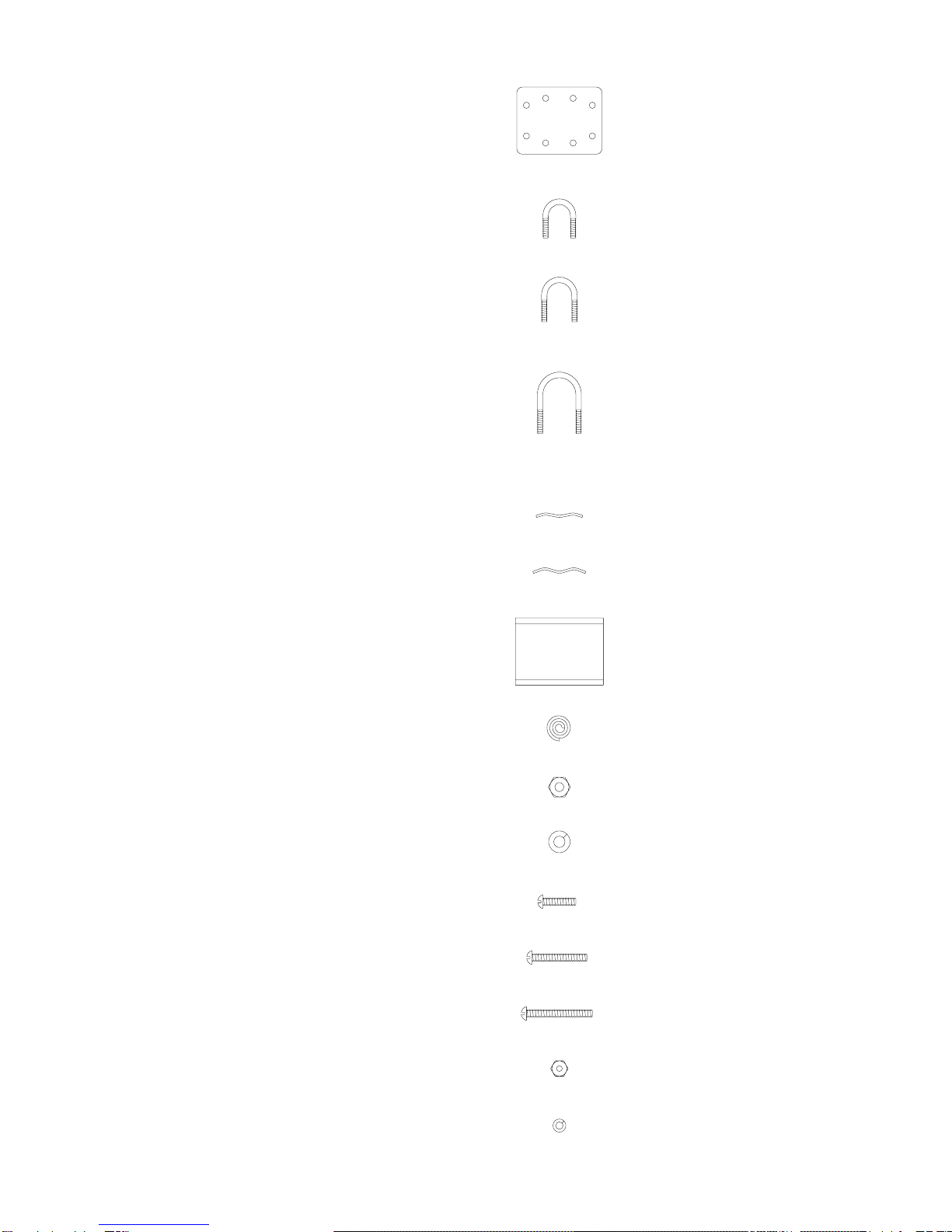
2. Attach a boom to element plate (N) to the fiberglass insulator (B) on the driven element using u-
bolts (O), lock washers (W) and
hex nuts (V). Center the plate so
it does not contact tubes (A).
Tighten securely.
3. Attach the remaining boom to ele-
ment plate (N) to the reflector as
per step 2.
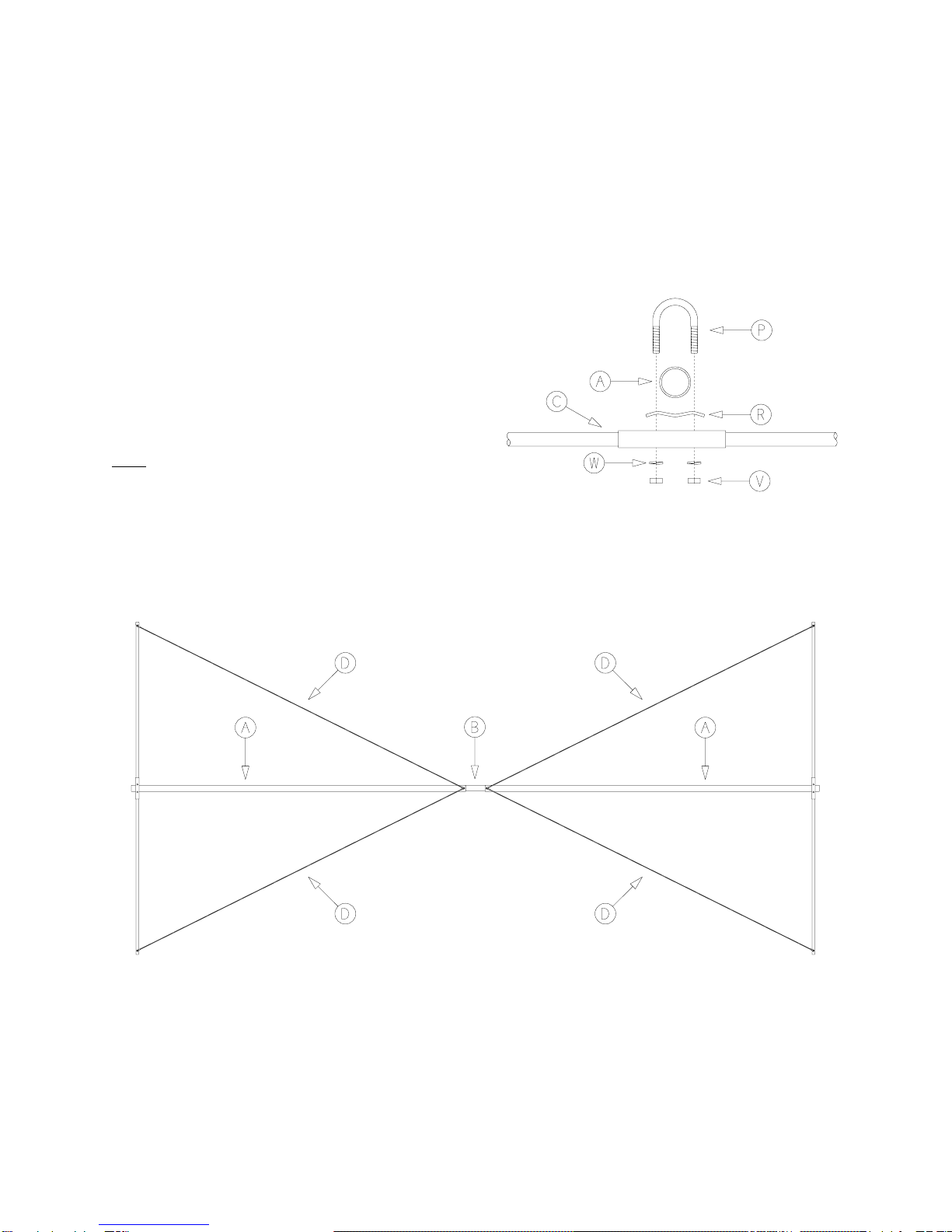
4. Fasten each boom to element
plate (N) to tube (L) using u-bolts
(P), M-shaped backing clamp (R),
lock washers (W) and hex nuts
(V).
5. Install the boom to mast plate (M)
at the center of tube (L). Secure
with the u-bolts (P), M-shaped
backing clamp (R), lock washers
(W) and hex nuts (V). Boom to
mast plate (M) will be 90° to the
boom to element plates (N).
This completes assembly of your But-
terfly™ antenna. Check to see that all
hardware is tight.
OPERATION
CAUTION: TO AVOID ELECTRICAL SHOCK, BE SURE THAT ALL TRANSCEIVERS AND
ACCESSORIES ARE UNPLUGGED FROM THE POWER MAINS BEFORE YOU CONNECT
THE FEED LINE. FOLLOW THE TRANSCEIVER MANUFACTURE’S DIRECTIONS RE-
GARDING GROUNDING. LOCAL ELECTRICAL CODES MAY APPLY.
The Butterfly™ is a directional antenna. That means
that most of the signal will be transmitted in one direc-
tion, off the end with the driven element. The antenna
must be pointed toward the other station for best
results, so you should provide some method of turning
it. A TV rotor will do, but you must not mount the an-
tenna more than a few inches above the top of the rotor.
A good FEED LINE to use is RG-8U. You may also
use RG-8X. RG-58 is NOT recommended as it breaks
easily and causes signal loss.
If you install a rotor, remember to leave enough slack
in the FEED LINE so that the antenna can turn 360°.
The FEED LINE may be taped to the boom of the an-
tenna and to the supporting structure.
A lighting arrestor is a good idea. Follow local codes
and the instructions with the arrestor.
Your 10/11 Butterfly™ beam is horizontally polarized.
This provides the best results for long distance opera-
tion and reduced noise. Do not attempt to mount the
antenna except as directed.