-2-
BEFORE YOU START
WARNING: INSTALLATION OF THIS PRODUCT NEAR POWER LINES IS DANGEROUS.
FOR YOUR SAFETY FOLLOW THE INSTALLATION INSTRUCTIONS.
WARNING: AT NO TIME DURING ASSEMBLY, INSTALLATION, ADJUSTMENT, OR
OPERATION SHOULD ANY PART OF THIS PRODUCT BE ALLOWED TO COME INTO
CONTACT WITH ELECTRIC POWER LINES, NOR SHOULD THIS PRODUCT BE
INSTALLED IN SUCH A WAY THAT ANY PART OF IT MAY CONTACT POWER LINES
DURING NORMAL OPERATION OR IN THE EVENT OF STRUCTURAL FAILURE.
FAILURE TO EXERCISE EXTREME CARE IN THIS MATTER CAN RESULT IN
DAMAGE TO PROPERTY, PERSONAL INJURY, OR DEATH.
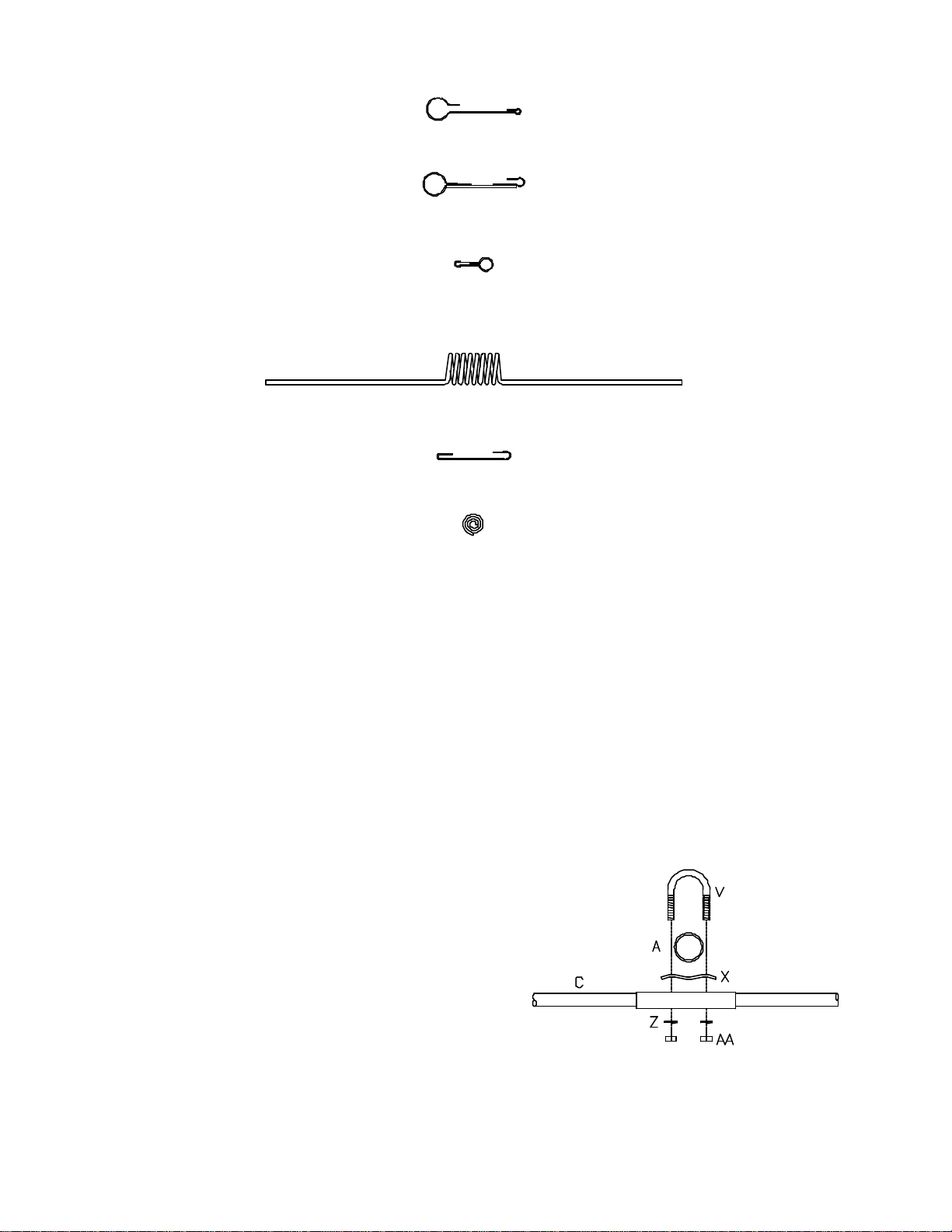
Before you start assembling the antenna, read through the instructions completely, paying special attention
to the pictorial diagrams. When you unpack the box, do so on a surface where you will not lose the small
parts. Check the parts against the PARTS LIST, identifying each part carefully.
NOTE: Check to see that all parts are present before beginning assembly.
NOTE: 3/4" screws unless directed to use other sizes.
INSTALLATION NOTES
CHOOSING AN INSTALLATION SITE: As with all directional antennas, care must be taken in the
choice of an installation site for your HF5B. Pick a place clear of power lines or other obstructions. The
HF5B should be mounted at least 30 ft (9.1 m) above the ground for proper operation. It should be able
to rotate without hitting anything. Finally, it should not be near any large masses of metal, like metal
roofing or siding. Plan your installation so that metallic guy wires are broken up with compression
insulators and no other antennas are nearby (like dipoles mounted right under the beam).
BALUNS: The sole purpose of the coaxial line "choke" balun shown in the instructions is to keep RF
current from flowing on the outside of the coaxial feed line. It does NOT transform impedances. This
form of balun has been featured in the ARRL Antenna Book for 40 years or more and it still works fine.
It also costs next to nothing. If, for some reason, you wish to use a commercially manufactured 1:1 balun
instead, make sure that it is installed BEFORE you do the "near ground" SWR adjustments on the driven
element. Most baluns will introduce odd bits of reactance into an antenna to which they're connected, and
that can throw off the tuning of a driven element that was adjusted with another balun in place or with no
balun at all.
MASTS AND GUYING: In order to avoid coupling between antenna elements and guy wires that can
detune the antenna it may be necessary to break up the guy wires with insulators. The typical metal "slip-
up" mast calls for a set of guys every ten feet or so, and that usually means a set close to the top of the
mast in order to steady the rotor and the antenna. If the separation between the antenna and the highest
set of guys is less that about 15 ft (4.6 m) it would be a good idea to use insulators on each of the
uppermost guys at intervals of 10 ft (3 m) or so. Place the first insulator on each guy AT THE MAST
OR TOWER, for that too is a conductor that can be coupled to the antenna by any horizontal or near-
horizontal guy wire connected to it. One or two insulators per guy wire should suffice because the HF5B
elements extend only a little more than 6 ft (1.8m) from the mast, and any coupling to the guy wire past
the second insulator will be negligible.