
careium Eliza S Quick start guide

www.careium.co.uk
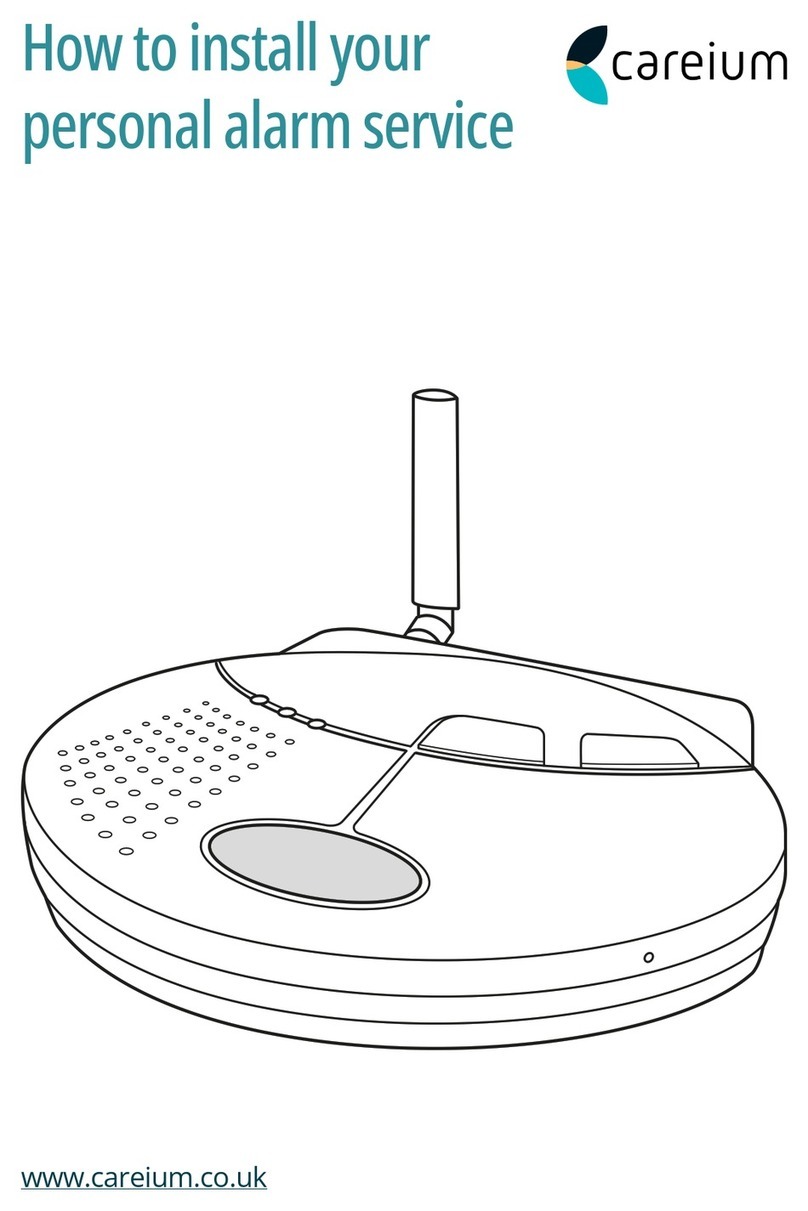
Eliza S Personal Alarm
Technical Guide

1
Welcome to Careium
Please read this manual thoroughly and retain it for future reference.
Before installation
IMPORTANT: Before installing your equipment, please ensure you have
provided us with all the service user details (contact information,
medical records, keyholder details, etc). If you have not already done
so, you can provide this via either the form on our website, available at
careium.co.uk/service-user-details or via the paper forms we previously
sent you. Alternatively, please contact our Customer Services team on
0300 333 6511, who can take this information over the telephone.
Please remember to update us with any changes to the information we
hold to ensure we have all the correct information when we respond to
activations from your equipment.
If you have any questions or issues, please see our comprehensive
FAQs online at careium.co.uk/contact/faqs
Note: All illustrations are for illustrative purposes only and may not accurately
depict the actual device. The items supplied with your unit might vary depending on
the software and accessories available in your region.

2
Installation & connection
Your personal alarm Eliza S is easy to install:
1Connect the power supply to the wall socket and the power supply lead
to the DC input socket. Keep the device connected to the mains power at
all times.
2Turn the power switch to the on ( ) position.
3Check that the power indicator ( ) lamp has a steady red light.
4 Thestatuslightshallgoowithin90secondsifthemobilenetwork
(GSM/UMTS/LTE) is detected.
5Carry out a test alarm from the Eliza S.

3
Read rst: Safety information
• Always test the system according to the instructions before use and
always test the product after adjustments have been made.
• The device is not always suitable for all users and should not be seen as a
substitute for carers.
• The device is NOT intended for life-sustaining equipment, where any
technical failure may result in serious injury or death.
• Check the unit regularly and replace if necessary.
• Users should pay particular attention to the potential for interference from
other systems operating in the same or adjacent radio frequency bands.
• The compartment covers may be opened only by authorised persons in
accordance with the instructions in the technical manual.
• Battery replacement may be performed only by authorised persons in
accordance with the instructions in the Maintenance section. Only use
recommended battery type as stated in the Technical Data section.
IMPORTANT: Always read and follow the safety information
accompanied by this symbol.
CAUTION: Only use batteries, power supply and accessories that
have been approved for use with this particular model. Connecting
other accessories may be dangerous and may invalidate the type of
approval and guarantee.
• Only use recommended power supply as stated in the
Technical Data section.
• The power supply can be used as a disconnecting device. The wall socket
shall be installed near the equipment and shall be easily accessible.
IMPORTANT: This device uses the mobile phone network. This means
that connection cannot be guaranteed in all circumstances.

4
Medical units
The use of equipment that transmits radio signals as a personal alarm can
interferewithinsucientlyprotectedmedicalequipment.Consultadoctor
or the manufacturer of the equipment to determine if it has adequate
protection against external radio signals, or if you have any questions.
To avoid potential interference, manufacturers of implanted medical devices
recommend a minimum separation of 15 cm between a wireless device and
the medical device.
If you have any reason to suspect that interference is taking place, turn
othepersonalalarmimmediately.Ifyouhaveanyquestionsabout
using your personal alarm with an implanted medical device, consult your
healthcare provider.
Important information
All systems using radio and network communication are subject to
interference beyond the user’s control. Products from Careium are designed
to minimise the impact of such interference.
Nevertheless, the user must be aware that system components can be
subjectedtointerferenceorotherinuencesthatmaycausemalfunction.
It is therefore important to regularly check that every part of the system
works in all areas, especially radio communications. Contact your supplier
immediately in case of any suspected malfunction.
Users should pay particular attention to the risk of disruption from products
which communicate using the same or adjacent radio frequency bands.
For further information, please contact your supplier or refer to the service
manual or the documentation at www.careium.com/support/.
The device has a rechargeable battery that enables the device to be operated
even in the event of a power failure. The device will beep for a short while
afterpowerfailure.TheAlarmReceivingCentrewillbenotiedintheevent
of power failure as well as low charge level. When the battery reaches a low
charge level, this is indicated by a blinking status light. The backup battery
power supply secures the operation up to 168 hours.

5
Description of functions
Eliza S is a digital personal alarm.
Adaptable for future needs and connects to a wide range of accessories
such as smoke and CO detectors – enabling the user a tailor-made solution.
Eliza S allows the user to call for assistance if they have an accident or a fall
at home. Eliza S can potentially be a life- saving device if someone has a fall
or some other accident when they are alone.
Eliza S has a built-in module for 2G, 3G and 4G mobile networks, the unit
has possibility to transfer alarms over mobile telephone networks. The unit
oerstheuserthepossibilityoftwo-wayhandsfreevoicecommunication,
even if the users is far away from the Eliza S, using existing standard for
VoIP (Voice over Internet Protocol) calling.
The unit uses SIP, a standard protocol to initiate speech and video over
digitalconnections.Inadditiontovoiceconnectedalarmcalls,ElizaSoers
a platform for transfer of detailed alarm information, speech messages,
online status etc.
TheElizaSisassignedauniqueidenticationnumber(ID)thatis
transferred and corresponding to personal information stored in the Alarm
Receiving Centre (ARC). The pendant is adapted for use with the unit (see
Pendant on page 15).

6
Activate alarm
The assistance alarm can be activated:
• by pressing the button on the personal alarm button.
• by pressing the integral alarm button on the Eliza S.
On activation, the Eliza S calls an alarm receiver to summon help.
Alarm transmitters
50 radio transmitters (triggers/sensors) can be programmed with the Eliza
S, e.g. smoke detector. In the event of an alarm from a radio transmitter,
the battery status of the radio transmitter is tested.
Alarm receivers
Upto10alarmreceiverscanbeprogrammed.Thealarmisidentiedusing
an alarm code which is programmed into the Eliza S.
The person receiving the alarm can then speak directly with the person
raising the alarm and take appropriate action.
Other functions
Additionalfunctionscanbeactivatedormodied–refertotheservice
manual or contact Careium on 0300 333 6511 for further information.

7
Eliza S overview
Top view
12 3
4
5
6
1Loudspeaker
2Alarm button (red)
3Power indicator
4Button with circle symbol (yellow)
5Button with square symbol (green)
6Status indicator

8
2ALARM RED
Steady light Normal operation
Blinking light Alarm activated
3POWER ON GREEN
Steady light Mains power
Blinking light Mains failure
4SQUARE GREEN
Press to cancel alarm
5CIRCLE YELLOW
Service menu etc
6STATUS YELLOW
O Normal operation
Steady light Network problem
Blinking light Low battery
Indicator lights & symbols

9
Back view
12 3 4
1 I/O connector — optional 3.5mm
audio out or wired input
2 External antenna connector —
optional
3 Power switch — turns unit on
oro
4Powersupplysocket—9V,2A
Other manuals for Eliza S
1
Table of contents
Other careium Security System manuals

Popular Security System manuals by other brands



EDM
EDM Solution 6+6 Wireless-AE installation manual
Highway Safety Group
Highway Safety Group EA401 user manual

Siren
Siren LED GSM operating manual
Detection Systems
Detection Systems 7090i Installation and programming manual
Se-Kure Controls
Se-Kure Controls MicroMini SK-4841 instructions
Siemens
Siemens FDM273 manual