Safety and Related Information
2010-11-04 2G8646 3
This equipment has been tested and found to comply with the
limits for a Class A digital device, pursuant to part 15 of the
FCC Rules. These limits are designed to provide reasonable
protection against harmful interference when the equipment is
operated in a commercial environment. This equipment
generates, uses, and can radiate radio frequency energy and, if
not installed and used in accordance with the User Guide and
other User Documentation, may cause harmful interference to
radio communications. Operation of this equipment in a
residential area is likely to cause harmful interference in which
case the user will be required to correct the interference at his
own expense.
Changes or modifications not expressly approved by the party
responsible for compliance could void the user’s authority to
operate the equipment.
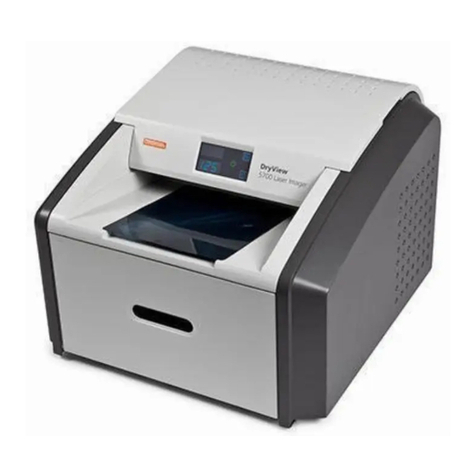
Do not use isopropyl alcohol to clean the exterior surfaces of
the laser imager. Isopropyl alcohol can dissolve the exterior
paint on the laser imager.
In the U.S., exhausted filters are considered to be
non-hazardous waste according to the US Environmental
Protection Agency Resource Conservation Recovery Act
(RCRA). Municipality owned and licensed solid waste
management facilities are an appropriate disposal option.
Contact your local or state solid waste authorities to determine
if additional disposal requirements apply. In other regions,
contact local or regional solid waste authorities for proper
disposal guidance. Go to the Carestream Health web site,
search for the Environmental Technical Summary document,
and refer to the End-of-Life-Management section.
Lithium batteries should only be replaced by an Authorized
Service Provider of Carestream Health, Inc., products. The
laser imager uses a lithium battery to power the clock and
calendar circuitry. THERE IS A DANGER OF EXPLOSION
IF THE BATTERY IS REPLACED INCORRECTLY. The
battery must be replaced only with the same or equivalent type.
The U.S. EPA’s RCRA does not regulate disposal of this lithium
battery. Users should discard spent batteries in municipal trash