G) The pressure filter element needs to be replaced at least once a year. If the couplings between the
vehicle and the Cargo Floor system are regularly removed, it is advisable to check the pressure
filter for dirt build-up and replace the pressure filter element more often, if necessary. If provided,
also check the return filter (not supplied with the Cargo Floor). Failure to replace a filter element on
time may cause damage to or malfunctions in the Cargo Floor system and the vehicle.
H) Moving parts must be shielded. Always maintain at least 10 meter [30’] distance from the Cargo
Floor system when it is in operation.
I) In the event of malfunctions/maintenance work, you may approach the Cargo Floor conveyor
system only if all equipment, including the hydraulic pump, have been shut off, and the Cargo Floor
system and the electro-hydraulic aggregate have been disconnected from the power supply and
pump.
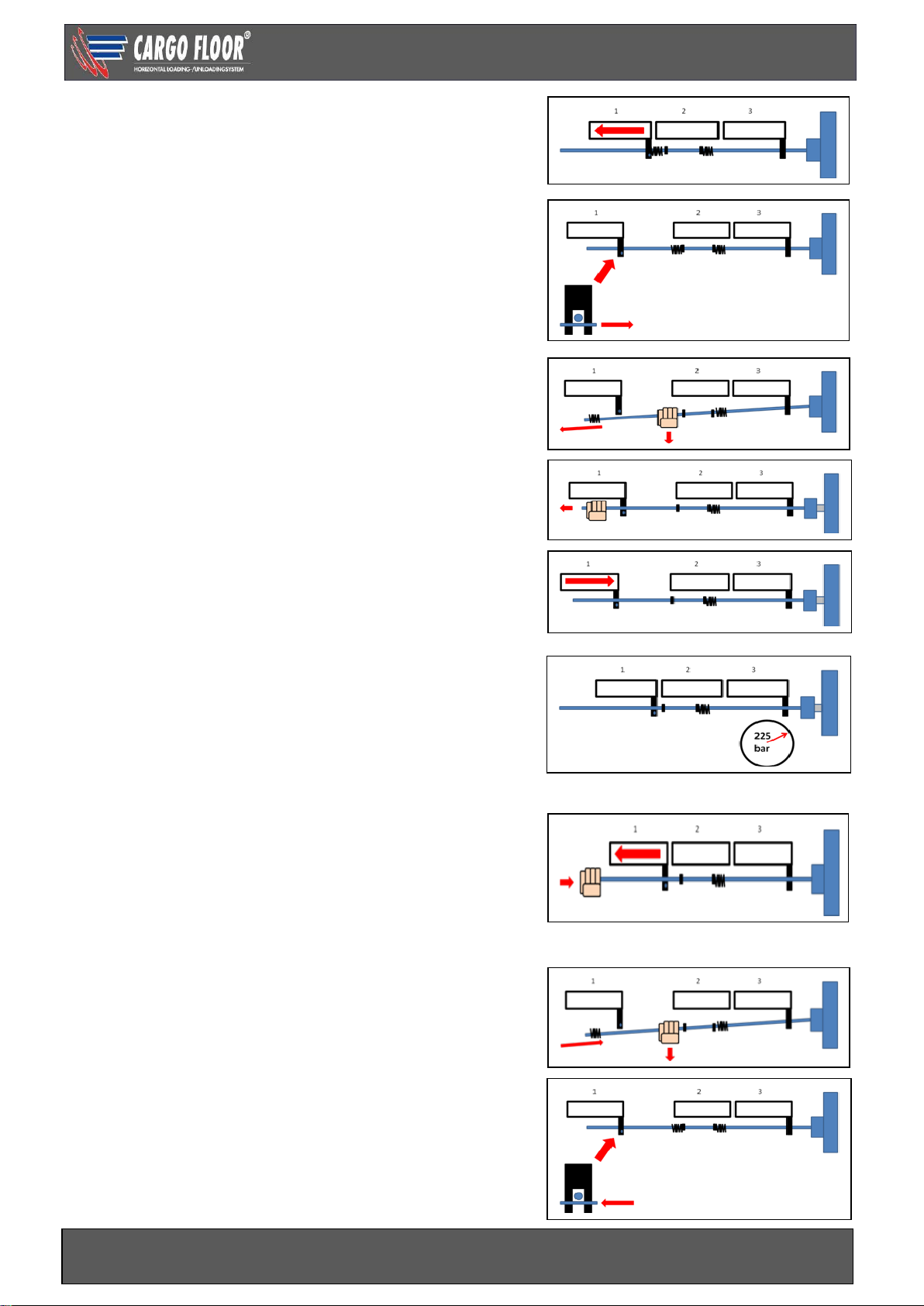
J) Regularly check and, if necessary, tighten any loose bolts that secure the aluminium floor profiles
to the Cargo Floor system. All such checks can simply be performed inside the vehicle itself by
qualified personnel. The Cargo Floor conveyor transport system must, however, be turned on in
unloaded condition and the person performing the check must place his finger half on the floor
profile and half on the bolt. There should be no appreciable movement/space between the floor
profile and bolt. Failure to check these bolts may lead to damage to the Cargo Floor system.
During this check, a second person must also be present to switch off the Cargo Floor system.
K) Check that the minimum required amount of oil is present 150 liter [40 US gallon]. Too little oil in
the hydraulic tank will cause damage to both the pump and the Cargo Floor system.
L) Do not allow the number of strokes to exceed the maximum allowable 16 power strokes per
minute. Only a CF500 SLC Power Speed Cargo Floor system may deliver up to 23 beats per
minute. A higher number of power strokes can cause damage to the Cargo Floor moving floor
system and the vehicle.
M) Hydraulic lines, couplings and hoses with very small diameters will cause damage.
N) If the Cargo Floor moving floor system fails to start or operates incorrectly, the Cargo Floor system
and the hydraulic pump must be shut down immediately. Subsequently, check all the checkpoints
before switching the pump and the Cargo Floor system back on. To prevent the oil from
overheating, regularly check the oil temperature by CAREFULLY and CAUTIOUSLY touching the
line and or oil tank. If either is too hot to the touch, stop touching them right away. WARNING:
TOUCHING OVERHEATED OIL AND COMPONENTS CAN CAUSE BURNS!
O) The cause of failure or malfunctioning of the Cargo Floor system may also be due to other
hydraulic components that may or may not be connected to the same hydraulic circuit of the Cargo
Floor system.
P) Jamming of the floor profiles caused by the transport of abnormal loads and or the freezing of the
floor or of the product to the floor may result in damage to the Cargo Floor system and the vehicle.
Recommendation: in the event of freezing, stop the system and try to find a hall (heated area) to
allow the product to thaw.
Q) Because the electrical power supply of the Cargo Floor system is often connected to the lighting
circuit of the vehicle, it is advisable to turn on the lighting throughout the operation of the system.
R) Maintenance and repairs to the Cargo Floor system may be only performed by qualified personnel.
Use only original Cargo Floor components to ensure maximum reliability and long service life.
S) Maximum cargo weight is subject to the limits set by law and applicable regulations. Even if the
system can transport heavier loads, the law determines the maximum limit. Excessively heavy
cargo can cause damage to the Cargo Floor transport system and the vehicle.
T) Check that the correct type and quality of hydraulic oil is used. The use of incorrect oil type may
cause damage to the Cargo Floor system and the pump.
U) Check the vehicle for correct voltage. Make sure there are no open electrical connections. A faulty
electrical system can cause damage to the Cargo Floor conveyor system and the vehicle.
V) Check that the bulkhead, if present, is functioning smoothly and properly. A properly functioning
bulkhead ensures that the product is unloaded in a clean and quick fashion. A malfunctioning
bulkhead may extend the unloading time and cause damage to the vehicle.
W) Use of the Cargo Floor system by unqualified personnel can cause damage to the Cargo Floor
system and the vehicle.
X) Excessively high oil temperatures will cause damage to the Cargo Floor system and other
hydraulic components, such as the pump.