4.15.4.Wait for through cooling before
subjecting the joint to mechanical stress
4.15.5. Make sure the weld has a clean,even
edge around the whole circumference.
4.16. To replace the heated bushes during
welding operations use heat-proof gloves
4.17. For any details not specified in this
manual,follow the instructions provided by the
manufacturers of the pipes and/or
connectors,
specifically with regard to temperatures,
times,
pressures, the height of the bead and the
compatibility of various materials to welding
Make sure that operations always comply
with
national standards regulating the welding of
plastics.
5. SAFETY STANDARDS
5.1. This equipment must only be used in full
compliance with the instructions given in this
manual. All other uses are to be considered
improper and forbidden. Improper use may
cause injury to the machine operator or third
parties and/or cause damage to the machine or
other objects.
5.2. All standards concerning health and
safety
in the workplace must be implemented at all
times.
5.3. Before using the machine personnel must
be
properly trained in its operation and in
applicable
accident-prevention regulations.
5.4. The components used in the construction
of
the machine and its operating principles are
such
that special care should be taken to carry out
the
following instructions:
5.4.1. Electric power supply
Make sure the mains electricity supply is
suitable
for the machine. Do not use an electricity
supply
which is subject to voltage surges or drops.
Use a
guaranteed mains supply or power
generators
fitted with voltage stabilizers. Make sure
the
machine’s power socket is protected with a
high
sensitivity differential switch (IΔ=30 mA)
and that the machine has an earth connection.
5.4.2. Electricity
Even if designed and manufactured in full
accordance with applicable standards and
fitted with all the required safety devices,
electrically powered machinery nonetheless
poses a risk to safety due to the nature
of this
type of energy (i.e. risk of electric shock). Do
not expose the machinery and its electrical
cables to the rain, to chemicals, to
mechanical stress (e.g. vehicles driving
across the cables). Use perfectly dry pipes
and connectors. Do not use the machine if your
hands are wet or the workplace is moist or
damp.
5.4.3. Avoiding burns
Do not touch the heating element metal
components or plastic parts close to the
welding surface during heating welding or
cooling, since the plate reaches very high
temperatures. Operate the machine with the
utmost care. Wear heatproof gloves and
protective clothing suitable for preventing
burns.
5.4.4. The workplace: Make sure that
unauthorized persons are unable to gain access
to the workplace. The workplace must be
clean, tidy, properly ventilated and well lit.
There should not be any gases, fumes or
flammable materials present, such as
solvents, oils, paints, etc. These may
constitute a fire risk if they come close
to the heating element. Keep any objects
or materials susceptible to heat damage
well away from the machine , When working
in tight
awkward places an external supervisor must be
present to provide assistance to the machine
operator in case of need.
5.4.5 Check and repairs:Before using the
machine,check that no components are
damaged,Replace cables or components as
soon as they become worn
Repaires must be carried out only by an expert
or specially trained technician using
exclusively original spare parts.Dismantling the
machine involves a risk of electric shock
No alterations may be made to the machine.
5.4.6. Presence of the operator at all times
during operation: The machine operator must
not leave the machine while it is welding or
heating up.
5.4.7. Use pipes that are chemically inert:
Do not carry out any welding operations on
pipes containing or which may have contained
substances which when heated generate
explosive
5.4.8. Support: Position the welding machine
using only the proper fork or bench supports.
5.4.9. Take care with cables: Do not
disconnect
plugs, sockets or connectors or move the
machine
by pulling on the electric cables.
5.4.10. Finally after work ,remember to
disconnect the welding machine from the mains
or supply socket
5.5. The machine must not be used in areas
where
there is a risk of explosion or fire. Only
specially
designed and manufactured machines must
be
used in workplaces of this kind.
5.6. The manufacturer and dealer will not be
liable
for personal injury or damage to property
arising
from the improper use of the machine.
6. FAULTS
6.1. WARNING
In the event of a fault of any kind during the
guarantee period, send the machine to the
manufacturer or an authorized repair centre.
Having repair work carried out by personnel
not authorized will immediately invalidate the
warranty.
6.2. TROUBLESHOOTING
FAULT
6.2.1. The heating element does not heat up
PROBABLE CAUSE
No current
REMEDY
Check that the plug is correctly inserted in the
socket.
Make sure that the power cable is not
damaged, especially the non-kink cable-grip
near the handgrip. Replace the cable if it is
worn
Check the continuity of the electrical system.
Check that the screws on the terminal board
inside the handgrip are properly tightened.
FAULT
6.2.2. The heating element does not heat
up
PROBABLE CAUSE
thermoregulator (TE models)
REMEDY
Replace the thermoregulator.
PROBABLE CAUSE
Faulty heating element
REMEDY
Replace the plastic welding unit.
FAULT
6.2.3. The heating element does not heat up
or it is impossible to set the
temperature
PROBABLE CAUSE
Faulty thermoregulator (TE models)
REMEDY
Replace thermoregulator.
FAULT
6.2.4. The heating element heats up and
reaches the correct temperature
PROBABLE CAUSE
thermoregulator (TE models)
REMEDY
Replace the thermoregulator (TE models).
7. STANDARD COMPONENTS,
OPTIONAL EQUIPMENT, SPARE PARTS
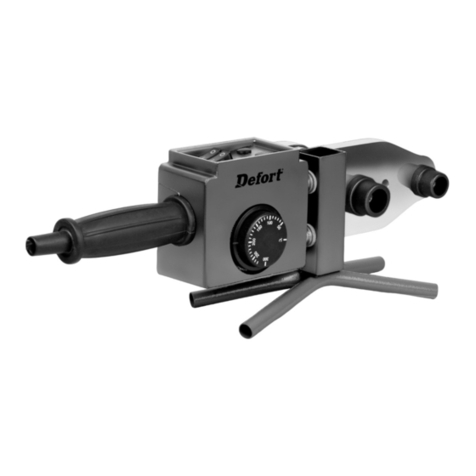
7.1. Standard components: Basic Plastic
Welding
Machine, fork support, bench bracket (optional
for
the R 25 TE, hexagonal wrench suitable for
socket head screws, pins for bushes, operation
and maintenance manual.
7.2. Optional supplies: steel tool box, M/F
welding bushes, platform unit and plastic
handgrip (for welding on the floor), protective
heat-proof gloves.
7.3.7.3.CODES FOR MALE AND FEMALE
WELDING BUSHES