9
INSTALLATION
1. The distance between the drain and the water conditioner should be as short as possible. (See Step 8)
2. It is not recommended to install any water conditioner with less than 10 feet of piping between its outlet and the inlet of a
water heater.
3. Do not locate unit where it or its connections (including the drain and overflow lines) will ever be subjected to room
temperatures under 33°F.
4. Do not subject the tank to any vacuum, as this may cause an “implosion” and could result in leaking. If there is a possibility a
vacuum could occur, please make provision for a vacuum breaker in the installation.
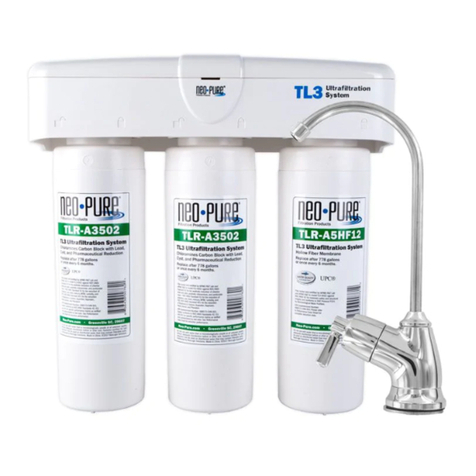
5. Installation of a 5 micron pre-filter is recommended before the UF Filter. This will ensure that larger particles will not
prematurely foul the membrane.
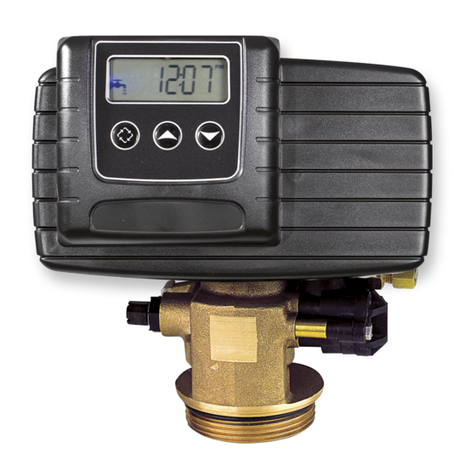
6. INLET/OUTLET PLUMBING: Be sure to install Bypass Valve onto main control valve before beginning plumbing. Make
provisions to bypass outside hydrants and other untreated fixtures are plumbed properly. Install an inlet shutoff valve and
plumb to the unit’s bypass valve inlet located at the right rear as you face the unit. There are a variety of installation fittings
available. They are listed under the Installation Fitting Assemblies section. When assembling the installation fitting package
(inlet and outlet), connect the fitting to the plumbing system first and then attach the nut, split ring and “O” Ring. Heat from
soldering or solvent cements may damage the nut, split ring or “O” Ring. Solder joints should be cool and solvent cements
should be set before installing the nut, split ring and “O” Ring. Avoid getting solder flux, primer, and solvent cement on any
part of the “O” Rings, split rings, bypass valve or control valve. If the building’s electrical system is grounded to the plumbing,
install a copper grounding strap from the inlet to the outlet pipe. Plumbing must be done in accordance with all applicable
local codes.
7. INSTALLING GROUND: To maintain an electrical ground in metal plumbing of a home’s
cold water piping (such as a copper plumbing system), install a ground clamp or jumper
wiring. (See drawing to the right.)
8. CONTROL VALVE DRAIN LINE: First, be sure that the drain can handle the backwash
rate of the system. Solder joints near the drain must be done prior to connecting the drain
line flow control fitting. Leave at least 6” between the drain line flow control fitting and
solder joints. Failure to do this could cause interior damage to the flow control. Install a 1/2”
I.D. flexible plastic tube to the Drain Line Assembly or discard the tubing nut and use the
3/4” NPT fitting for rigid pipe (recommended). If the backwash rate is greater than
5.3 gpm, use a 3/4” rigid drain line. Where the drain line is elevated but empties
into a drain below the level of the control valve, form a 7” loop at the discharge end of the
line so that the bottom of the loop is level with the drain connection on the control valve. This
will provide an adequate anti-siphon trap. Piping the drain line overhead <10 ft is normally not a problem. Be sure adequate
pressure is available (40-60 psi is recommended). Where the drain empties into an overhead sewer line, a sink-type trap must
be used. Run drain tube to its discharge point in accordance with plumbing codes. Pay special attention to codes for air gaps
and anti-siphon devices.
NOTE: Drain line nut will not be supplied for units having a backwash rate greater than 7 gpm.
9
. BOTTOM OF TANK DRAIN CONNECTION: At the bottom of the tank is a 1” male threaded
connection fitting. This connection should be fitted with a ball valve. IMPORTANT – the 1” connection
is wide open and will require a ball valve. A drain line should then be run to the nearest drain location.
The ball valve is in the closed position and opened manually to periodically blow the tank down of
debris. This should be done manually at least once per month or if a pressure drop is noticed across the
system.
NOTE: The manufacturer does not include the ball valve or drain line – this needs to be supplied and
installed by the dealer or installer.
5
MICRON
FILTER
TYPICAL DRAIN LINE INSTALLATIONS
bottom drain port