10 11
Conducted RF
IEC 61000-4-6
Radiated RF
IEC 61000-4-3
3 Vrms
150 kHz to 80 MHz
3 V/m
80 MHz to 2,5 GHz
3 V
3 V/m
Portable and mobile RF communica-
tions equipment should be used no
closer to any part of the “Daylight”,
including cables, than the recommended
separation distance calculated from the
equation applicable to the frequency of
the transmitter.
Recommended separation distance
d=1.2√P
d=1.2√P80MHzto800MHz
d=2.3√P800MHzto2.5GHz
where P is the maximum output power
rating of the transmitter in watts (W)
according to the transmitter manufactur-
er and d is the recommended separation
distance in metres (m).
FieldstrengthsfromxedRFtransmit-
ters, as determined by an electromag-
netic site survey,a should be less than
the compliance level in each frequency
range.b Interference may occur in the
vicinity of equipment
marked with the following symbol:
Normative references
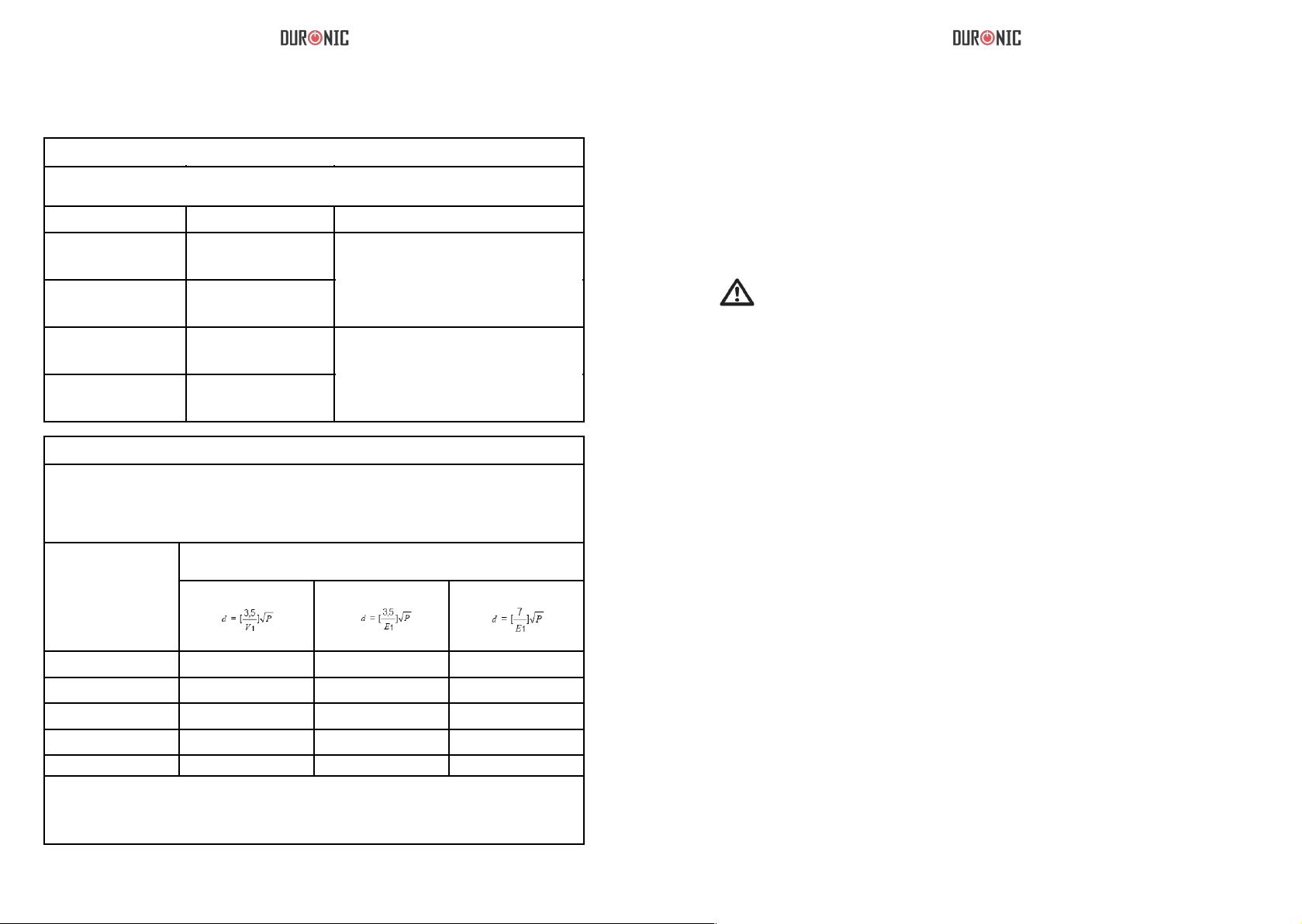
Guidanceandmanufacturer’sdeclaration–electromagneticimmunity
NOTE UT is the a.c. mains voltage prior to application of the test level.
NOTE 1 At 80 MHz and 800 MHz, the higher frequency range applies.
NOTE 2 These guidelines may not apply in all situations. Electromagnetic propagation is
affectedbyabsorptionandreectionfromstructures,objectsandpeople.
Fieldstrengthsfromxedtransmitters,suchasbasestationsforradio(cellular/cordless)telephonesand
land mobile radios, amateur radio, AM and FM radio broadcast and TV broadcast cannot be predicted
theoreticallywithaccuracy.ToassesstheelectromagneticenvironmentduetoxedRFtransmitters,an
electromagneticsitesurveyshouldbeconsidered.Ifthemeasuredeldstrengthinthelocationinwhich
the “Daylight” is used exceeds the applicable RF compliance level above, the Medical Daylight should be
observed to verify normal operation. If abnormal performance is observed, additional measures may be
necessary, such as reorienting or relocating the “Daylight”.
Overthefrequencyrange150kHzto80MHz,eldstrengthsshouldbelessthan[V1]V/m.
Immunity test
Immunity test
IEC 60601 test level
IEC 60601 test level
Compliance level
Compliance level
Electromagnetic environment –
guidance
Electromagnetic environment –
guidance
The“Daylight”isintendedforuseintheelectromagneticenvironmentspeciedbelow.The
customer or the user of the “Daylight” should ensure that it is used in such an environment.
The“Daylight”isintendedforuseintheelectromagneticenvironmentspeciedbelow.The
customer or the user of the “Daylight” should ensure that it is used in such an environment.
Electrostatic
discharge (ESD)
IEC 61000-4-2
Electrical fast
transient/burst
IEC 61000-4-4
Surge
IEC 61000-4-5
Power frequency
(50/60 Hz)
magneticeld
IEC 61000-4-8
3 A/m 3 A/m
Voltage dips,
short
interruptions and
voltage
variations
on power supply
input lines
IEC 61000-4-11
<5 % UT
(>95 % dip in UT)
for 0,5 cycle
40 % UT
(60 % dip in UT)
for 5 cycles
70 % UT
(30 % dip in UT)
for 25 cycles
<5 % UT
(>95 % dip in UT)
for 5 sec
<5 % UT
(>95 % dip in UT)
for 0,5 cycle
40 % UT
(60 % dip in UT)
for 5 cycles
70 % UT
(30 % dip in UT)
for 25 cycles
<5 % UT
(>95 % dip in UT)
for 5 sec
±1 kV differential
mode
±2 kV common
mode
±1 kV differential
mode
±2 kV common
mode
±6 kV contact
±8 kV air
±2 kV for power
supply lines
±1 kV for input/
output
lines
±2 kV for power
supply lines
±1 kV for input/
output
lines
±6 kV contact
±8 kV air
Floors should be wood, concrete
orceramictile.Ifoorsare
covered with synthetic material,
the relative humidity should be at
least 30 %.
Mains power quality should be
that of a typical commercial or
hospital environment.
Mains power quality should be
that of a typical commercial or
hospital environment.
Mains power quality should be
that of a typical commercial
or hospital environment. If the
user of the “Daylight” requires
continued operation during
power mains interruptions,
it is recommended that the
“Daylight” be powered from an
uninterruptible power supply or a
battery.
Powerfrequencymagneticelds
should be at levels characteristic
of a typical location in a
typical commercial or hospital
environment.
Guidanceandmanufacturer’sdeclaration–electromagneticimmunity