REV A ECN 14100 04/23/18 3
Equation 1 above, defines the low frequency
at which the accelerometer sensitivity will be 3db
down when compared to the reference sensitivity
measured at 100 Hz. The discharge time constant for
Model 3306A is 6.2 Sec. yielding a lower -3db
frequency of 0.03 Hz, from equation 1. Due to the
extremely long dischange time constant the sensor
might exhibit spiking during fast thermal transients
As rule of thumb, the lower -5% frequency is
three times the -3db frequency or 3 x .03 = 0.09 Hz.
INSTALLATION
(Refer to Outline/Installation drawing 127-
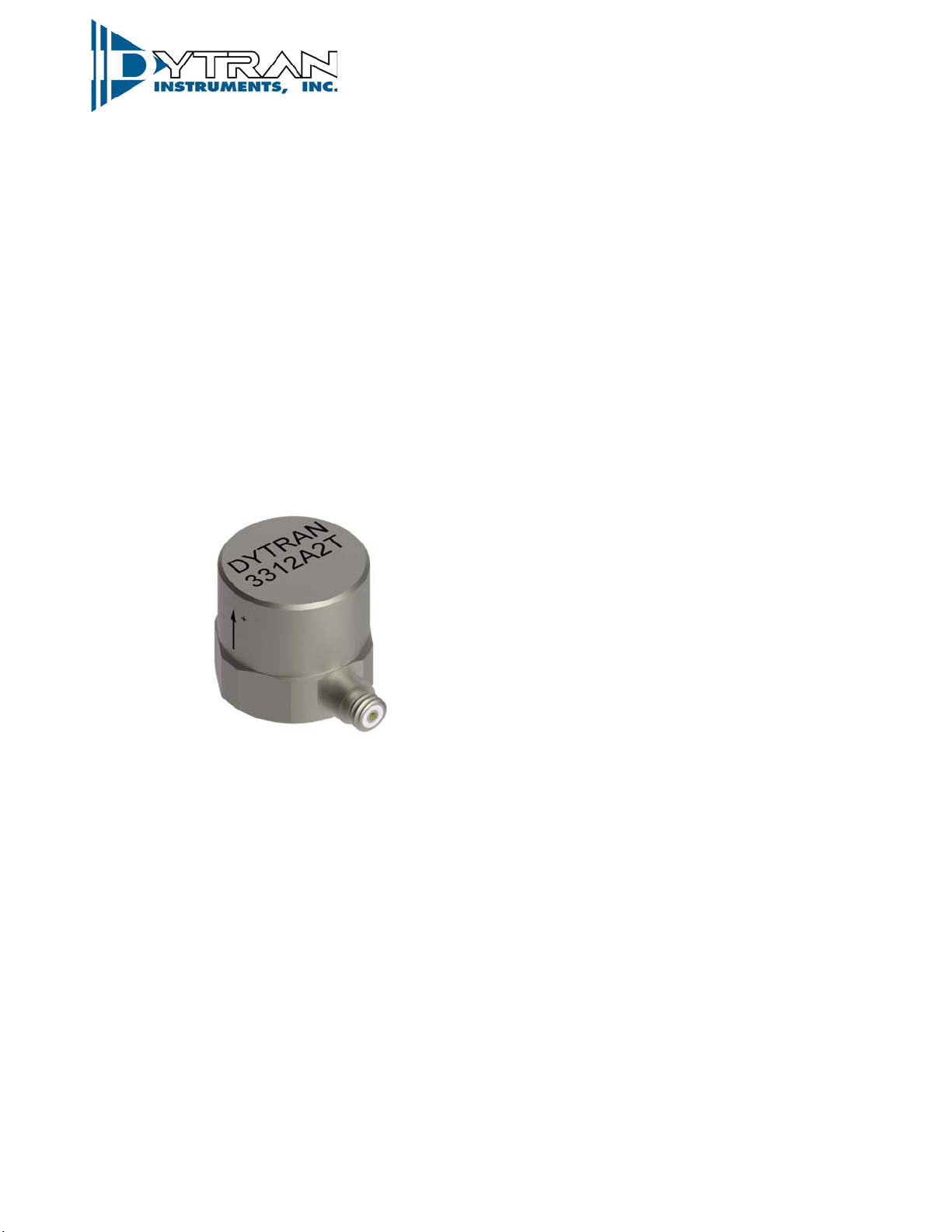
3312A2T) To install Model 3312A2T, is necessary to
prepare (or find) a flat mounting area of approximately
1 inch diameter. Ideally, the mounting surface should
be flat to .001 in. TIR. The flat mounting surface
ensures intimate contact between accelerometer base
and mounting surface for best high frequency
transmissibility, thus accuracy.
At the center of the mounting area, drill and
tap a 10-32 mounting port in accordance with
instructions on drawing 127-3312A2T. Clean the area
to remove all traces of machining chips, burrs, etc.
Next, thread the Mod. 6200 mounting stud
into the base of the 3312A2T. The stud should enter
easily and thread in up to the raised collar of the stud
by hand. This collar prevents the stud from bottoming
inside the tapped hole in the 3312A2T where it could
possibly cause stresses in the base structure which
could, in turn, cause anomalous behavior of the
accelerometer at higher frequencies.
After seating the stud, spread a light coating
of silicone grease, or other lubricant, on either of the
mating surfaces and thread the accelerometer/stud
combination into the tapped hole by hand, until the
accelerometer base seats against the mounting
surface. Check to see that the mating surfaces are
meeting properly, i.e., that they are meeting flush and
that there is not an angle formed between the two
surfaces indicating that they are not co-planar. If this
condition is observed, torquing the accelerometer
down will strain the base causing possible poor
frequency response and even erroneous reference
sensitivity. Inspect the perpendicularity of the tapped
hole.
If the hand-tight meeting between the two
surfaces is satisfactory, torque the 3312A2T to the
mating surface with 20 to 25 lb-inches of torque,
preferably measuring the torque with a torque wrench
torquing on the hex surface only.
Proper torque will ensure the best high
frequency performance from the instrument as well as
repeatability of sensitivity when mounting and
remounting.
Connect the cable (typically Model 6019AXX
to the accelerometer snugging up the threaded lock
ring tightly by hand.
NOTE: Do not use a pliers or vise grips on
the knurled lock ring. This could damage the
connector of the 3312A2T and/or the cable
connector.
To avoid stressing the cables which could
lead to early failure, especially under larger
excursions of the test object, it is good practice to tie
the cable down to a fixed surface near the mounting
area at a point approximately one inch from the
accelerometer.
If there is excessive motion between the
accelerometer and the nearest tie point, allow a strain
loop of cable to let relative motion occur without
stressing the cable.
Connect the other end of the cable to the
"Sensor" jack of the Dytran power unit (Models 4102,
4103, 4110, 4114, etc.) and switch the power on.
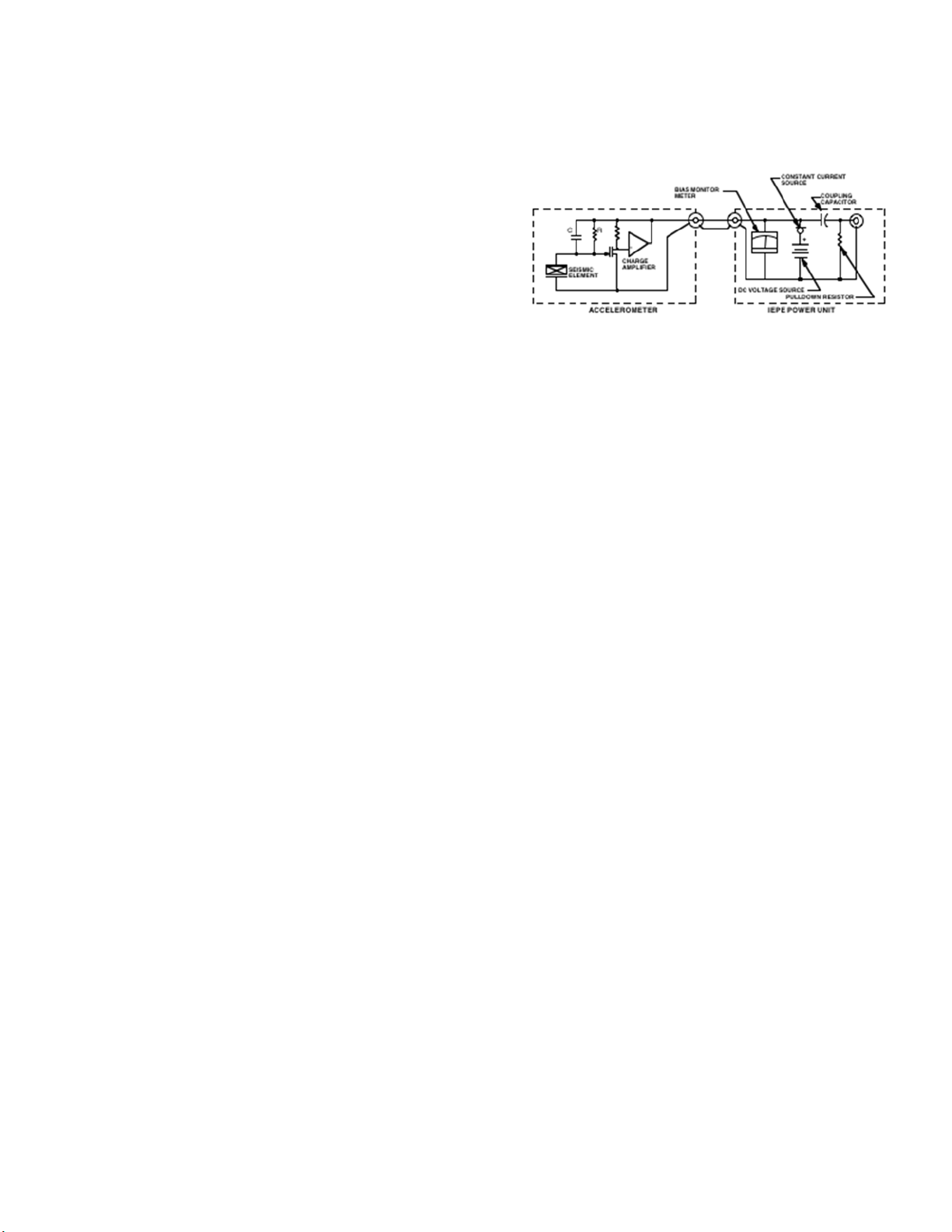
Observe the monitor voltmeter located at the
front panel of each of the power units. If the meter
reads in the mid-scale region, (labeled "Normal"), this
tells you that the cables, accelerometer and power
unit are functioning normally and you should be able
to proceed with the measurement.
Check for shorts in the cables and connectors
if the meter reads in the "Short" region. Check for
open cables or connections if the meter reads in the
"Open" area. In this manner, the meter becomes a
trouble shooting tool for the measurement system.
HIGH FREQUENCY RESPONSE
All piezoelectric accelerometers are basically
rigid spring mass systems, i.e., second order systems
with essentially zero damping. As a result, these
instruments will exhibit a rising characteristic as the
resonance is approached. A filter incorporated into
Model 3312A2T compensates for this rise.
The frequency at which the sensitivity may
increases or decrease by 5% is approximately 4000
Hz, the frequency to which the 3312A2T is calibrated.
The accelerometer is usable above this frequency but