6
GB
6.2 Connecting the discharge line
The discharge line (min. 19 mm (3/4”)) must be
connected to the R1 (1”) female thread discharge
line connector of the equipment either directly or
with the aid of a threaded nipple.
With the right couplings it is also possible, of
course, to use a 13 mm (1/2“) delivery hose. The
smaller delivery hose results in a lower delivery
rate.
During the priming operation, fully open any shut-
off mechanisms (spray nozzles, valves, etc.) in
the pressure line so that the air can escape
without obstruction.
6.3 Electrical connections
Connect the appliance to a 240 V ~ 50 Hz socket-
outlet with earthing contact. Minimum fuse 10
ampere.
A built-in thermostat protects the motor from
overloading and blocking. The pump is switched
off automatically by the thermostat if overheating
occurs and is switched on again automatically
after cooling.
7. Operation
Install the equipment on a solid and level surface.
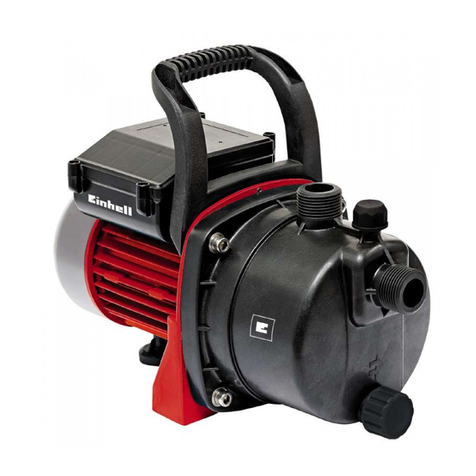
Remove the ventilation screw (7).
Unscrew the coarse filter screw (6) and remove
the coarse filter (8) together with the non-return
valve (9) as shown in Figure 2. Now you can fill
the pump housing with water via the coarse filter
screw (6). Filling the intake line accelerates the
intake process.
Assemble in reverse order.
Open the discharge line.
Connect the mains cable.
Switch on the equipment with the power switch
(3) - water can be suctioned in for up to 5 minutes
(maximum suction height).
After finishing the work, switch off the equipment
with the power switch (3).
8. Replacing the power cable
If the power cable for this equipment is damaged, it
must be replaced by the manufacturer or its after-
sales service or similarly trained personnel to avoid
danger.
9. Cleaning, maintenance and
ordering of spare parts
The equipment is almost completely maintenance
free. In order to ensure a long service life, however,
we recommend that you regularly check and care for
the product.
Important!
The equipment must be disconnected from the power
supply (pull the power plug) prior to performing any
maintenance.
9.1 Servicing
If the equipment becomes clogged, connect the
discharge line to the water line and disconnect the
suction hose. Open the water line. Switch on the
equipment several times for approx. two seconds.
This should resolve the majority of clog-related
problems.
Replacing the mains cable: Important:
Disconnect the equipment from the power
supply! A defective mains cable may only be
replaced by a qualified electrician.
There are no parts inside the equipment which
require additional maintenance.
9.2 Cleaning the coarse filter insert
Clean the coarse filter insert at regular intervals,
and replace it if necessary.
Remove the coarse filter screw (6) and coarse
filter (8) together with the non-return valve (9)
(Figure 2).
Disassemble the coarse filter insert as shown in
figure 3.
Do not use abrasive cleaning agents or petrol to
clean the coarse filter and the non-return valve.
Clean the coarse filter and the non-return valve by
tapping them on a flat surface. In cases of
stubborn dirt, first clean with soapy water, then
rinse with clear water and air-dry.
Assemble in reverse order.
9.3 Storage
If the pump is not going to be used for a long time
or has to be removed for the winter months, rinse
it out with water, empty it completely and allow it
to dry.
The equipment must be completely drained
before it is subjected to frost.
After long stoppages, make sure the rotor turns
correctly by briefly switching the pump on and off.