2
2.3 Additional Hydraulic Safety Precautions
Failure to observe and comply with the following precautions
could result in death or serious personal injury. Property
damage could also occur.
• Do not remove or disable the pump relief valve. Never set
the relief valve to a higher pressure than the maximum rated
pressure of the pump.
• To avoid personal injury and equipment damage, make sure
all hydraulic components are rated for at least 10,150 psi [700
bar] working pressure.
• The system operating pressure must not exceed the pressure
rating of the lowest rated component in the system. Install
pressure gauge(s) in the system to monitor operating pressure.
It is your window to see what is happening in the system.
• Make sure that all system components are protected from
external sources of damage, such as excessive heat, flame,
moving machine parts, sharp edges and corrosive chemicals.
• Do not handle pressurized hoses. Escaping oil under pressure
can penetrate the skin. If oil is injected under the skin, see a
doctor immediately.
• Always do a visual inspection of the system before placing
it into operation. If any problems are found, do not use the
manifolds. Have the equipment repaired and tested before it
is returned to service.
• Never use a manifold that is leaking oil. Do not use a manifold
that is damaged, altered or in need of repair.
• Do not loosen plugs, relief valves or any other hydraulic
components unless hydraulic pressure is completely relieved.
• Always be sure that hydraulic pressure is fully relieved before
disconnecting hydraulic hoses, loosening hydraulic couplers,
or performing any cylinder disassembly or repair procedures.
• Always read, understand and follow all safety precautions
and instructions, including those that are contained within the
procedures of this manual.
• Shut O valves should always be closed when no hydraulic
hoses are being used on those valves.
CAUTION
Failure to observe and comply with the following precautions
could result in minor or moderate personal injury. Property
damage could also occur.
• Do not lift hydraulic equipment by the hoses or swivel
couplers. Use the carrying handle or strap.
• Keep hydraulic equipment away from flames and heat.
Excessive heat will soften packings and seals, resulting in
fluid leaks. Heat also weakens hose materials and packings.
For optimum performance, do not expose equipment to
temperatures of 150˚F [65˚C] or higher. Protect all hydraulic
equipment from weld spatter.
• Immediately replace worn or damaged parts with genuine
Enerpac parts. Enerpac parts are designed to fit properly and
to withstand high loads. Non-Enerpac parts may break or
cause the product to malfunction.
• Hydraulic equipment must only be serviced by a qualified
hydraulic technician. For repair service, contact the Enerpac
Authorized Service Center in your area.
• To help ensure proper operation and best performance, use of
Enerpac oil is strongly recommended.
• Use dust cap(s) when manifolds is disconnected from the
hose(s). Keep the entire manifolds clean to prolong its life.
3.0 DESCRIPTION
Portable assembly of hydraulic manifolds for single acting or
double acting cylinders up to 10,150 psi [700 bar] of pressure.
Split flow for up to 4 multi point lifting.
The manifolds have the following main elements (Refer to Figure
1, 2 & 3 for references):
1. Shut-Off valve: This valve allows to the operator open or
close the flow to the output.
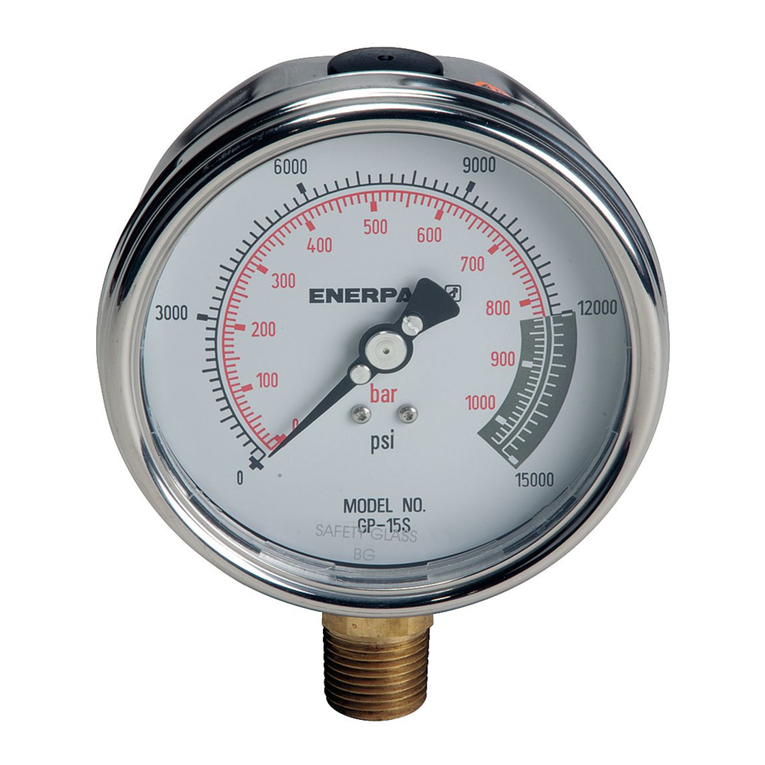
2. Manometer: Every output is supplied with a manometer up
to 10,150 psi [700 bar] of pressure. The operator can check
the pressure in the outlet line.
3. Manifold outlet A: Oil flow outlet that must be connected to
the cylinder.
4. Manifold inlet P: Oil flow inlet. The HPU outlet must be
connected to this point.
5. Manifold inlet T: For double acting pumps, the HPU returning
line must be connected to this inlet.
6. Manifold outlet B: For double acting cylinders, this outlet
must be connected to the returning oil flow of the cylinder
(i.e. the small chamber for general purpose cylinders).
2
3
3
6
4
AMGC41 MANIFOLD AMGC42 MANIFOLD
KEY:
1. Shut-Off Valve
2. Manometer
3. Cylinder big chamber outlet *
4. Oil pressure line inlet
5. Returning flow inlet
6. Cylinder small chamber outlet *
* For general purpose cylinders
Figure 1, Manifolds Main Components