Warnings and Precautions
1. Not for use on children under 2 years of age.
2. Keep out of reach of children under 12 years of age.
3. Never immerse the thermometer in water or other liquid (it is not
waterproof). For cleaning and disinfection, please follow the
instructions in the “Cleaning and Disinfection” section of these use
instructions.
4. Never use the thermometer for purposes other than its intended use.
Please follow the general safety precautions when using the
thermometer on children.
5. Keep the thermometer out of direct sunlight in a dry, dust-free,
well-ventilated area at a temperature between 50.0 – 104.0°F (10.0 –
40.0°C). Do not use the thermometer in a high humidity environment
(> 85% RH).
6. Do not use the thermometer if there are signs of damage on the
Infrared Temperature Sensor or elsewhere on the instrument! Please
contact the manufacturer.
7. This thermometer consists of high precision parts. Do not drop or
twist the instrument. Protect it from severe impact and shock.
8. Please consult your doctor if you see such symptoms as unexplained
irritability, vomiting, diarrhea, dehydration, changes in appetite or
activity, seizure, muscle pain, shivering, sti neck, pain when
urinating, etc., even in the absence of fever.
9. Those who exhibit a normal temperature may still need to receive
medical attention. When determining the severity of illness of people
on antibiotics, analgesics or antipyretics, temperature reading should
not solely be relied upon.
10. Temperature elevation may signal a serious illness, especially in
adults who are elderly, frail, or have a weakened immune system, or
neonates and infants. Please seek professional advice immediately
when there is a temperature elevation in a person who meets any of
the following criteria:
• Over 60 years of age (fever may be dulled or even absent in
elderly patients).
• Diagnosed with diabetes mellitus or a weakened immune
system (e.g. HIV positive, cancer, chemotherapy, chronic
steroid treatment, splenectomy).
• Bedridden (e.g. nursing home patient, stroke, chronic illness).
• A transplant patient (e.g. liver, heart, lung, kidney).
11. This thermometer is not intended for use on children under 2 years
of age. It is not intended to measure hypothermic temperatures.
Do not allow children to take their temperature unattended.
12. Use of this thermometer is not intended as a substitute for
consultation with your physician or pediatrician. It is for household
use only.
13. Do not use the thermometer for continuous temperature monitoring
purposes.
14. Do not take a measurement while or immediately aer nursing a
baby.
15. Patients should not drink, eat, bathe or engage in physical activity
for 30 minutes before using the thermometer. Aer eating, some
organs have to work, such as the stomach, intestinal tract, etc.,
generating extra heat which aects temperature accuracy.
Fig. 5
Note: Forehead temperature measurement reading is an indicative
reading. Measured forehead temperature can fluctuate up 1°F (0.5°C)
from your actual body temperature. Please be aware of the factors that
influence accuracy as described in the Temperature Taking Tips and
Warnings and Precautions sections of these use instructions.
Directions for Use
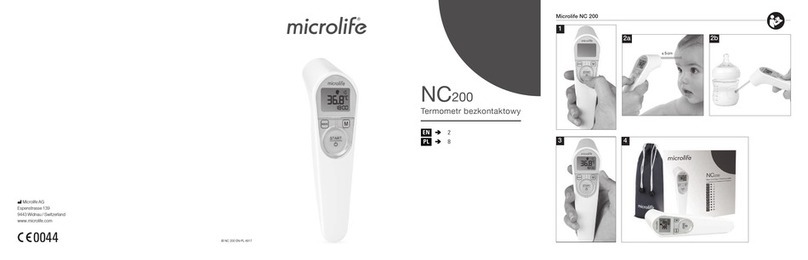
Please load the batteries (included) before using the thermometer. Take
the batteries out if you will not use the thermometer for a long time,
such as more than one month.
Additionally, this thermometer has a one-button design (Measurement
Trigger) that serves three purposes, depending on use (Power, Measure,
Settings).
Take your forehead temperature
Press the Measurement Trigger to power on the thermometer.
Aim the Infrared Temperature Sensor at the middle of a person’s
forehead from 1.2 – 2.0 inches (3.05-5.08 cm) away, then press and
release the Measurement Trigger. About 1 second later, you will hear a
beep and can instantly see the temperature measured on the digital
display. In Body Mode, the symbol will be displayed on the screen.
2. Release button
1. Press button
- 8 -