G.R.A.S. SOUND & VIBRATION
Single-channel Low-noise Measuring System consisting of: Type 40HH and Type 12HF - Page 4
1 Introduction
Fig. 1.1 shows a ½″ Low-noise Level Microphone System Type 40HH which comprises:
• ½″ Microphone Type 40AH.
• ½″ Preamplier Type 26HH with two built-in compensation lters and an overload-warning
LED.
To complete the system, a special single or 10-channel power module is required and is avail-
able from G.R.A.S., i.e.
• Type 12HF for single-channel measurements, see Fig. 1.2 (left)
or
• Type 12HM for multi-channel (1 to 10) measurements, see Fig. 1.2 (right).
The chosen power module provides all necessary voltages for powering the preamplier(s) as
well as polarizing the microphone(s).
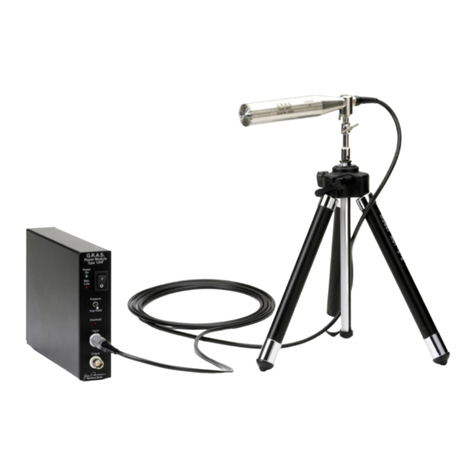
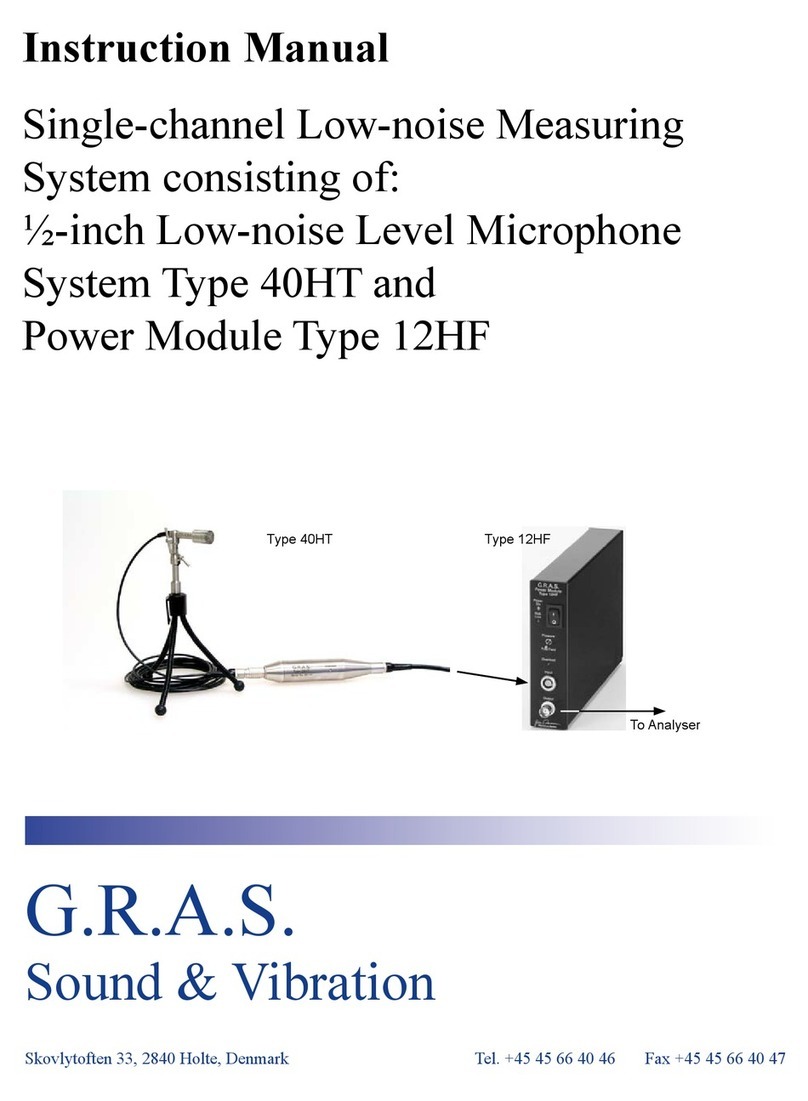
Fig. 1.3 shows a Single-channel Low-noise Measuring system (as described in this document)
and consists of:
• ½″ Low-noise Level Microphone System Type 40HH.
• Power Module Type 12HF.
Note: the power module must be ordered separately, and the tripod and tripod adapter are
optional extras.
Fig. 1.1 ½″ Low-noise Measurement Microphone System Type 40HH
1.1 Microphone Type 40AH
The Type 40AH is a special high-sensitive ½″ microphone. It is externally polarized with a spe-
cially reduced inherent noise oor in order to achieve a high dynamic range and wide frequency
range.
1.2 Preamplier Type 26HH
The body of the Preamplier has an overload-warning LED, (Fig. 1.1), which is repeated on the
front panel of the chosen power module (see Fig. 2.1).
The signal of the microphone is amplied by 20 dB in the Preamplier Type 26HH.
The two compensation lters give the system two parallel outputs which correspond to:
a) linear pressure-frequency response
b) linear free-eld frequency response at an angle of 0 ° incidence.
The choice of which frequency response to use is made via a two-position switch marked
Pressure / Free Field on the front panel of the chosen power module (see Fig. 2.1).
Fig. 1.4 shows the responses of the two compensation lters as well as the free-eld response
for 0 ° incidence. Note: free-eld corrections are added to the lowest curve.
Fig. 1.5 shows what these free-eld corrections are for various angles of incidence.
Fig. 1.6 shows, for a complete low-noise measuring system, a typical noise oor in ⅓-octave
bands for both the linear and A-weighted cases.
Overload-warning LED indicates when the measured
sound pressure level overloads the system’s electronics