4xx Preliminary Generic User Guide. 4 Jan 06 6
INTRODUCTION to the 4xxSA Series of Modem
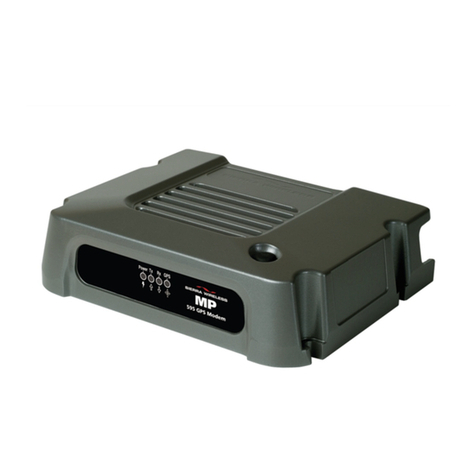
Model 4xx Stand Alone Modem
The 4xxSA Series is an asynchronous modem designed for RS232/422/485*
communications over un-terminated private wire utilizing Frequency Shift Keying
techniques (tones). The modems can communicate in 2 Wire Half Duplex or 4
Wire Full Duplex at baud rates up to 19.2Kbt/s depending on the model, all have
adjustable timing parameters. The modems are typically deployed in a Point to
Multi-point configuration such as TMC Master polling scheme that communicates
with Remote Traffic Controllers.
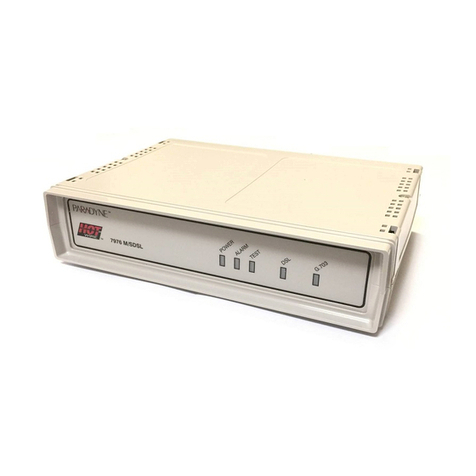
An ergonomic design has been employed that groups all the status information on
the front panel, all the switch selectable options on the bottom panel and all the
connections to and from the modem on the rear panel.
Two Data Ports are provided, Main and Auxiliary, the main Data Port DB9
typically connects to a TMC Master or a local controller while the Auxiliary RJ45
connector can be used to bring in Fiber or Radio based communications into the
main data stream. The modem has unique ability to generate RTS handshaking to
itself or to an attached device when the KOD option is installed.
*RS422/485 is an option that must be specified at the time of order.
The Key On Data (KOD) Option
Modems cannot raise or lower RTS or initiate handshaking, the only exception to
this rule are the new GDI Modems with an optional installed KOD Module.
All copper wire modems (DCE) require RTS to be raised at its data port to start
the FSK transmission process over the copper wire. This process is normally
taken care of by an external DTE device such as a controller.
A very good example of a problem is when you want to connect a DCE device,
such as a radio into a 2/4Wire FSK system heading back to the TMC. The
problem here is the radio has no means to raise and lower the modems RTS, so
nothing gets transmitted. We cannot wire RTS permanently high as this would
monopolize the transmission path which is a shared with other modems.
With a KOD device installed, data flowing from the radio arrives at the KOD
module which in turn raises the modems RTS and starts the FSK transmission
process. At the end of the transmission the KOD device lowers RTS to stop the
carrier so as to allow other modems on the line to transmit.
The KOD function can be reversed so that the modem can generate RTS to the
outside world and look like a “DTE” to devices that require a handshake.
The 419SA AC version has an internal power supply with Power ON LED’s on
the front and back panels; a 12 Volt DC version is also available.